When people in our community are going through a tough time in their marriage, they often ask me, “what is legal separation in Texas?” The answer usually catches them by surprise. The short, simple truth is this: Texas doesn't have a formal, court-recognized status called "legal separation."
Even if you and your spouse have moved into separate homes in Atascocita or Humble, signed a lease on a new apartment, and divided up the mail, in the eyes of the law, you are still 100% married. That legal reality doesn't change until a judge signs a final divorce decree. This can be a jarring realization, especially when all you're trying to do is find some peace and stability for your family.
The Truth About Legal Separation in Texas
I've talked with countless families in Atascocita, Humble, and all over northeast Harris County who thought that living apart was enough to create a "legal separation." It's one of the most common—and most dangerous—misconceptions in Texas family law.
In our state, there’s no middle ground. There's no "it's complicated" status. You are either married, or you are divorced. This black-and-white distinction has massive implications for your money, your property, and what you owe to each other. We understand how stressful this can feel, but knowing the truth is the first step toward protecting yourself.
What Living Apart Actually Means Legally
So, what happens when you live apart without being divorced? Because Texas is a community property state, the clock on your shared financial life just keeps ticking.
Here's a practical, step-by-step look at what that means for your family:
- Your Paycheck is Still "Our" Paycheck: Any money you earn, any bonuses you get, and even the contributions you make to your 401(k) while living apart are still legally considered community property.
- Their Debt Can Become Your Problem: If your spouse runs up a huge credit card bill or takes out a personal loan after you've separated, you could still be on the hook for that debt.
- There's No Automatic Shield: Moving out doesn't create a legal forcefield around your assets. Your spouse can still make financial decisions that directly affect you, for better or for worse.
The bottom line is that until a divorce is finalized, Texas law sees you and your spouse as a single financial unit. Your financial lives are legally tangled together, no matter how many miles apart you live.
To help clear up any confusion, let’s break down the common assumptions people have versus the legal facts here in Texas.
Legal Separation Myth vs. Texas Reality
| Common Expectation of Legal Separation | The Reality in Texas Law |
|---|---|
| "Living apart separates our finances." | All income, assets, and debts acquired are still community property until the divorce is final. |
| "I'm not responsible for their new debt." | You may still be held liable for debts your spouse incurs before the divorce decree is signed. |
| "The court will recognize our separation date." | Texas law does not have a formal "date of separation" that cuts off financial ties. The only date that matters is the date of divorce. |
| "It gives me legal protection without divorce." | There is no formal status to grant this. Protections must be established through temporary court orders during a divorce case. |
This table really highlights why just "separating" isn't enough to protect yourself. You need to take specific legal steps to create that separation.
So, Why Does Texas Law Work This Way?
The state’s approach is designed to avoid a messy legal limbo. By not recognizing legal separation, Texas law pushes for a clear resolution for families. You can read a bit more on this topic from another perspective on this insightful family law blog.
This framework forces couples to make a firm decision: either commit to reconciling the marriage or move forward with a divorce to legally dissolve it. While it might feel rigid, the good news is that Texas law gives us powerful tools to create the structure and protections you need during the divorce process. We'll get into those next.
Effective Legal Alternatives to Separation in Texas
When you're dealing with the stress of a marriage in crisis, the last thing you need is legal confusion. Many people in Atascocita and Humble ask us about "legal separation," only to learn that Texas doesn't actually have a formal status for it. This can feel like you're stuck in limbo—needing space and clear rules but not quite ready to file for divorce.
The good news is that you have powerful legal options. Instead of relying on an informal, handshake agreement (which often falls apart), you can use the court system to create a structured and enforceable separation period. Think of it as building a legal framework that gives your family the stability and clear boundaries you need right now.
These tools establish a clear rulebook for you and your spouse, defining who pays which bills, where the children will live, and how you'll handle finances while you figure things out. It’s about replacing chaos with predictability.
This decision tree helps visualize your path forward when you're considering a separation in Texas.
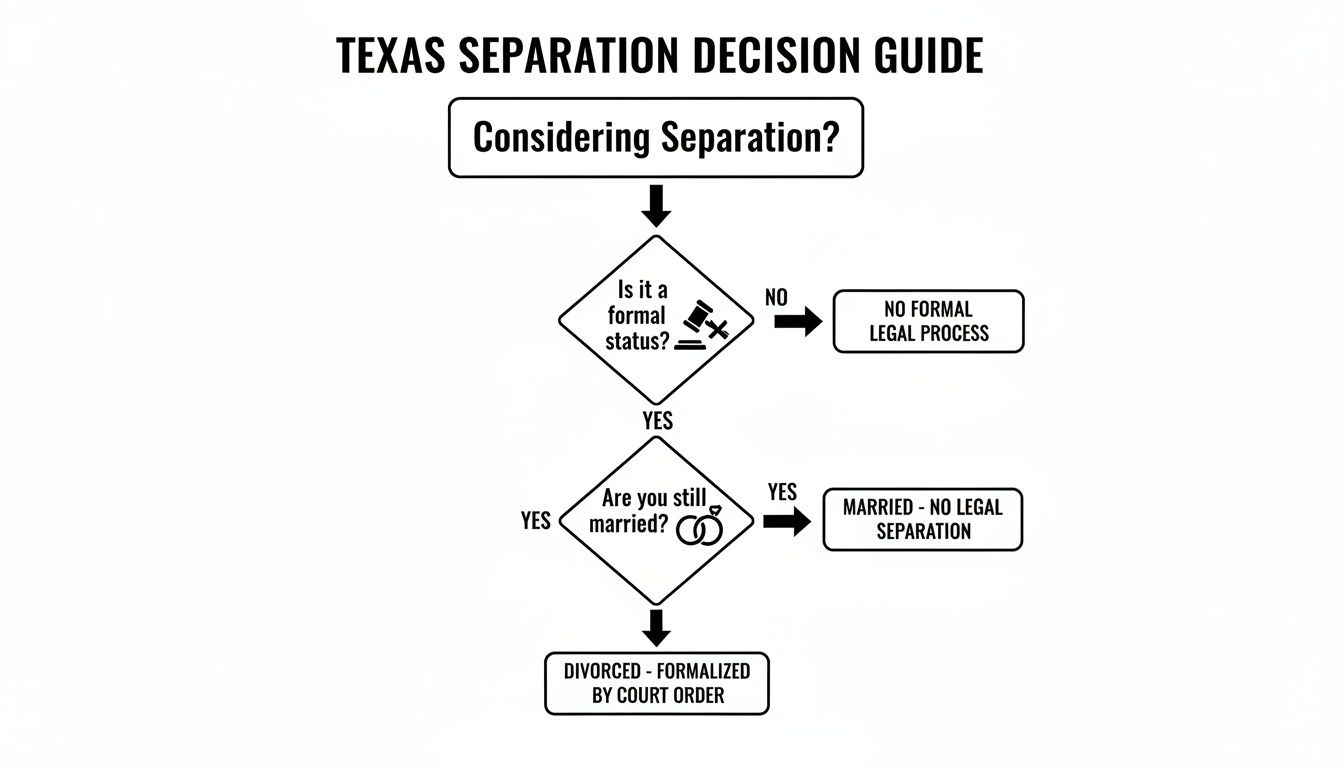
As you can see, even though you remain legally married, Texas law provides structured paths to manage this time, whether it leads to getting back together or formally divorcing.
Temporary Orders: A Court-Enforced Rulebook
By far, the most common and effective tool we use is a set of Temporary Orders. You can think of these as the official "rules of engagement" for your separation, signed by a Harris County judge. Once in place, they are legally binding and are specifically designed to keep the peace and maintain financial stability while a divorce is pending.
Temporary Orders can cover almost every aspect of your life while you're living apart, including:
- Child Custody and Visitation: They create a clear possession schedule, spelling out where the kids will live and when each parent will see them. This gives children a much-needed routine during an uncertain time.
- Child and Spousal Support: The court can order one spouse to pay temporary child support and, in some situations, temporary spousal support to ensure everyone's basic financial needs are met.
- Use of the Marital Home: A judge can decide who gets to stay in the family home in Atascocita and who needs to find another place to live.
- Bill Payments and Finances: These orders dictate who is responsible for the mortgage, car payments, and credit cards. No more guessing games or financial chaos.
- Protection of Property: They can also prevent either spouse from draining bank accounts, selling off assets, or racking up new debt in the other's name.
These orders bring immediate clarity to a confusing situation and stop one spouse from making impulsive decisions that could hurt the other or the children. They deliver the structured separation you're looking for, but with the full authority of the court behind them.
SAPCR: A Solution for Unmarried Parents or Separated Spouses
But what if you aren't ready to file for divorce, yet you urgently need rules for your children? In that case, a Suit Affecting the Parent-Child Relationship (SAPCR) is your answer. A SAPCR (pronounced “sap-sir”) is a legal case focused solely on establishing custody, visitation, child support, and medical support for a child.
You can file a SAPCR without filing for divorce. This is a common strategy for married parents who are living apart but haven't decided on divorce, and it's the standard process for unmarried parents. The final orders from a SAPCR are just as enforceable as a divorce decree, giving your children the stability they deserve.
Partition and Exchange Agreements
For couples who want to divide their property without actually divorcing, a Partition and Exchange Agreement can be a great option. This is a legal contract that lets you turn community property into separate property. For example, you could agree that a joint savings account now belongs entirely to one spouse, while the family SUV now belongs to the other.
While a Partition Agreement is great for dividing assets, it's important to know what it doesn't do. It cannot address custody or support, and it only works if both spouses are willing to cooperate. Many couples find that mediation is the key to negotiating these agreements successfully. You can learn more about divorce mediation in Texas and see how a neutral third party can help you find common ground.
Ultimately, these agreements are a way to achieve a financial separation while legally remaining married. By understanding these powerful alternatives, you can regain control of your situation and create a clear path forward for you and your family here in the Atascocita area.
Protecting Your Children and Finances While Living Apart
When a marriage hits a breaking point and you find yourselves living under separate roofs, the two things that keep you up at night are almost always the same: your kids and your money. The sheer uncertainty can feel crushing. How do you make sure the children have a stable routine? How can you protect your family's finances from a spouse who might be angry, scared, or just plain reckless?
This is where Texas law steps in with some incredibly practical tools. Even though we don't have a formal "legal separation" status, you aren't left without options. Instead of relying on verbal agreements that can vanish in the heat of an argument, you can get court-enforceable orders that act as a clear, official rulebook for your family while you're separated. These legal protections—often called Temporary Orders or filed as part of a Suit Affecting the Parent-Child Relationship (SAPCR)—are designed to bring order to the chaos and give everyone a predictable path forward.

Creating Stability for Your Children
During the turmoil of a separation, what kids need most is consistency. A court order delivers just that by laying out the rights and responsibilities of each parent in black and white. This isn't about one parent "winning" and the other "losing"—it's about building a stable foundation where your children can feel secure and loved.
Here is a step-by-step guide to what a SAPCR or set of Temporary Orders will typically establish:
- A Clear Possession Schedule: Think of this as a detailed calendar that spells out exactly when the kids will be with each parent. It covers everything from weekdays and weekends to holidays and summer vacations, putting an end to the constant negotiation and conflict over parenting time.
- Child Support Obligations: The court doesn't guess. It uses specific guidelines from the Texas Family Code to calculate and order a set amount of monthly child support, ensuring your children's financial needs are met consistently.
- Decision-Making Rights: The order clarifies who gets the final say on big decisions in your child's life, like education and non-emergency medical care. For families here in our area, this could be as specific as deciding which parent has the right to enroll a child in Humble ISD schools.
- Geographic Restrictions: It's common for a court to establish a boundary, often a county or school district, where the primary parent must live with the children. This keeps the kids close to their other parent and rooted in their community here in northeast Harris County.
These orders give your children the incredible gift of predictability. They know where they’ll be sleeping each night and see that both parents are still fully involved in their lives.
Safeguarding Your Financial Future
Just as important as protecting your kids is protecting your financial stability. Trying to live apart without a court order leaves you completely exposed. Your spouse could make a series of bad decisions—or intentionally malicious ones—and you might have no way to stop them until the damage is done.
Temporary Orders create a financial firewall, stopping either spouse from harming the marital estate.
A scenario we see all too often in our Atascocita office is one spouse panicking and draining the joint savings account, leaving the other with no way to pay the mortgage. Temporary Orders can freeze those accounts, preventing either person from making large withdrawals without a mutual agreement or the judge's permission.
These orders are designed to press "pause" and maintain the financial status quo. They can specifically stop either spouse from:
- Selling Community Property: Prevents your spouse from selling the family car, furniture, or other shared assets without your consent.
- Draining Bank Accounts: As mentioned, this is a huge one. It keeps one person from wiping out joint checking or savings accounts.
- Incurring New Debt: A judge can forbid either spouse from taking out new loans or racking up charges on joint credit cards, protecting you from debts you didn't create.
- Changing Insurance Policies: Orders can require that health, life, and auto insurance policies for both spouses and the children remain active and unchanged.
A Real-World Example in Atascocita
Let’s picture a local couple, Maria and David, who have decided to separate. David moves into an apartment in Humble, and Maria stays in their Atascocita home with their two kids. Without any court orders, things quickly spiral. David, feeling hurt and angry, transfers half the money from their savings to furnish his new apartment, leaving Maria short on the mortgage payment. They fight constantly over when he’ll see the kids, which creates a ton of stress for everyone, especially the children.
Now, let's imagine the same situation but with Temporary Orders in place. Maria comes to our firm, we file for divorce, and we immediately ask the court for temporary relief. A Harris County judge signs an order that:
- Gives Maria temporary exclusive use of the family home.
- Sets a fixed, predictable visitation schedule for David and the kids.
- Orders David to pay a specific amount of temporary child support and spousal support.
- Freezes their joint bank accounts, allowing withdrawals only for pre-approved bills.
Instantly, the conflict subsides. Maria knows she can pay the bills. David has guaranteed, quality time with his children. And their shared assets are safe. These orders created the structure they desperately needed to get through their separation with dignity and security—providing the exact protections people are looking for when they ask, "what is legal separation in Texas?"
How Community Property Works When You Live Apart
One of the most dangerous—and common—misconceptions I see in my practice is when a client says, "We've been living apart, so my money is my money." In Texas, that couldn't be further from the truth. Until a judge signs that final divorce decree, the law views you and your spouse as a single financial entity. It doesn't matter if you live in separate houses, different cities, or even on opposite sides of the country.
This all comes down to Texas being a community property state. In a nutshell, this means almost every asset you earn and every debt you take on from the day you get married to the day you get divorced belongs to the "community." That means it’s half yours and half your spouse’s.
And here’s the critical part: there's no pause button on this rule just because you've separated. It keeps running in the background, which can lead to some seriously unfair outcomes if you don't take the right legal steps to protect yourself.
The Financial Tangle of Separation
Let's make this real. Imagine a couple living separately in the Humble area. The husband lands a huge year-end bonus at work. Even though they haven't shared a home for six months, that entire bonus is legally considered community property. His wife has a valid claim to half of it.
Now, let's flip that scenario. The wife moves into a new apartment and, to furnish it, opens a new credit card and racks up thousands in debt. Because that debt was created while they were still legally married, her husband could be on the hook for paying it back.
This is a crucial takeaway for anyone asking about legal separation in Texas: Physical distance does not create financial distance. Until a judge says otherwise, your financial lives remain completely intertwined.
This is exactly why you need to understand the difference between community property and separate property during this in-between period. For a deeper look, you can learn more about how community property is defined in our guide, but the key thing to grasp is just how much is at stake.
Community Property vs Separate Property During Separation
To put a finer point on it, let's look at how assets and debts are usually classified under Texas law, even when spouses are living in different homes in Atascocita, Kingwood, or anywhere else.
| Type of Asset or Debt | Typically Considered Community Property | Typically Considered Separate Property |
|---|---|---|
| Income & Earnings | Your paycheck and your spouse's paycheck, work bonuses, commissions. | N/A – Income earned during marriage is community property. |
| Retirement Accounts | Contributions made to a 401(k), IRA, or pension during the marriage. | The value of the account on the day you got married. |
| Real Estate | A house bought during the marriage, even if only one name is on the title. | A house you owned before the marriage. |
| New Purchases | A car, furniture, or other major item bought by either spouse. | An item bought with money proven to be from a separate source (e.g., inheritance). |
| Debts | Credit card debt, personal loans, or medical bills incurred by either spouse. | Student loans or other debts incurred before the marriage. |
| Gifts & Inheritance | N/A – These are exceptions to the rule. | A direct inheritance received by one spouse or a gift given solely to them. |
Looking at this breakdown, it’s easy to see why simply moving out is never enough to protect your finances.
Why a Legal Agreement Is Essential
You are financially exposed to every decision your spouse makes, and they are just as exposed to yours. This is where legal tools like Temporary Orders or a Partition and Exchange Agreement become non-negotiable.
These legal documents are the only way to officially draw a line in the sand. They can state that, from a specific date forward, each spouse's income is their own separate property. They can also stop one spouse from piling up new debt that the other would be responsible for.
Without these court-enforced agreements, the community property clock just keeps on ticking, creating a bigger and more complicated financial mess to clean up down the road. It’s a necessary step to protect your future.
The Risks of an Informal Do-It-Yourself Separation
For many couples in Atascocita and Humble, the first move toward separation is just that—one person moving out. It seems like the most straightforward solution to a painful problem, giving you both some much-needed breathing room. But without any kind of legal framework, this "DIY separation" can quickly turn into a financial and legal disaster. What feels like a step toward independence can actually tangle you up in even bigger problems down the road.
Simply living in different places offers zero legal protection. In the eyes of Texas law, you are still 100% married, which means you're still financially and legally tethered to everything your spouse does. This can put your home, your credit score, and your sanity on the line.

Financial Dangers of Unofficial Separation
Let’s play out a common Harris County scenario. You and your spouse agree to separate. You find a new apartment, and you both agree that they’ll keep paying the mortgage on the house in Atascocita and handle the joint credit cards. For a month or two, everything seems fine.
Then the calls begin. First, it’s the mortgage company, saying the house payment is three months late. Then, a credit card company calls to inform you that a joint account has been maxed out on purchases you knew nothing about.
Here's the hard truth: because your name is still on that mortgage and those credit cards, you are just as legally responsible for the debt as your spouse. Without a court order spelling things out, there’s very little you can do in the short term. Your credit score could plummet, and you could even find yourself facing foreclosure because of your spouse’s behavior.
In Texas, an informal agreement is just that—informal. It has no legal teeth. When one person breaks a promise, the other is left holding the bag, and it can take years to clean up the financial mess.
The Sensitive Issue of Abandonment
Beyond the money, the way you leave the family home can have a huge impact on a future divorce, especially when kids are in the picture. If you move out without a clear, documented plan for how you'll co-parent, your spouse could later twist the facts and accuse you of "abandoning" the family.
Now, abandonment is a specific legal term that requires proving someone left with no intention of ever coming back, but just the accusation can be incredibly damaging. Your spouse might argue that you left the kids, weren't interested in being a parent, and were simply running from your responsibilities.
Even if it’s completely false, a claim like this can throw a wrench into child custody negotiations. A Harris County judge might start to question your commitment, putting you on the defensive. This is exactly why it’s so critical to get a formal parenting plan in place through a court order before one of you moves out, or at least immediately after.
Why Inaction Is Not a Safe Strategy
It’s natural to want to avoid the stress and formality of the court system. But in this situation, doing nothing is often the riskiest move you can make. An informal separation leaves you completely exposed.
- Shared Liability: You are on the hook for any community debt your spouse racks up until the day the divorce is final.
- Asset Depletion: What’s to stop your spouse from draining the joint savings account, selling shared property, or cashing out a 401(k) without your consent? Nothing.
- Custody Disadvantages: Moving out without a formal custody agreement can easily be spun to make you look bad in court.
- No Enforceability: A verbal promise to pay a bill or let you see the kids is worthless if your spouse changes their mind. A judge can't enforce a handshake deal.
Getting Temporary Orders isn't about picking a fight; it's about preventing one. It sets a clear, enforceable rulebook that protects you, your kids, and your finances while you figure out what comes next.
So, What's Your Next Move?
When you're facing the end of a marriage, the path forward can feel anything but clear. It's an incredibly tough time, and the legal side of things often just adds to the stress.
The most important thing to remember is this: even though Texas doesn't officially recognize "legal separation," you absolutely have powerful tools at your disposal. Things like Temporary Orders and Partition Agreements can give you exactly what you need—protection for your kids, financial stability, and the space to figure out what's next.
Knowing your options is one thing; acting on them is what truly creates change. For our friends and neighbors here in Atascocita, Humble, and the surrounding areas, having a solid plan is non-negotiable.
A Practical Checklist for Getting Started
If you're thinking about separating, it's easy to feel overwhelmed. Here’s a simple, step-by-step checklist to help you get organized and feel a little more in control.
Get Your Paperwork in Order: Start pulling together important financial documents. Think recent pay stubs, bank statements, tax returns from the last couple of years, mortgage or lease agreements, and credit card statements. Getting this done now will save you a massive headache later.
Figure Out Your "Must-Haves": Take a quiet moment to think about what a good outcome actually looks like for you. What are your biggest worries when it comes to the kids? The house? Your financial independence? Jotting these down can make a world of difference.
Talk to Someone Who Knows the Ropes: This is the big one. You need to sit down with a family law attorney who really understands how the Harris County courts work. An informal, "handshake" separation is loaded with risks you might not even see coming. Getting professional advice is your best line of defense.
Taking that first step to get legal advice isn't admitting defeat; it's taking back control. It’s about swapping out that feeling of uncertainty for a real, concrete strategy designed for your family.
Here at The Law Office of Bryan Fagan, our Atascocita team isn't just based in this community—we're part of it. We get the unique pressures families here are facing, and we're here to give you honest, compassionate advice. You don't have to go through this by yourself.
Reach out to our Atascocita office today and schedule a free, confidential consultation. Let's sit down and map out a plan that protects what matters most to you, so you can move forward with confidence.
Frequently Asked Questions About Separation in Texas
When you're facing a potential split, your mind is probably swimming with questions. It's completely normal. The way Texas handles separation can be confusing, so let's clear up some of the most common concerns we hear from families right here in the Atascocita and Humble areas.
Can I Stay on My Spouse’s Health Insurance if We Separate?
This is a big one, and the answer is: maybe. Since you are still legally married during a separation, you can often remain on your spouse’s health insurance plan.
But here’s the catch—it all comes down to the fine print of the insurance policy itself. Some plans have tricky clauses that could end your coverage once you start living apart, even if you haven't filed for divorce. Don't just assume you're covered. It's absolutely crucial to call the insurance provider and get a clear "yes" or "no" directly from them. Losing your health coverage out of the blue can turn a difficult situation into a crisis.
How Long Do We Have to Be Separated Before a Texas Divorce?
This is a common misconception. In Texas, there is no mandatory separation period required before you can file for divorce. You don't have to live apart for a certain amount of time to get the ball rolling.
The real requirement is about residency. To file for divorce, one of you must have lived in Texas for at least the last six months and in the specific county where you file (like Harris County) for at least the last 90 days.
Once the divorce petition is filed, a clock starts ticking on a mandatory 60-day waiting period. A judge cannot finalize your divorce until those 60 days are up. Think of it as a "cooling-off" period required by the state, but it has nothing to do with how long you were separated beforehand.
Can We Create Our Own Separation Agreement Without a Court?
Yes, you and your spouse can absolutely create your own private agreements to handle financial matters. For instance, a "Partition and Exchange Agreement" is a contract you can use to formally divide your property and debts. When both people are on the same page, this can be a great way to sort things out.
However, when it comes to your kids, a private handshake deal isn't enough. Any agreement dealing with custody, visitation schedules, or child support needs a judge’s stamp of approval to become a legally enforceable court order. Without that, you have very little power if the other parent stops following the plan. An attorney from our Atascocita office can help you draft a solid agreement that protects your rights and will stand up in court.
Sorting through the details of Texas family law can feel overwhelming, but you don't have to do it alone. If you have more questions or you're ready to figure out the best path forward for your family, the team at The Law Office of Bryan Fagan – Atascocita TX Lawyers is here to help. Schedule your free, no-obligation consultation with us today at https://www.atascocitaattorneys.com.