 Skip to content
When you're facing a divorce in Atascocita, it can feel like your world is spinning out of control. The path forward can seem uncertain, filled with potential conflict and stress. But you don't have to get dragged through a bitter courtroom fight. Divorce mediation in Texas offers a more peaceful way forward—a constructive path that lets you and your spouse make decisions about your future, guided by a neutral professional, right here in our community.
Choosing a Peaceful Path Through Divorce Mediation
The end of a marriage is tough. There's no way around the emotional toll it takes on a family. For many folks in Atascocita, Humble, and across northeast Harris County, the thought of a long, expensive court battle just adds another layer of dread.
Thankfully, there's a better way.
Divorce mediation gives you a structured, private, and far less confrontational space to work through your disagreements. It’s less like a courtroom showdown and more like a facilitated conversation. A trained, impartial mediator is there to guide the discussion, helping you and your spouse find common ground on the issues that matter most to your family.
Empowering You to Control the Outcome
In a traditional divorce, a judge who doesn't know you or your family makes the final calls. Mediation flips that script entirely, putting the decision-making power right back in your hands.
You and your spouse, with advice from your own attorneys, work together to create agreements that actually fit your family's unique situation. This process lets you control what happens with the big issues:
- Property Division: Figuring out a fair way to divide the assets and debts you’ve built up together, from your family home in Atascocita to retirement accounts.
- Child Custody and Visitation: Creating a practical parenting plan that truly serves your children's best interests and works with their school schedules in Humble ISD.
- Child Support and Spousal Support: Arriving at financial arrangements that make sense for your children and for each of you moving forward.
This collaborative spirit often produces far more creative and workable solutions than a judge could ever impose. For example, a couple in Humble with non-traditional work hours can craft a custom visitation schedule that would never come from a standard court order.
Mediation is about building a new future, not just tearing down the past. It creates a space for respectful negotiation, which is absolutely critical when you have kids and need to maintain a co-parenting relationship for years to come.
By taking this route, you’re starting things off on a cooperative note. You also get to keep your private life private, since all negotiations happen behind closed doors, not in a public courtroom. This focus on working together can dramatically reduce the emotional strain on everyone involved, helping your family move forward with respect.
If this cooperative approach sounds right for you, the first step is to understand your legal rights. The Law Office of Bryan Fagan provides clear, dedicated guidance for families exploring divorce mediation in Texas.
At The Law Office of Bryan Fagan – Atascocita TX Lawyers, we are committed to providing compassionate and practical solutions to our neighbors. If you live in the Atascocita area and want to explore how mediation can lead to a more peaceful resolution for your family, we're here to help. Schedule a free, no-obligation consultation with our Atascocita office today to talk about your specific situation.
How The Texas Divorce Mediation Process Works
Knowing what actually happens inside a divorce mediation can take a lot of the fear and uncertainty out of the process. For families in Atascocita, Humble, and the surrounding areas, having a clear roadmap from that first meeting to a final, signed agreement makes everything feel more manageable. It's a structured, practical journey designed to help you and your spouse find solutions you can both agree on.
Think of a mediator as a skilled guide on a challenging hike. You and your spouse are still in charge of the pace and the ultimate destination. The mediator doesn't carry you, but they have the map, point out the potential pitfalls, and help keep the conversation moving forward so you both reach the end of the trail successfully.
Kicking Things Off: Choosing a Mediator
The whole process starts once you and your spouse agree to give mediation a try. The first step is selecting a neutral third party to guide the conversation. This person is often an attorney with specialized mediation training, but they can also be another qualified professional. Their only job is to help facilitate communication and explore options—they do not represent you or your spouse, and they won't give legal advice.
After you've chosen a mediator, they'll schedule the first session. Here in Harris County, many mediations happen in person, but virtual sessions are also becoming very common, which adds a lot of flexibility for busy Atascocita families. That initial meeting is all about setting ground rules for respectful dialogue and creating an agenda of the key issues you need to resolve, such as:
- Dividing up community property (like your house in Kingwood or a family business in Humble)
- Creating a workable parenting plan and possession schedule for your kids
- Calculating child support and figuring out if spousal maintenance is needed
- Deciding how to handle shared debts
The Negotiation Phase: Finding Common Ground
During the mediation sessions, the mediator keeps the conversation on track, moving through each issue on your agenda. They make sure both of you get a chance to speak, voice your concerns, and brainstorm potential solutions. The goal is to keep things productive and focused on outcomes you can both live with.
If things are particularly tense and sitting in the same room feels impossible, don't worry. Many Texas mediators use a technique called “shuttle mediation.” You and your spouse will be in separate rooms (or separate virtual breakout rooms), and the mediator will go back and forth between you, carrying offers, counter-offers, and ideas. This simple change can lower the emotional temperature dramatically, allowing for more logical negotiations without direct confrontation.
This flowchart shows how mediation creates a more direct and less contentious path to a final agreement compared to a court battle.
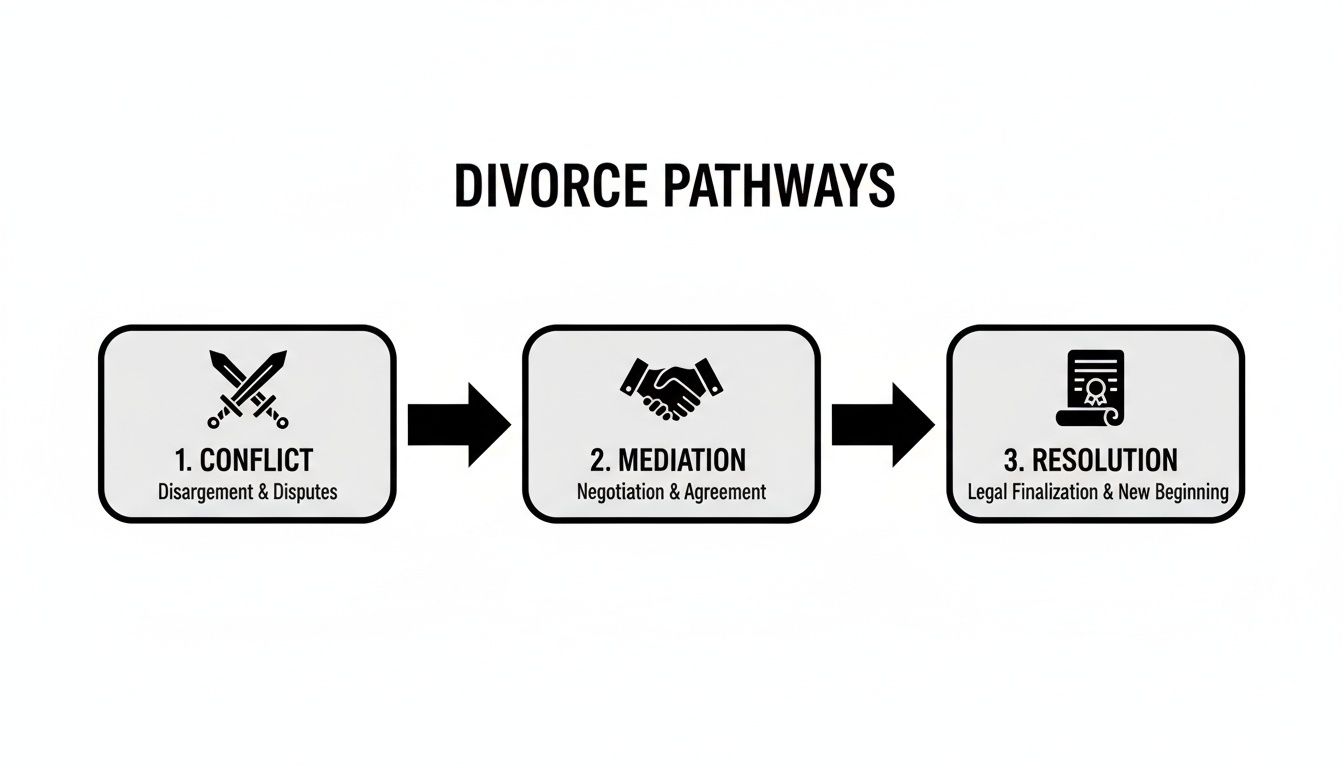
As you can see, mediation is designed to steer you away from prolonged conflict and directly toward a resolution.
Your Attorney's Crucial Role
While the mediator acts as a neutral guide, your own attorney is your personal advocate. Their job is to stand in your corner, protecting your legal rights and personal interests every step of the way. A seasoned Atascocita family lawyer gives you confidential advice based on Texas law, helps you analyze settlement proposals, and makes sure any deal you're considering is truly fair and won't cause problems for you down the road.
This is why preparation is so important. Going in with a clear understanding of your goals and financials makes your attorney's guidance even more effective. You can find out more about what to expect and how to prepare for your divorce mediation in our comprehensive guide.
The following table breaks down the entire process into distinct stages.
Key Stages of Divorce Mediation in Texas
| Stage | What Happens At This Stage | Key Objective |
|---|---|---|
| 1. Agreement to Mediate | Both spouses agree to try mediation and choose a neutral mediator. | Commit to a collaborative process and select an impartial facilitator. |
| 2. Pre-Mediation Prep | You and your attorney gather financial documents and define your goals. | Enter the mediation fully informed and prepared to negotiate effectively. |
| 3. The Mediation Session(s) | The mediator guides negotiations, either in the same room or via "shuttle mediation." | Discuss all key issues (property, kids, support) and find common ground. |
| 4. Reaching an Agreement | If successful, the mediator drafts a Mediated Settlement Agreement (MSA). | Document all agreed-upon terms in a preliminary written agreement. |
| 5. Signing the MSA | Both spouses and their attorneys review and sign the MSA. | Make the agreement legally binding and irrevocable under Texas law. |
| 6. Finalizing the Divorce | Your attorney uses the MSA to draft the Final Decree of Divorce for the judge. | Formally conclude the divorce based on the terms you created together. |
This table shows the logical progression, from the initial decision to mediate all the way to the judge's final signature.
Once you and your spouse have hammered out an agreement on everything, the mediator will draft a Mediated Settlement Agreement (MSA). This is the document that lays out every single decision you've made in clear, precise legal language.
Don't underestimate the power of this document. Under the Texas Family Code, a properly drafted and signed MSA is irrevocable and legally binding. This is a huge deal—it provides the certainty and finality you need to move forward. From there, your attorney takes the MSA and drafts the Final Decree of Divorce, which is the order the judge signs to officially end your marriage.
Why Mediation Is a Smarter Choice for Atascocita Families
When you're facing a divorce, the path you choose can make all the difference. For many families right here in Atascocita and Humble, stacking mediation up against a traditional courtroom battle makes the choice incredibly clear. Opting for mediation isn't just about sidestepping a judge; it's a conscious decision to protect your family’s emotional and financial future.

It’s an approach that fundamentally changes the conversation. Instead of focusing on winning a fight, you’re working together to build a stable foundation for whatever comes next. That’s a decision that pays dividends long after the ink on the divorce decree is dry.
The Power of Privacy and Confidentiality
One of the biggest reliefs for our clients is learning that mediation is completely confidential. Court proceedings are public record—anyone can walk into a Harris County courthouse or look up your case online. Mediation is the exact opposite.
Every conversation, every financial disclosure, and every personal disagreement stays within the four walls of the mediation room. For people living in close-knit communities like Atascocita, that level of privacy is invaluable. It lets you work through one of life's most difficult chapters without worrying about public scrutiny.
Substantial Cost and Time Savings
Let's be blunt: traditional divorce litigation can be outrageously expensive and drag on for what feels like an eternity. The cycle of court costs, mounting attorney's fees, and endless hearings can easily drain your family’s resources, adding a layer of intense financial stress to an already emotional time.
Mediation flips that script. It is significantly more cost-effective precisely because you're spending your time finding solutions, not fueling conflict. This efficiency translates directly into a faster resolution. Most Texas families who choose mediation finalize their divorce in a matter of months, not years. That means everyone can start moving forward with their lives much, much sooner.
Imagine this: Instead of a judge imposing a rigid, one-size-fits-all parenting schedule, you and your spouse sit down and craft a plan that actually works for your life—one that accommodates your kids’ activities in Humble ISD and your own unique work schedules. That's the kind of practical, tailor-made solution mediation delivers.
This hands-on approach doesn't just save you money; it gives you back control over the timeline, freeing you from the mercy of an overloaded court docket.
Preserving Your Co-Parenting Relationship
This might be the most important benefit of all. A divorce ends a marriage, but when you have children, it doesn't end your family. You will be co-parents for life.
The adversarial nature of a courtroom battle can poison any goodwill that’s left between spouses, making it nearly impossible to work together later. Mediation does the opposite. By encouraging communication and mutual respect, it helps you preserve a functional relationship. That's absolutely critical for your kids, who need to see their parents acting like a team.
Nearly half of all Texas divorces involve children under 18, which really underscores the emotional stakes for families in Harris County. Mediation is where you can hash out custody and support in a private, efficient way, without the destructive fallout of a court fight.
Shielding Your Finances for the Future
The price of a litigated divorce goes far beyond legal fees. A drawn-out fight over assets can cause long-term financial damage that’s hard to recover from. Mediation, however, promotes open financial disclosure and creative problem-solving to divide your property fairly and logically.
This process gives you the power to make sound financial decisions that protect your own future. To get a better sense of what's involved, our firm has created a helpful guide on how to protect assets during a divorce.
When you choose mediation, you aren't just settling a legal dispute. You're making a strategic investment in a healthier, more stable future for you and your children.
Understanding the Costs and Timeline in Harris County
When you’re facing a divorce, two questions usually jump to the front of the line: "How much is this going to cost?" and "How long will this take?" For families in Atascocita and Humble, where planning for the future is everything, the thought of unpredictable legal bills can be terrifying. This is where divorce mediation in Texas really shines, offering a much more manageable and cost-effective way forward.
Unlike a courtroom battle where legal fees can quickly spiral, mediation costs are far more transparent. Most Harris County mediators charge by the hour, and you and your spouse simply split that fee. This structure puts you both in the driver's seat, giving you direct control over the total expense.
The final cost really boils down to three things: how complex your finances are, how many issues you need to work through, and—most importantly—how willing you both are to cooperate and find a middle ground.
Breaking Down Mediation Expenses
A straightforward divorce with less conflict might wrap up in a single half-day or full-day session. On the other hand, a more complex situation involving things like a family business, several properties, or a highly detailed parenting plan might require a few sessions to iron everything out.
Even in those more complicated cases, the total cost is almost always just a fraction of what you’d spend fighting it out in court.
Think of it like this: litigation is like paying for two separate cabs stuck in rush-hour traffic with the meters running indefinitely. Mediation is like splitting the cost of one pre-booked shuttle that takes the most direct route. The entire process is built for efficiency, and that efficiency saves your family a significant amount of money.
The real value of mediation isn’t just in the dollars saved, but in the certainty it provides. You’re investing in a structured process designed to get you to a resolution, not paying to fuel an ongoing battle.
Mediation has become incredibly popular across Texas, and its cost-effectiveness is a huge reason why. Several things can influence the final price tag, like the mediator's experience—a seasoned professional might charge more per hour but can often resolve issues faster—and the number of sessions you need. In a major metropolitan area like Houston, rates can be higher than in smaller towns simply due to demand.
How Mediation Accelerates Your Timeline
The timeline is just as crucial as the cost. The Harris County court system is incredibly backlogged. A litigated divorce can easily drag out for a year or more, leaving your life on hold as you wait for the next hearing on the court's calendar. That kind of prolonged uncertainty is emotionally and financially exhausting.
Mediation, however, moves at your family's pace.
You can schedule sessions as soon as you and your spouse are ready. Many couples reach a complete agreement in just a few weeks or months. Once you sign the Mediated Settlement Agreement (MSA), the rest is mostly paperwork.
Of course, Texas law has a few rules that apply to every divorce. There’s a mandatory waiting period before any divorce can be finalized. You can learn all about the 60-day waiting period for divorce in Texas in our detailed article on the topic. Even with this requirement, mediation ensures you have everything settled and are ready to go the moment you’re legally able to.
For busy Atascocita families juggling jobs, school, and kids' activities, this efficiency is a game-changer. It means you can close this chapter and start the next one with far less disruption and on a much faster timeline than the court system could ever offer.
The Power of a Mediated Settlement Agreement in Texas Law
So, what gives an agreement you reach in mediation its real teeth? It all boils down to a critical document called the Mediated Settlement Agreement, or MSA. This isn't just some informal handshake deal; under Texas law, the MSA is the legally binding foundation of your entire mediated divorce. It’s what provides the certainty and finality you need to move forward.

Think of the MSA as the final, agreed-upon blueprint for your post-divorce life. It’s the official record of every single decision you and your spouse hammered out during mediation, from who gets the house in Atascocita to the parenting schedule for your kids.
What Makes an MSA Ironclad?
The Texas Family Code grants a properly handled MSA some serious legal weight. For it to be binding and, most importantly, irrevocable, it has to hit a few specific legal marks.
- It must clearly state—often in bold letters, all caps, or underlined text—that the agreement cannot be revoked.
- It has to be signed by both you and your spouse.
- If you each have an attorney present, they must sign it as well.
Once those boxes are checked, the deal is done. This is a massive advantage of using divorce mediation in Texas. It means neither of you can wake up the next day with a case of "buyer's remorse" and try to back out. That legal finality provides incredible peace of mind and allows your family to start healing and moving on.
The "irrevocable" nature of the MSA is one of the strongest protections the law offers in mediation. It ensures all the hard work, negotiation, and compromise you invested doesn't just fall apart, dragging you back into conflict.
From Private Agreement to Official Court Order
After the MSA is signed, you're on the home stretch. The toughest part is behind you, but there's one more step: turning your private agreement into a public, enforceable court order.
This is where your Atascocita family law attorney takes the lead. They will take the MSA and use it to draft the Final Decree of Divorce. This formal legal document is basically the MSA translated into the language the court system uses. It’s then submitted to a Harris County judge for a signature.
At this point, the judge’s job isn’t to second-guess your decisions. Texas courts strongly encourage couples to settle their own disputes, so they almost always approve an agreement reached in mediation. Once the judge signs that Final Decree, your divorce is official. Your MSA is now a court order, making every provision—from child support payments to holiday schedules—legally enforceable.
This structured path is a key reason alternative dispute resolution (ADR) is so popular in Texas family law. The system empowers you to find your own solutions, using flexible tools like private or even virtual mediation, and then backs up your agreement with the full force of law. You can explore more Texas divorce facts to understand why mediation is so strongly favored by the courts.
Common Questions About Divorce Mediation in Atascocita
It’s only natural to have a lot of questions when you're facing a divorce. For families here in Atascocita, Humble, and across our part of Harris County, getting clear, honest answers is the first step toward feeling in control of the situation. We want to tackle the most common concerns we hear from our neighbors and show you why this process often paves the best path forward for your family.
We've compiled the questions we get asked most often to give you some practical, straightforward guidance.
Do I Still Need My Own Attorney if We Use a Mediator?
Yes, absolutely. This is one of the most critical points we stress to clients for their own protection. It’s a common misunderstanding that a mediator works for both spouses. The reality is, the mediator is a neutral third party—think of them as a referee. Their job is to guide the conversation and keep it productive, but they cannot legally advise or advocate for either one of you.
Your own attorney, on the other hand, is your champion. Their sole focus is protecting your interests and your future. An experienced family lawyer from The Law Office of Bryan Fagan – Atascocita TX Lawyers will:
- Help you understand your specific rights under Texas law.
- Analyze settlement offers and tell you honestly what a fair deal looks like in your situation.
- Scrutinize every word of the final Mediated Settlement Agreement (MSA) before you ever sign.
Having your own lawyer in your corner ensures the agreement you reach is fair, legally sound, and something you can actually live with for years to come.
What if We Can't Agree on Everything in Mediation?
That's perfectly okay! Mediation isn't an all-or-nothing game. In fact, reaching a partial agreement is still a huge win. Every single issue you settle in mediation is one less thing you have to fight over—and pay lawyers to argue about—in a courtroom.
For instance, maybe you and your spouse in Kingwood can easily agree on how to split your bank accounts and retirement funds, but you just can't see eye-to-eye on one small detail of the summer visitation schedule. You can lock in all the points of agreement in a partial MSA.
This simple act dramatically narrows the focus of your dispute. Now, your attorneys can concentrate their time (and your money) on resolving that one final sticking point. It makes the rest of the process worlds more efficient and less stressful for everyone.
Even settling 80% of your issues in mediation can save you thousands of dollars and months of court delays. It turns a potential war into a much smaller, more manageable negotiation.
Is Mediation a Good Idea if We Have a High-Conflict Divorce?
For many couples who find it hard to be in the same room, mediation is not only appropriate—it’s often the best solution. But we need to make a crucial distinction: high conflict is not the same as domestic violence or a situation with a severe power imbalance. In cases involving family violence or abuse, mediation is not appropriate, and we would immediately pursue a different legal strategy to ensure your safety.
However, for spouses who simply can't communicate without the conversation devolving into an argument, mediation provides a much-needed structure. A technique called shuttle mediation is incredibly effective here.
In shuttle mediation, you and your spouse are in separate rooms, and the mediator literally walks back and forth between you, carrying offers and counteroffers. This removes the face-to-face tension, lowers the emotional temperature, and allows the mediator to facilitate a calm, logical negotiation on your behalf.
How Should We Prepare for Our First Mediation Session?
Good preparation is the number one thing you can do to ensure a successful mediation. Walking in organized and with a clear head gives you a powerful advantage and sets a productive tone for the day. We always walk our Atascocita clients through a few key steps before they sit down at the table.
Step-by-Step Preparation:
- Gather Your Financials: Pull together recent statements for everything—bank accounts, retirement plans (like 401(k)s or IRAs), credit cards, mortgages, and car loans.
- Create a Simple Inventory: Make a quick list of your major assets (the house, cars, investments) and your debts. It doesn't have to be perfect, just a solid starting point.
- Think About Your Goals: Before the negotiation starts, take some time to think about what a good outcome looks like for you. What are your absolute must-haves? What do you believe is truly best for your kids?
- Keep an Open Mind: Come to the table ready to negotiate. Mediation works because of compromise. The goal isn't to "win," but to find a fair solution that lets both of you start your next chapter on solid ground.
Taking these steps helps you and your attorney work as a team to secure the best possible future for your family.
Going through a divorce is one of the toughest things you'll ever do, but you don't have to face it alone. The team at The Law Office of Bryan Fagan – Atascocita TX Lawyers is here to provide compassionate, expert guidance to families in our community. If you think mediation could be the right approach for you, we're ready to protect your interests and help you build a stable future.
To talk about your specific situation and get a better sense of your options, please schedule a free, no-obligation consultation with our Atascocita office. Let's find a peaceful way forward, together.


