When you get down to it, the difference between a contested and an uncontested divorce is simple: one is built on agreement, the other is defined by disagreement.
If you and your spouse are on the same page about every detail needed to end your marriage, you're looking at an uncontested path. But if even one single issue can't be resolved without a judge stepping in, your divorce becomes contested. For families here in Atascocita and Humble, understanding this distinction is the first step toward moving forward with clarity and confidence.
Understanding Your Divorce Options in Atascocita, TX
Going through a divorce in the Atascocita or Humble area is a heavy burden, but understanding the two main paths you can take is the first step toward getting your footing. The legal route you choose will have a massive impact on the time, money, and emotional energy your family spends. To make the right call for your family's future, you need to know exactly what each option means under Texas law.
An uncontested divorce is what we often call an "agreed divorce." This is only possible when you and your spouse see eye-to-eye on every single issue required to end the marriage. That means complete agreement on:
- The division of all your community property and debts, from the house to the credit card bills.
- Child custody arrangements (conservatorship), including visitation schedules and parental rights.
- The exact amount and duration of child support.
- Whether any spousal support (alimony) will be paid.
On the other hand, a contested divorce is what happens when you can’t agree on one or more of these key areas. It doesn't mean you're fighting about everything. A single point of conflict—like who gets to keep the family home on Lake Houston or how to split up the holiday visitation schedule—is all it takes to make a divorce contested in the eyes of a Harris County court.
In our experience serving local families, many divorces start with the hope of being uncontested. But once the nitty-gritty financial and parenting details come out, disagreements often pop up. That’s why getting clear legal advice from a local Atascocita attorney from day one is so crucial.
Key Differences At a Glance
For our neighbors here in northeast Harris County, it's helpful to see the core differences side-by-side. This table breaks down the basics.
| Characteristic | Uncontested Divorce | Contested Divorce |
|---|---|---|
| Agreement Level | Full agreement on all issues from the very beginning. | Disagreement on at least one major issue. |
| Legal Process | Collaborative and straightforward with minimal court time. | Formal litigation, discovery, hearings, and a potential trial. |
| Decision-Maker | You and your spouse, making decisions together. | A judge makes the final, binding decisions for you. |
| Timeline | Much faster, often wrapping up soon after Texas's 60-day waiting period. | Can drag on for many months, sometimes even years. |
| Financial Cost | Significantly lower legal fees and court expenses. | Substantially higher due to attorney hours and litigation costs. |
The route you take will affect your life for years to come. An uncontested divorce is almost always a more peaceful and affordable solution. However, sometimes a contested divorce is the only way to stand up for your rights and secure your family's future.
It's also worth looking into alternatives that can help you find common ground. To see how a collaborative approach might work for you, you can learn more about divorce mediation in Texas and discover how it can turn conflict into resolution.
Navigating the Divorce Process in Harris County
It’s one thing to understand the textbook definitions of contested and uncontested divorce, but it's another thing entirely to see how those paths play out in the Harris County court system. For families in Atascocita and Humble, just knowing what to expect can make an overwhelming situation feel more manageable. The road you take will look dramatically different depending on whether you and your spouse are on the same page.
This flowchart lays out the two distinct journeys—one built on agreement, the other on resolving conflict.
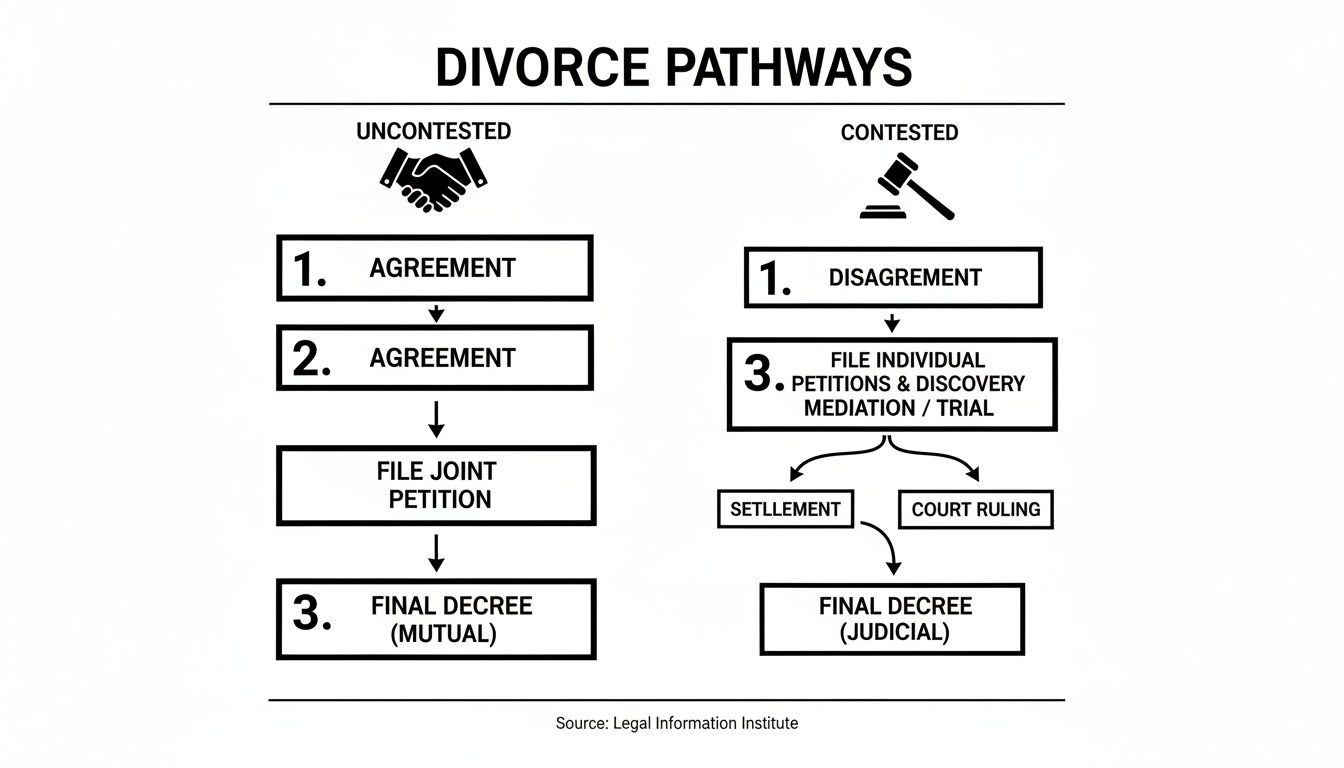
As you can see, the uncontested path is a pretty direct line from filing to finalization. The contested route, however, involves several complex stages that require significant court oversight and legal guidance.
The Streamlined Path of an Uncontested Divorce
An uncontested divorce is the most direct way to legally end a marriage in Texas. Since you’ve already sorted out all the major issues, the court process is really just about making your agreement official and legally binding.
Here’s a step-by-step look at how it typically unfolds for an Atascocita family:
- File the Petition: One spouse files an Original Petition for Divorce with the Harris County District Clerk.
- Sign the Waiver: Shortly after, the other spouse typically signs a Waiver of Service. This simple document tells the court they've received the petition and agree to move forward without being formally served, setting a cooperative tone right from the start.
- Draft the Decree: Your attorney will draft the single most important document in your case: the Agreed Final Decree of Divorce. This is the master document that outlines every detail of your settlement, from how you’ll divide your property to the specifics of a child custody plan.
- Finalize in Court: Once both of you have signed off on it, the final step is usually a quick court appearance called a "prove-up" hearing. It’s a short, informal meeting where a judge confirms the agreement is fair before signing off on it. This can happen anytime after Texas’s mandatory 60-day waiting period has passed.
The Complexities of a Contested Divorce
When you and your spouse can’t agree, the legal process becomes much more involved to ensure everyone’s rights are protected. A contested divorce in Harris County is designed to resolve disputes through a series of structured, court-supervised steps.
- Petition and Service: It also starts with filing an Original Petition for Divorce. But instead of a simple waiver, the other spouse must be formally "served" with the lawsuit by a sheriff or private process server. From that point, they have a strict legal deadline to file an Answer with the court.
- Discovery Phase: What follows is the discovery phase, a formal process where both sides exchange information under oath. This can involve several tools:
- Interrogatories: A list of written questions that the other party must answer in writing.
- Requests for Production: Formal demands for documents like bank statements, retirement account information, and property deeds.
- Depositions: Out-of-court testimony given under oath in front of a court reporter, where attorneys can ask questions directly.
- Temporary Orders: During this period, you’ll likely have hearings for Temporary Orders. These are court orders that establish the rules of the road while the divorce is ongoing. A judge might decide who gets to stay in the family home in Humble, set up a temporary child visitation schedule, or determine who pays which bills.
- Mediation: In Harris County, nearly every contested case is ordered to mediation before it can ever see the inside of a courtroom for trial. This is a formal negotiation session where a neutral third-party mediator works with both sides to try and broker a settlement.
- Trial: If mediation doesn't work, the last resort is a trial. Here, both sides present their evidence and arguments, and a judge makes the final, binding decisions on every issue you couldn't resolve.
No matter which path you think you're on, understanding the first steps is critical. You can learn more about the initial paperwork and procedures in our guide on how to file for divorce in Texas.
Comparing the Financial and Time Costs of Divorce
When I sit down with families from Atascocita and Humble, two questions almost always come up first: "How much is this going to cost?" and "How long will this take?" The answers hinge almost entirely on whether your divorce will be contested or uncontested. The path you take will have a massive impact on your family's financial stability and emotional well-being for years to come.

The financial gap between these two approaches can be staggering. An uncontested divorce is, by a long shot, the more affordable route. Why? Because you're paying for significantly fewer hours of an attorney's time. When you've already resolved all the major issues, the legal work boils down to drafting the right documents and finalizing the agreement, not fighting it out in court.
Breaking Down the Financial Investment
The cost of a divorce isn't just one big bill; it's a collection of different expenses. Seeing where the money goes really helps clarify why a contested case can get so expensive, so quickly.
- Court Filing Fees: Every divorce in Harris County starts with a filing fee paid to the District Clerk. This is a fixed cost you'll face regardless of the path you choose.
- Attorney Fees: Here’s the biggest variable. For an uncontested case, fees are generally predictable. In a contested divorce, the meter is always running—every phone call, email, motion, and court appearance adds to the final bill.
- Mediation Expenses: In Harris County, if you can't agree, the court will almost certainly order you to mediation. The mediator is a neutral third party, and their fee is typically split between you and your spouse.
- Expert Witness Fees: When a case gets complicated, you might need to hire outside help. This could mean bringing in financial experts, property appraisers, or child custody evaluators, each of whom can add thousands of dollars to your total cost.
National studies show uncontested divorces cost, on average, thousands of dollars less than contested cases. For a family in our community, that's money that could go toward a down payment on a new home, your child's education, or simply rebuilding your financial security.
Timelines: The Texas 60-Day Rule and Beyond
Texas law requires a mandatory 60-day waiting period from the day the Original Petition for Divorce is filed. No divorce, no matter how amicable, can be finalized before those 60 days are up. For an uncontested divorce, this often sets the timeline. Many of our clients who come in with an agreement are able to finalize their divorce shortly after that 60-day mark.
A contested divorce is a much longer journey. The court system moves deliberately to give both sides time for discovery, negotiations, and scheduling hearings. It's not at all unusual for a contested case in Harris County to take a year or even longer to finalize, especially if it goes all the way to a final trial.
The longer a divorce drags on, the more it costs—not just in money, but in emotional energy. An uncontested divorce gives you something invaluable: closure. It lets your family start the healing process that much sooner.
Beyond the direct legal fees, a huge part of the financial puzzle is dividing your property. For many homeowners in our area, figuring out strategies for splitting home equity in a divorce is a top priority. This can be handled smoothly in an uncontested agreement or become a major battleground in a contested case.
The way your marital estate is divided isn't random; it's governed by specific state laws. To get a better handle on how your assets and debts will likely be treated, we highly recommend reading up on what is community property in Texas. Understanding these core principles will empower you to make smarter decisions, whether you're working collaboratively with your spouse or preparing for a potential fight in court.
Ultimately, when it's a viable option, choosing the uncontested route gives you a clear advantage. It saves you money, saves you time, and most importantly, it keeps you and your spouse—not a judge—in control of your family's future.
The Emotional Impact on Your Family and Children
Beyond the legal paperwork and financial negotiations, the way you divorce will echo through your family’s emotional life for years to come. For parents here in Atascocita and Humble, this human element is often the toughest, most important part of the entire process. The difference between a contested and an uncontested divorce isn't just about court dates and legal strategy; it's deeply personal, especially when you have kids.

An uncontested divorce, by its very nature, is built on cooperation. This shields your family from the raw stress of a long, drawn-out legal fight. When parents can find a way to work together, they aren't just splitting up their assets; they're showing their children how to handle conflict with respect. That collaborative approach is crucial for maintaining stability and dialing down the anxiety kids inevitably feel when their world is changing.
Preserving Co-Parenting and Stability
When a divorce is uncontested, the goal is always to find solutions, not to point fingers. This mindset is priceless for keeping a healthy co-parenting relationship intact. If you and your ex-spouse can communicate without hostility, you create a united front that gives your children a powerful sense of security. They need to see that even though mom and dad aren't married anymore, you're still a team when it comes to them.
On the other hand, a contested divorce can easily push parents into opposing corners. The entire process is adversarial by design, which can destroy trust and make future cooperation feel impossible. The conflict rarely stays in the courtroom, often bleeding into your co-parenting relationship for years after the judge's final order. An uncontested divorce, however, allows parents to model cooperation and problem-solving, which is essential for helping children adjust and setting the foundation for a positive new family dynamic.
A child’s ability to adapt and thrive after a divorce is directly tied to the level of conflict between their parents. Choosing a path that minimizes hostility is one of the greatest gifts you can give them during this difficult time.
Navigating Complex Emotional Challenges
We get it—not every situation allows for a peaceful agreement. Sometimes, deeply rooted issues like addiction or substance abuse make cooperation feel impossible and magnify the emotional damage to the family. These kinds of problems can make an already painful process feel incredibly isolating for everyone.
For those navigating a divorce where addiction is part of the story, finding people who truly understand can be a lifeline. Resources like support groups for spouses of alcoholics can provide a sense of community and solidarity. Taking care of your own emotional health is the first step toward being able to support your children through this.
Ultimately, the goal is to come out of the divorce with a family structure that, while different, is still healthy and supportive for your kids. The legal path you take will have a direct and lasting impact on whether you can achieve that. If you're struggling to figure out what's best for your family's emotional future, you don't have to do it alone.
Our team at The Law Office of Bryan Fagan is here to offer guidance with compassion and real-world experience. Contact our Atascocita office today for a free consultation to talk about your situation in a safe, confidential setting.
When a Contested Divorce Is the Only Way Forward
Everyone hopes for a smooth, amicable divorce, especially here in the Atascocita and Humble communities. But let's be realistic—that's not always possible. Sometimes, the issues are just too complicated or the trust is too broken for a simple agreement. In these cases, a contested divorce isn't about looking for a fight; it's about protecting your rights and securing a fair outcome for your future.
The first step is recognizing when an uncontested divorce is simply not a safe or viable option. If you can't rely on your spouse to be transparent or negotiate fairly, the formal court process becomes your most important shield.
Red Flags That Point to a Contested Divorce
Certain situations almost always make a simple, agreed-upon divorce impossible. If any of these scenarios sound familiar, it’s a strong indicator that you'll need the structure and oversight of the Harris County court system to get a fair resolution.
- Hidden or Undisclosed Assets: Do you suspect your spouse is hiding money, property, or investments? If so, an uncontested divorce is off the table. You need the legal power of the discovery process to force the disclosure of financial records, bank statements, and other documents to reveal the true value of your marital estate.
- A Family Business Is Involved: Dividing a business, especially a local Atascocita or Humble business that has been the family's livelihood, is rarely straightforward. It requires professional valuations to determine its worth, legal analysis to figure out how much is community property, and tough decisions about its future.
- Major Disagreements on Child Custody: When you and your spouse are at a complete impasse over who the children will live with or what a possession schedule should look like, a judge must step in. The court's primary job is to make a decision based on the best interest of the child, and that requires a formal process of presenting evidence and testimony.
- A Severe Power Imbalance or History of Control: In relationships where one spouse has always held all the financial power or made every decision, a fair negotiation is nearly impossible. A contested divorce provides a structured legal setting that helps level the playing field and ensures your voice is heard.
A contested divorce provides a framework of rules and judicial oversight that ensures one party cannot simply steamroll the other. It’s a system designed to enforce fairness when fairness isn't being offered voluntarily.
The Critical Role of a Judge
In the toughest situations, a judge's involvement is more than just helpful—it’s absolutely essential for your safety and financial security. While uncontested divorces are simpler, they leave vulnerable spouses exposed when dealing with complex finances, power imbalances, or a history of domestic abuse. The formal discovery and judicial oversight in a contested divorce are crucial protections. You can learn more about the legal framework of contested cases and why these safeguards exist.
Take a situation involving domestic violence, for example. A judge can issue protective orders to keep a spouse and the children safe while the divorce is underway. That kind of immediate, enforceable protection just isn't available in an informal negotiation. The court offers a neutral, supervised environment where you can speak up without being intimidated.
In the end, while we all want a peaceful resolution, the top priorities have to be justice and safety. If you're facing deception, control, or a fundamental disagreement over your children's well-being, choosing a contested divorce isn't a failure. It's the responsible and necessary path forward. The legal system is in place to protect you when you can't protect yourself.
How Our Atascocita Law Firm Can Guide You
Figuring out whether your divorce will be contested or uncontested is a critical first step. The next, and just as important, is finding a legal advocate who will have your back, no matter which direction your case goes. Here at The Law Office of Bryan Fagan, we're not just practicing law in the Atascocita and Humble area—we're part of this community. We've helped countless local families find their way through these challenging transitions with straightforward, compassionate advice.
Our entire process starts with one thing: listening. We know that no two families are alike, and your situation deserves a strategy built around your specific circumstances and what you hope to achieve for your future.
Your Advocate, No Matter the Path
Whether you're on the verge of a cooperative agreement or bracing for a fight in court, having the right lawyer is non-negotiable. Even in a seemingly simple uncontested divorce, an attorney ensures every legal box is ticked and the final agreement is truly fair. You don't want any surprises down the road.
In a contested divorce, that role becomes even more critical. Your attorney is your champion in negotiations, mediation, and, if it comes to it, the courtroom. They handle the intricate legal maneuvers so you can focus on your family. To get a broader perspective, you can explore more about the roles of an attorney on FindLaw.com.
We believe our primary job is to empower you with the knowledge to make confident decisions for yourself. We cut through the confusing legal jargon so you are always clear on where you stand and what all your options are.
Take the Next Step Today
You don’t have to figure all this out on your own. We invite you to come in for a free, no-obligation consultation at our Atascocita office. It's a chance for you to tell us what's going on, in complete confidence, and get real answers about how Texas law applies to your specific situation.
We’ll walk you through what the process looks like and help you decide the best way forward. From straightforward uncontested divorces to the complexities of a high-asset divorce, our team is here and ready to support you.
Reach out to The Law Office of Bryan Fagan today to set up your free consultation. You deserve to have a local attorney who genuinely cares about the outcome of your case.
Your Top Questions About Texas Divorce Answered
Going through a divorce is bound to bring up a lot of questions. Here in our Atascocita office, we see families every day trying to figure out what comes next. Let's walk through some of the most common questions we hear about contested versus uncontested divorce in Texas.
Can a Divorce Change from Contested to Uncontested?
Absolutely, and it happens more often than you might think. A divorce might kick off with a lot of conflict, but as the process moves forward, things can shift. Once you and your spouse start exchanging information and sit down for mediation, you might find you’re not so far apart on issues that once felt like major hurdles. If you manage to find that common ground and agree on everything, your lawyer can shift gears and finalize the case on an uncontested basis.
On the flip side, things can go the other way. An uncontested divorce can become contested. I’ve seen couples start out on friendly terms, only to hit a wall over one key issue—like deciding who gets to stay in the family home in Humble. When negotiations break down like that, the case becomes contested, and we have to adjust our legal strategy to protect your interests in a more formal court setting.
Do I Really Need a Lawyer for an Uncontested Divorce?
Legally, no, you aren't required to hire a lawyer for an uncontested divorce in Texas. But I can tell you from experience that it's a very good idea. An experienced family law attorney does far more than just fill out paperwork. We draft your Final Decree of Divorce with an eye toward the future, making sure your rights are protected and helping you avoid messy, expensive legal fights years from now.
Your lawyer also makes sure every document is filed correctly with the Harris County District Clerk and that your agreement is actually enforceable under Texas law. Think of it as a small investment now to prevent a world of financial and emotional pain later.
How Is Property Divided in a Texas Divorce?
Texas operates under community property laws. In simple terms, this means that almost all assets and debts you both acquired during the marriage are considered owned by both of you. When you divorce, that property has to be divided in a "just and right" way, which doesn't automatically mean a 50/50 split.
The big difference comes down to who makes the decision:
- Uncontested Divorce: You and your spouse work together to decide how to split your property. You stay in control of the final outcome.
- Contested Divorce: If you can't agree, you leave it in the hands of a judge. They will listen to the evidence and decide for you.
Getting a handle on these basics is a great start, but every family’s circumstances are different.
The decisions you make at the beginning of this process will have a lasting impact on your future. At The Law Office of Bryan Fagan – Atascocita TX Lawyers, we're here to offer the clear-headed, compassionate advice you need. Schedule a free, confidential consultation at our Atascocita office today to speak with a local attorney who knows how to protect what matters most to you.