When you're facing the end of a marriage, most people in our Atascocita community immediately think of one word: divorce. But there's another, less common path called an annulment. Understanding the difference is critical, because the choice between the two isn't just about legal terms—it changes everything about your standing and your future.
Unlike a divorce, which ends a valid marriage, an annulment is a court declaration that your marriage was never legally valid to begin with. The key isn't how long you were married; it's about whether the marriage had a fundamental legal flaw from the moment you said "I do." To file for an annulment, you have to prove to a Harris County judge that your situation meets one of the very specific grounds set by Texas law, like fraud, duress, or a legal incapacity.
Understanding Annulment and Divorce in Texas
Let's break down the core difference. A divorce dissolves a marriage that was legally sound when it started. An annulment, on the other hand, essentially erases it, treating the marriage as if it never happened in the eyes of the law.
This distinction has significant, real-world consequences for residents of Atascocita, Humble, and northeast Harris County. It affects how property is handled, whether spousal support is a possibility, and even your official marital status moving forward. While the emotional process can feel very similar to a divorce, the legal journey is entirely different.
When is an Annulment a Realistic Option?
Here in Harris County, a judge won't grant an annulment just because a marriage was short-lived or a mistake. Texas law is very strict. You must prove one of the specific "grounds" that make a marriage void or voidable.
Think about a real-world scenario we've seen. A couple gets married in Atascocita, and months later, one spouse discovers the other was still legally married to someone else at the time of the wedding. That prior, undissolved marriage makes the new one legally invalid from day one. An annulment is the correct legal tool to formally nullify this second, void marriage.
At its core, an annulment addresses a defect that existed at the moment of marriage. A divorce, on the other hand, addresses issues that arise during a legally valid marriage, leading to its end.
Grasping this fundamental difference is the first step. If you suspect your marriage was invalid due to circumstances present when you exchanged vows, you might be a candidate to file for an annulment.
Why The Difference Matters For Your Future
The decision between an annulment and a divorce has lasting impacts. Because an annulled marriage is treated as though it never existed, the Texas concept of "community property" doesn't apply in the same way. Instead of a judge dividing a marital estate, the goal is simply to restore each person's separate property back to them.
For many of our clients, legally erasing a marriage offers a unique form of closure that a divorce can't provide. It validates the feeling that the union was flawed from the very beginning. However, it's important to know that proving the grounds for an annulment is often much more difficult than getting a no-fault divorce.
If you're weighing your options, our guide on how to file for divorce in Texas offers a clear look at the alternative process.
Annulment vs. Divorce: A Quick Comparison for Texans
To make it clearer, let's look at the key differences side-by-side. Understanding these distinctions is vital when deciding how to move forward in Harris County.
| Legal Consideration | Annulment | Divorce |
|---|---|---|
| Legal Basis | Marriage was invalid from the start due to specific grounds (e.g., fraud, bigamy). | Marriage was valid but is now being legally dissolved due to "insupportability." |
| Property Division | No community property to divide; court aims to restore separate property to each party. | The marital estate (community property) is divided in a "just and right" manner. |
| Spousal Support | Generally not available, as there was no valid marriage to create the obligation. | Spousal maintenance may be awarded if certain eligibility requirements are met. |
| Legal Effect | The marriage is declared void, as if it never legally happened. | The marriage is legally terminated; the parties' status changes from "married" to "divorced." |
| Time Limits | Strict deadlines (statutes of limitation) apply depending on the specific grounds. | No-fault divorce can be filed at any time after meeting residency requirements. |
This table highlights just how different these two paths are. Choosing the right one requires a careful legal analysis of your specific circumstances.
At The Law Office of Bryan Fagan, we understand the sensitive and personal nature of this decision. We're here to provide the compassionate, knowledgeable guidance you need. To discuss your unique situation, contact our Atascocita office for a free, confidential consultation.
The Legal Grounds for a Texas Annulment
Thinking about an annulment in Texas? The first thing to understand is that it’s worlds away from a no-fault divorce. You can’t just walk into a Harris County courthouse and say the marriage was a mistake. An annulment declares the marriage void—as if it never legally happened. To get there, you have to prove to a judge that the marriage was invalid from the very start based on very specific legal reasons, or "grounds," laid out in the Texas Family Code.
This isn't an easy hurdle to clear. A judge will demand clear and convincing evidence, and frankly, each ground comes with its own set of traps, including strict and unforgiving deadlines. If you wait too long or continue to live together as a married couple after you discover the problem, you could lose your chance for an annulment completely.
When One Spouse Was Underage
This is probably one of the more clear-cut reasons for an annulment. In Texas, you have to be 18 to get married without special permission. If someone between 16 and 17 gets married without parental consent, that marriage is considered "voidable."
- Who can file? A parent, a legal guardian, or a court-appointed "next friend" of the underage person can file the petition to annul the marriage.
- The Clock is Ticking: This is crucial—the petition must be filed before the underage person's 18th birthday. If they turn 18 and continue living together as a couple, the law sees the marriage as ratified, or confirmed. The window for an annulment slams shut.
Imagine a 17-year-old from Humble gets married secretly. Their parents have a very limited time to act. Once that 18th birthday cake is cut, the opportunity to annul on these grounds is gone for good.
Marriage Under the Influence of Alcohol or Narcotics
If one person was so intoxicated from alcohol or drugs that they genuinely lacked the mental capacity to consent to getting married, the marriage can potentially be annulled. The key here is proving you were incapable of understanding what was happening at the exact moment the ceremony took place.
But there's a big "if." If you sober up and then voluntarily continue to live together as spouses, you lose your right to an annulment. That act of staying together essentially validates the marriage, making it legally binding, no matter how it started.
Impotency
An annulment can be granted if, at the time of the wedding, one spouse was permanently impotent—meaning they were physically unable to consummate the marriage.
There are two critical conditions here. First, the person filing for the annulment must not have known about the impotency before the wedding. Second, you can't have voluntarily lived with your spouse after you found out about the impotency.
It's vital to distinguish this from infertility. An inability to have children is not a valid reason for an annulment in Texas. Permanent impotency, however, is. This is obviously a very sensitive and personal matter, and proving it in court requires a delicate legal strategy.
Fraud, Duress, or Force
This is a common reason people seek an annulment, but it can be one of the toughest to prove. It covers situations where you were either tricked or forced into a marriage.
Fraud isn't just about a white lie. A Harris County judge will need to see that you were deceived about something absolutely essential to the marriage itself—not something like a person's income or social connections.
Globally, many legal systems recognize similar grounds. Throughout the United States, states often permit annulments for fraud involving hidden criminal records, pregnancy by another person, or undisclosed STDs. You can read more about these global legal standards to see how they compare with Texas law.
Duress or Force is exactly what it sounds like: you were threatened or coerced into getting married against your will. You have to show the court that you would never have consented without that threat hanging over you.
For both fraud and force, there's an absolute rule: once you discover the lie or are free from the threat, you cannot continue to voluntarily live together as a married couple. If you do, you've legally accepted the marriage, and the door to an annulment is closed.
Mental Incapacity
This ground applies if one person lacked the mental capacity to understand the nature and obligations of the marriage contract when they said, "I do." This isn't about being drunk; it points to a more permanent or underlying mental condition.
And just like with the other grounds, if the couple continues to live together voluntarily during a time when the person regains their mental competence, the marriage is considered ratified and can no longer be annulled.
Other Key Grounds to Know
There are two other, less common situations that can qualify for an annulment, both with extremely short deadlines.
- Concealed Divorce: Let's say your spouse got divorced less than 30 days before marrying you, and you had no idea. This is grounds for an annulment, but you must file your petition within one year of your wedding date.
- Marriage Before the 72-Hour Waiting Period: Texas law requires a 72-hour waiting period between when a marriage license is issued and when the ceremony can take place. If that rule wasn't followed (and you didn't get an official waiver), you have just 30 days from the wedding date to file for an annulment.
Each of these legal pathways has very precise requirements and deadlines that are set in stone. One misstep or missed deadline can get your case thrown out, leaving a divorce as your only path forward. Given the complexities, talking to a knowledgeable family law attorney in Atascocita should be your very first move.
Getting an Annulment in Harris County: A Step-by-Step Walkthrough
So, you've looked at the grounds for annulment and believe it’s the right path for you. Now what? The idea of filing legal paperwork in a place as large as Harris County can be intimidating, but it doesn't have to be. Let's walk through what actually happens, from the first document you prepare to the final judge's ruling.
Think of it as a roadmap. This process starts with a single, crucial legal document and involves specific procedures with the Harris County District Clerk, formal notification to your spouse, and of course, court fees.
Starting Your Case: The Original Petition
Your first real move is to draft an Original Petition for Annulment. This isn't just a form you fill out; it's the formal document that officially opens your case and tells the court your story. It lays out who you and your spouse are and, most critically, the legal reasons—the grounds—you’re using to ask for the annulment.
Precision is key here. Your petition must clearly and factually state why your marriage is invalid under the Texas Family Code, whether it's due to fraud, duress, or another recognized reason. A simple mistake or an overlooked detail at this stage can create problems for your case right from the start.
It’s important to understand that in an annulment case, the burden of proof is squarely on your shoulders. Your petition is the foundation of your entire argument, so it needs to be solid, accurate, and legally sound.
Along with the petition, you’ll also need to fill out a Civil Case Information Sheet. This is a more administrative form that gives the court basic data about your case. Together, these documents get the legal ball rolling.
Making it Official: Filing with the Harris County District Clerk
With your Petition for Annulment drafted, it's time to file it. For anyone in Atascocita, Humble, or the surrounding areas, this means engaging with the Harris County District Clerk. You have two options: file in person at the Harris County Civil Courthouse downtown or file electronically through the state's e-filing system.
When you file, you’ll have to pay a filing fee to cover the court's administrative costs. In 2024, this fee is generally around $300. Court fees can change, so it's always a good idea to double-check the District Clerk's website for the most current amount. If the fee is a hardship, you can ask the judge to waive it by filing a document called a "Statement of Inability to Afford Payment of Court Costs."
Once filed, the clerk will stamp your petition, give it a unique case number, and assign it to one of the Family District Courts in Harris County. That case number is now the official identifier for your case and must be on every single document you file from here on out.
The Next Move: Legally Notifying Your Spouse
After your case is filed, Texas law is very clear: you must formally notify your spouse that you're seeking an annulment. This isn't optional, and you can't just text them or hand them the papers yourself. This formal notification is called service of process.
You have a few ways to handle this in Harris County:
- Personal Service: This is the go-to method. A sheriff's deputy, a constable, or a private process server will physically hand-deliver a copy of your filed petition and a court summons (called a citation) directly to your spouse.
- Waiver of Service: If your spouse is cooperative and agrees to the annulment, they can sign a Waiver of Service form. This must be signed in front of a notary and filed with the court. It's a much smoother process that avoids the need for a stranger to show up at their door.
- Substituted Service: What if you can't find your spouse? If you can prove to the judge you’ve made a serious effort to locate them, you can ask for permission to "serve" them in another way. This could mean leaving the documents with someone at their job or, in very rare situations, even through social media.
Without proof of proper service, the court simply cannot proceed with your case. It’s a legal checkpoint you have to pass.
This visual shows a few of the common situations that lead people to file for an annulment.
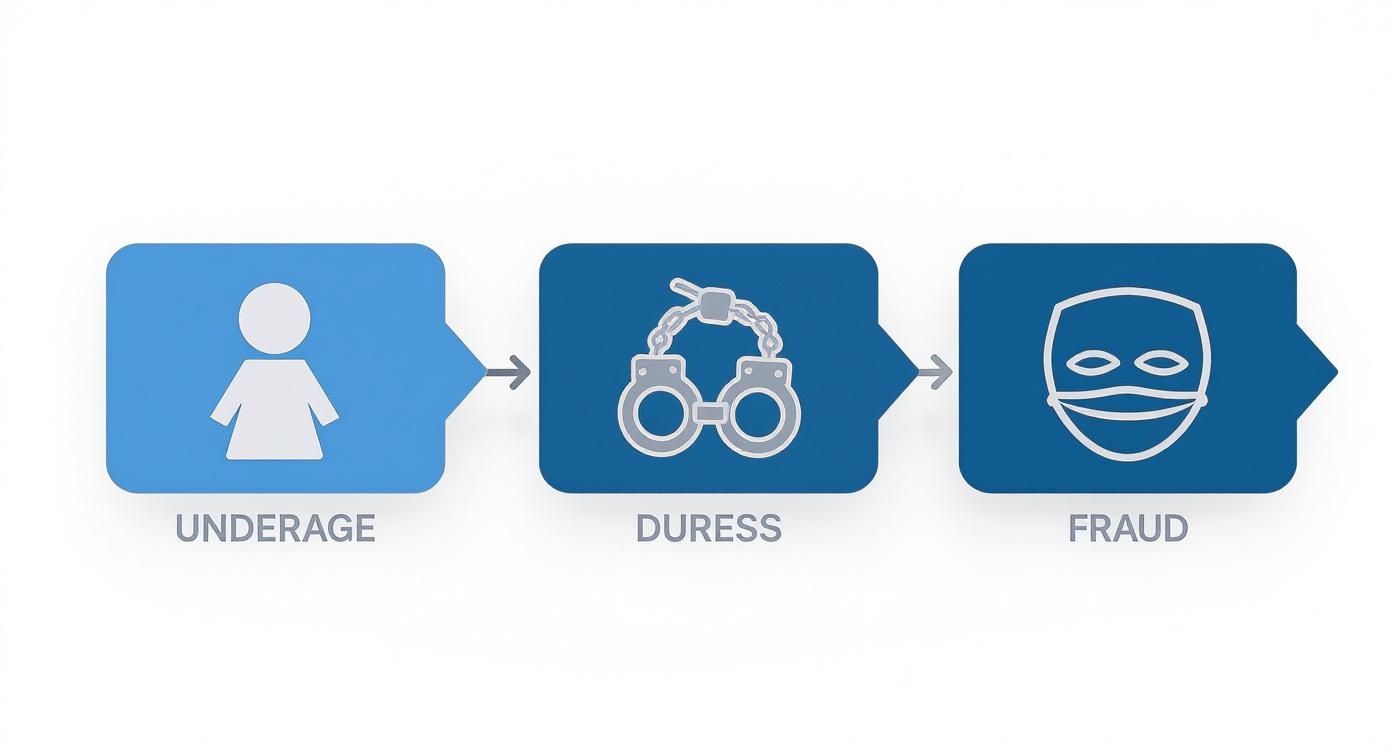
Whether your case is based on age, being forced into the marriage, or some form of deception, each path requires its own specific evidence to be successful in front of a judge.
What to Expect After Your Spouse is Served
Once your spouse officially receives the papers, a legal clock starts ticking. They have a limited time to file a formal response with the court, which is called an "Answer." What they do next—or don't do—determines how the case proceeds.
If they file an Answer and disagree with the annulment, your case becomes "contested." You're now likely headed for mediation to try and resolve the disagreement. If that doesn't work, the final step is a trial where a judge will hear from both of you before making a final decision.
But what if they don't respond at all? If the deadline passes and they haven't filed an Answer, you can ask the court for a default judgment. This doesn’t mean you win automatically. You still must schedule a hearing, go before the judge, and present your evidence to prove the grounds for annulment. The judge has to be fully convinced that you meet the legal standard before they will sign the final decree. For a closer look at these timelines, our guide on how long it takes for an annulment can be a really helpful resource.
Getting through these steps takes a sharp eye for detail and a good handle on Harris County court rules. At The Law Office of Bryan Fagan, our job is to manage this entire process for you. We are here to support our Atascocita community. Give us a call to schedule a free consultation at our Atascocita office and see how we can help.
How to Prove Your Annulment Case in Court
https://www.youtube.com/embed/4HaIA7ph0Wc
Unlike a no-fault divorce where you just need to state the marriage is broken, an annulment is a completely different ballgame. When you file for an annulment, you're not just ending a marriage—you're asking a judge to declare that it was never legally valid in the first place. This means you have to prove it.
Think of it this way: you have the burden of proof. It’s on you to convince the court with solid, clear evidence that your marriage was invalid from the very beginning. Your story, no matter how compelling, isn't enough on its own. You need facts to back it up.
Gathering the Right Evidence for Your Claim
The kind of proof you'll need hinges entirely on why you're seeking the annulment. You're basically a detective building a case, piece by piece, to show the judge exactly how your marriage fails to meet Texas's legal standards. A folder full of well-organized proof can mean the difference between getting your annulment granted or having your petition denied.
Let’s walk through some common scenarios we see with clients from Humble and Atascocita, and the evidence that makes their cases strong.
- Fraud or Deception: To prove fraud, you have to show you were intentionally tricked into the marriage over something fundamental. The best evidence is often in writing—think text messages, emails, or even social media DMs where your spouse admits to the lie. Testimony from a trusted friend or family member who can say, "Yes, I was there when he told her he wanted kids, but he later told me he never did," can be a game-changer.
- Duress or Force: This means proving you were coerced or threatened into getting married. It often comes down to witness testimony. You need people who can testify about what they personally saw or heard—the threats, the intense pressure, the coercion. Any threatening letters or texts would also be powerful, direct proof.
- Underage Marriage: This one is usually the most straightforward. The key evidence is official paperwork. A certified copy of the minor's birth certificate paired with the marriage license will clearly show their age at the time of the wedding. It's hard to argue with official documents.
- Mental Incapacity: Proving someone lacked the mental capacity to consent to marriage is complex and requires more than just your own account. A judge will be looking for objective evidence like medical records, a formal psychological evaluation, or testimony from a doctor or therapist who can speak to the person's mental state at that specific time.
Here's a key takeaway for anyone filing in Harris County: Your evidence has to be a perfect match for the specific legal reason you're claiming. Vague complaints or bringing up unrelated issues will only weaken your case in front of a judge.
Preparing Your Witnesses to Testify
Witnesses can truly make or break your annulment case. A credible person who can back up your story adds a powerful layer of validation. But it's not enough to just find someone willing to show up; they need to be prepared.
Your best witness is someone with firsthand knowledge. For example, if you’re claiming duress, a witness who says, “I personally heard her father threaten to disown her if she didn't go through with the wedding,” is far more impactful than someone who vaguely says, “She seemed really stressed out before the big day.” See the difference?
Before you ever step into a courtroom, you need to sit down with your witnesses. Go over what they know and what they remember. Help them anticipate the kinds of questions they might be asked and stress how important it is to stick to the facts—what they personally saw and heard. Their job is to testify clearly and confidently, not to speculate.
Presenting a Clear and Persuasive Argument
Once you've gathered all your evidence and prepped your witnesses, the final piece of the puzzle is putting it all together for the judge in a clear, organized way. This is where having an experienced attorney becomes so critical. We know how to frame the story of your case, how to introduce evidence properly so it gets admitted, and how to question witnesses to highlight the most important facts for the judge.
Your goal in court is to tell a story that fits perfectly within the legal grounds for an annulment in Texas. By methodically laying out each piece of proof, from documents to live testimony, you build a logical argument that leads the judge to one inescapable conclusion: the marriage was never valid.
Proving an annulment case is a detailed and demanding legal process. If you're in the Atascocita area and think you have grounds, please don't try to handle this on your own. Contact The Law Office of Bryan Fagan for a free consultation to go over your situation and see how we can help you build the strongest case possible.
Common Mistakes When Filing for an Annulment
The path to getting a marriage annulled in Texas is a narrow one, and it's full of legal tripwires. When you file for an annulment, even a seemingly minor mistake can get your petition denied, leaving you with divorce as your only option. We've seen too many well-meaning people from places like Atascocita and Humble make simple errors that sink their entire case before it even gets off the ground.
You have to understand that the legal standards for an annulment are incredibly strict—far more than for a divorce. A Harris County judge isn't going to bend the rules for you. Your case has to be built on a rock-solid foundation, free from the kind of mistakes that are easily avoided with a bit of foresight and the right guidance.
Missing Strict Filing Deadlines
One of the most heartbreaking mistakes is simply waiting too long. Unlike a divorce, which you can file for pretty much anytime, annulments come with rigid, unforgiving deadlines that hinge on the specific reason you’re filing.
- Concealed Divorce: Did you find out your spouse was divorced less than 30 days before marrying you? The clock is ticking. You have only one year from the wedding date to file.
- 72-Hour Waiting Period Violation: Was your marriage ceremony rushed, happening before the required 72-hour waiting period was over? You have just 30 days to act.
If you miss that deadline, even by a single day, the court will almost certainly throw out your case. It is absolutely crucial to move quickly the moment you realize you might have grounds for an annulment.
Accidentally Validating the Marriage
This is a tricky one, but it’s a surprisingly common way people undermine their own case. For many of the grounds for annulment—like fraud, duress, or intoxication—Texas law has a huge catch: you cannot voluntarily live together as spouses after you discover the problem.
Let's say you discover you were tricked into the marriage. If you continue to live with your spouse for several more weeks, a judge will likely view that as you "ratifying" or accepting the marriage, despite its flawed beginning. What you do after you find out about the issue is just as important as the issue itself.
By continuing to live together, you are essentially telling the court that the issue wasn't serious enough to invalidate the marriage. This action can undo even the strongest annulment claim.
Having Insufficient Evidence
An annulment isn't a "he said, she said" argument. The burden of proof is entirely on you, and you have to back up your claim with clear, convincing evidence. Just telling the judge you were deceived or forced into the marriage won't cut it. You need real proof.
Think in terms of tangible evidence, such as:
- Written communication like text messages or emails that clearly show the fraud.
- Credible witness testimony from friends or family who saw the coercion firsthand.
- Official documents, like a birth certificate showing a spouse was underage.
Coming to court without this kind of solid evidence is one of the most frequent reasons annulment petitions get denied.
It's important to remember just how different and rare this process is. This isn't just a different flavor of divorce; it's a completely separate legal action that requires filing a petition, serving your spouse, and presenting your case at a hearing.
Think of getting legal help not as an expense, but as a critical investment in your future. At The Law Office of Bryan Fagan, we help our Atascocita clients navigate this complex process and avoid these costly errors. We make sure your paperwork is flawless, your deadlines are met, and your case is presented as strongly as possible. Schedule a free consultation with our Atascocita office today to protect your rights and get some peace of mind.
Common Questions We Hear in Our Atascocita Office
If you're thinking about an annulment, your head is probably swimming with questions. That's completely understandable. Here in our Atascocita office, we talk to people every day who are trying to make sense of this complicated process. We're part of this community, and we want to help you find clarity. Let's walk through some of the most common—and critical—questions we get asked.
What Happens to Our Kids and Property?
This is usually the very first thing people ask, and for good reason. When children are involved, Texas law is clear: their well-being comes first. Even if the marriage is declared void, a judge will still make formal orders for custody, visitation, and child support, just like in a divorce. The law protects the children, ensuring they are cared for no matter what.
Property is a different story. Since an annulment essentially says a valid marriage never existed, there’s no "community property" to divide. Instead, the court focuses on restoring each person's separate property back to them. For any assets you acquired together, the judge will aim for a "just and right" division. This can get messy fast, especially if finances were intertwined.
How Long Do I Have to File for an Annulment in Texas?
This is where things get tricky. The deadlines for filing are incredibly strict and depend entirely on why you are seeking the annulment. These time limits, called statutes of limitation, are not suggestions—they are absolute.
For instance, if your claim is based on fraud or duress, you lose your right to an annulment if you continue to voluntarily live with your spouse after you find out the truth. If you discover your spouse had a recent divorce (less than 30 days before your wedding), you have only one year from the date you got married to file.
Don't wait. These deadlines are set in stone, and missing one means losing your chance to file. It's vital to speak with an attorney right away to figure out the specific timeline for your case.
Is an Annulment Cheaper Than a Divorce in Harris County?
People often assume an annulment is the cheaper, faster option, but that’s rarely the case. In fact, it can be significantly more expensive. Why? It all comes down to the burden of proof.
With a standard no-fault divorce, you don't have to prove anything went wrong. With an annulment, you have to build a full-blown legal case. You'll need to gather evidence, find witnesses, and convince a judge that your situation meets the very specific legal grounds. If your spouse decides to fight it, the costs for legal work can easily surpass those of a typical divorce.
Can I File for an Annulment Without a Lawyer?
Legally, yes, you can represent yourself. Realistically, it’s a huge gamble. The legal standards are high, the rules of evidence are complicated, and as we've mentioned, the deadlines are unforgiving.
A small mistake on your petition or a failure to present your evidence properly could get your entire case thrown out. An experienced family law attorney knows what a Harris County judge needs to see and hear. We can help you build the strongest case possible from the very start. Thinking through how to choose a divorce attorney is a crucial first step that can give you a major advantage.
The road to an annulment can feel overwhelming, but you don't have to walk it by yourself. The dedicated team at The Law Office of Bryan Fagan – Atascocita TX Lawyers is here to offer the clear-headed, compassionate advice you need. We are your neighbors, serving Atascocita, Humble, and the surrounding communities. We invite you to schedule a free, no-obligation consultation at our Atascocita office to go over your situation and see how we can help. Visit us at https://www.atascocitaattorneys.com to get started.