Skip to content
When you're facing a divorce in Atascocita, one of the first questions that comes to mind is almost always about money. Let's cut right to the chase: Texas law is incredibly strict when it comes to what most people call alimony. Here, it's officially known as 'spousal maintenance,' and the state puts a hard limit on what a judge can order.
The absolute maximum is the lesser of $5,000 per month or 20% of the paying spouse's gross monthly income. That's it. This means you won't see the kind of massive, open-ended alimony awards that are common in other states. This guide will walk you through what this means for you and your family here in northeast Harris County.
Understanding the Financial Realities of Texas Spousal Maintenance
As a marriage comes to an end, figuring out the financial path forward can feel like a monumental task. For many families right here in Humble and Atascocita, the word "alimony" conjures up images from movies—huge, long-term payments flowing from one ex-spouse to another. The reality of how much alimony in Texas a court can actually order is a world away from that.
The Texas Family Code treats spousal maintenance as a temporary, rehabilitative tool. It’s not meant to create a permanent financial dependency. The whole point is to provide a short-term safety net, giving the lower-earning spouse a chance to get the skills or education needed to stand on their own two feet financially. This philosophy is baked directly into the state's strict payment caps, providing a clear starting point for residents of Atascocita navigating this process.
The Strict Caps on Spousal Maintenance Payments
Texas has one of the tightest frameworks for spousal maintenance in the entire country. The law is crystal clear: a judge cannot order payments that exceed the lesser of two specific amounts: $5,000 per month or 20% of the paying spouse's average gross monthly income.
This cap is a major constraint, especially when you compare it to other states where judges have much more leeway. For instance, if a spouse in Humble earns $10,000 a month in gross income, the absolute maximum a court could order them to pay is $2,000 a month (20%), not the $5,000 cap. This strict ceiling forces both sides to have a much more realistic conversation about finances right from the start.
What Does the Maximum Payment Look Like in Practice?
To help our neighbors in northeast Harris County see what these numbers actually mean for their own families, we've put together a straightforward table. It shows the maximum possible monthly payment a court could order at different income levels. Keep in mind, this is just the ceiling—a judge isn't required to award the maximum. The final amount depends on many other factors.
Maximum Monthly Spousal Maintenance in Texas (Statutory Cap Examples)
This table illustrates the maximum possible monthly spousal maintenance payment in Texas based on the paying spouse's gross monthly income, as per the Texas Family Code's 'lesser of $5,000 or 20%' rule.
| Paying Spouse's Gross Monthly Income | 20% of Gross Monthly Income | Statutory Cap | Maximum Possible Monthly Payment |
|---|---|---|---|
| $4,000 | $800 | $5,000 | $800 |
| $8,000 | $1,600 | $5,000 | $1,600 |
| $15,000 | $3,000 | $5,000 | $3,000 |
| $25,000 | $5,000 | $5,000 | $5,000 |
| $40,000 | $8,000 | $5,000 | $5,000 |
As you can see, the 20% rule is the limiting factor for most incomes, and only when a spouse earns $25,000 a month ($300,000 a year) or more does the $5,000 cap come into play.
Key Takeaway: The Texas approach to spousal maintenance is all about providing a temporary bridge to self-sufficiency. The strict financial caps give both parties a clear and predictable understanding of potential obligations right from the get-go.
Knowing these limits is the first step in setting realistic expectations for your financial future after divorce. It highlights why it's so critical to focus on a fair division of property and create a solid plan for becoming financially independent. The Law Office of Bryan Fagan – Atascocita TX Lawyers is here to help you navigate these rules and fight for a fair outcome that protects your interests.
Step 1: Do You Qualify for Spousal Maintenance in Texas?
Before we can even begin to talk about dollar amounts, a Texas court has to answer a more fundamental question: does the spouse asking for support even qualify? Many people assume spousal maintenance is a given in divorce, but that’s just not how it works here. The law sets a high bar, and clearing the strict eligibility requirements is the very first hurdle.
Think of it as a two-part test. First, you have to prove you have a genuine financial need. Second, you must fit into one of the specific scenarios the law recognizes for support.
The Foundational Test of Need
The first thing any judge in Harris County is going to look at is whether the spouse asking for support will lack enough property after the divorce to provide for their “minimum reasonable needs.” This isn't about maintaining the lifestyle you had during the marriage; it’s about having enough to cover the basics—a roof over your head, utilities, food, and transportation right here in the Atascocita and Humble area.
A court will scrutinize the assets you're awarded in the divorce. If you walk away with a significant amount of cash or property that can produce income, it’s going to be much tougher to convince a judge you need monthly checks from your ex-spouse.
The Two Main Paths to Eligibility
Once you've shown a clear financial need, you then have to meet one of several specific conditions. For most families in our community, it really boils down to two main pathways.
The most common route is what many call the 10-year marriage rule. To qualify this way, you have to prove three things:
- The marriage lasted for 10 years or longer.
- You genuinely lack the ability to earn enough money to provide for your own minimum reasonable needs.
- You were diligent during the divorce process in trying to earn income or develop skills to become self-sufficient.
That last point is a big one. A judge wants to see that you're not just sitting back waiting for a check. They'll look at whether you've been actively job hunting, going back to school, or getting job training. A stay-at-home parent from Humble in a 20-year marriage who raised the kids will be seen very differently than a spouse in a 12-year marriage who just finished a professional degree with a clear path to a great career.
The second major path is the family violence exception. This rule comes into play if the paying spouse was convicted of (or received deferred adjudication for) an act of family violence against you or your child. The act must have happened within two years of filing for divorce or while the divorce was ongoing. For a deeper dive, you might find our guide on whether you can get alimony in Texas helpful.
This flowchart helps visualize how Texas courts cap the final award amount.
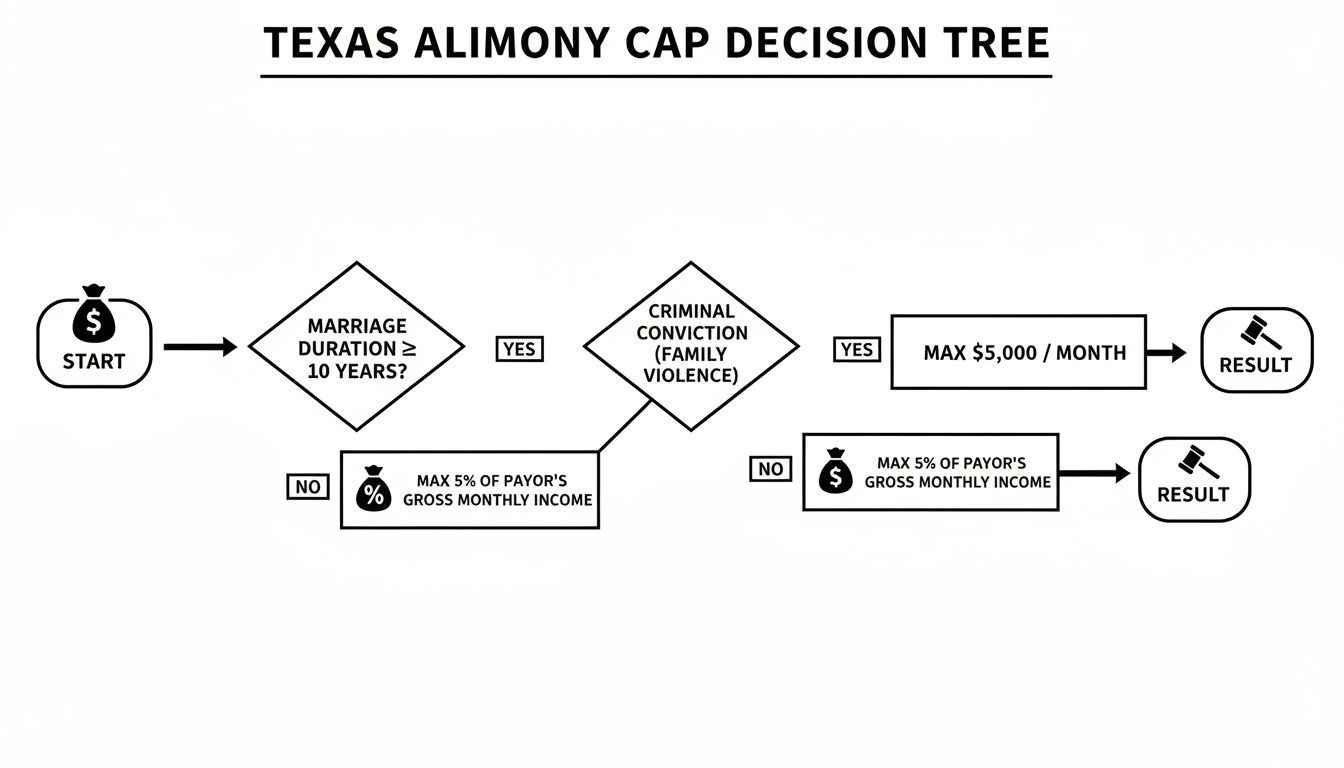
As the chart shows, the award will always be the lesser of the two statutory limits: $5,000 per month or 20% of the paying spouse's gross monthly income.
A Note on Other Scenarios: While they aren't as common, you might also be eligible if you have a debilitating physical or mental disability that prevents you from working, or if you are the primary caretaker of a child of the marriage who has a disability requiring substantial and personal care.
Proving you meet these tough standards isn't a simple matter of checking a box. It requires presenting clear evidence and making a persuasive argument to the court, a process where a local Atascocita attorney can be invaluable.
Step 2: How a Harris County Judge Decides Your Alimony Case

So, you’ve met the strict eligibility rules for spousal maintenance. What now? It’s a common misconception that once you qualify, a set amount is automatically awarded. That's not how it works in Texas.
Meeting the legal requirements simply gets your foot in the courtroom door. From there, a Harris County judge has to look at the whole story—the unique circumstances of your marriage, your financial reality, and what your future looks like—to decide on an amount and duration that's fair. There's no simple calculator for this; it’s a deeply human process guided by a specific set of factors in the Texas Family Code.
The Key Factors a Judge Considers
Think of a judge as a builder. They use each of these factors as a building block to construct a full picture of your family's situation. Only after seeing the complete structure can they make a ruling on how much alimony in Texas is right for your case.
Here are the most critical elements they'll analyze:
- Financial Resources of Both Spouses: The judge starts with the bottom line. What assets and property will each of you walk away with after the divorce? What is your realistic ability to earn an income? Someone leaving the marriage with significant income-producing property is less likely to receive a large maintenance award.
- Education and Employment Skills: The court takes a hard look at each person's education level, job history, and marketable skills. They’ll also consider how long it would realistically take the spouse seeking support to get the training or education needed to find a self-sustaining job.
- The Length of the Marriage: While a 10-year marriage is often the minimum to even be eligible, the actual duration matters a great deal. A judge will naturally see a 30-year marriage, where one spouse may have been out of the workforce for decades, very differently than an 11-year one.
- Age and Health: This is a big one. The age, employment history, earning power, and the physical and emotional health of the spouse asking for maintenance are crucial. A 60-year-old with chronic health problems has a vastly different future ahead than a healthy 35-year-old.
A Human-Centered Decision: At the end of the day, the court's job is to create an order that’s fair and equitable. This isn't about punishing one person or rewarding another. It’s about acknowledging the roles, contributions, and sacrifices made during the marriage to ensure a just outcome.
Contributions, Conduct, and Other Considerations
Beyond the raw numbers and personal stats, the court also digs into the dynamics of the marriage itself. These factors provide the crucial context that shapes the final decision.
Contributions to the Family and Career
A judge will absolutely look at the non-financial contributions made over the years. This can include:
- Contributions as a Homemaker: The court explicitly recognizes the value of raising children, managing the household, and creating the stability that allowed the other spouse to focus on building a career.
- Contributions to the Other’s Career: Did you work to put your spouse through medical school or help them get a professional license? That's seen as a direct investment in their long-term earning capacity.
Marital Misconduct
While Texas is a no-fault divorce state, a judge can consider evidence of misconduct from either spouse when it comes to alimony. This can include:
- Adultery: Infidelity can definitely influence a judge’s thinking on the amount and duration of maintenance.
- Cruel Treatment: A documented history of physical or emotional abuse is a very significant factor.
- Wasting Marital Assets: If one spouse blew community funds on gambling, an affair, or other irresponsible spending, the judge can take that into account when structuring the final awards.
For anyone in Atascocita or Humble, winning a fair outcome is about presenting a clear, compelling story backed by solid evidence. You need to show the judge the complete picture of your marriage, your financial needs, and the real efforts you're making to move forward. At The Law Office of Bryan Fagan – Atascocita TX Lawyers, our job is to help you gather that evidence and tell your story effectively.
Step 3: How Long Spousal Maintenance Payments Can Last
One of the biggest sources of anxiety during a divorce is staring into an unknown financial future. For many of our clients in Atascocita and Humble, a key question is simple and direct: if spousal maintenance is awarded, how long will those payments continue?
Texas law doesn't leave this to guesswork. It provides clear, firm limits on the duration of court-ordered maintenance, and the timeline is tied directly to the length of your marriage. The whole idea is to provide a temporary bridge, not a lifelong solution.
The court's goal is what we call rehabilitative support. This means giving a spouse a set amount of time to get the skills, education, or experience needed to get back on their feet financially. In fact, the law specifically requires judges to order payments for the shortest possible time needed for that to happen. A judge won't just rubber-stamp the maximum duration allowed; they will look closely at what is truly necessary for the receiving spouse to become self-sufficient.
Maximum Timelines Based on Marriage Length
The Texas Family Code puts a hard ceiling on how long maintenance payments can last. The longer you were married, the longer the potential period of support. This structure is designed to give both sides a predictable framework so you can plan for the future with more certainty.
To help you see how this works, we've broken down the statutory limits in this simple table.
Texas Spousal Maintenance Duration Limits by Marriage Length
| Length of Marriage | Maximum Duration of Maintenance Payments |
|---|---|
| Less than 10 years (but eligible due to family violence) | 5 years |
| 10 to 20 years | 5 years |
| 20 to 30 years | 7 years |
| 30 years or more | 10 years |
As you can see, the law sets clear boundaries. Even after a marriage that lasted three full decades, the absolute maximum duration for court-ordered support is 10 years. These timelines really drive home the state's policy: maintenance is a temporary helping hand, not a permanent arrangement.
Are There Any Exceptions for Indefinite Support?
The idea of "lifelong alimony" is largely a myth here in Texas. However, the law does carve out a couple of very specific and rare exceptions where a judge can order support for an indefinite period. These situations are not taken lightly by the courts and require a very high burden of proof.
A judge may only order indefinite spousal maintenance if the receiving spouse is unable to become self-supporting because of:
- A Debilitating Disability: This isn't just a minor health issue. It refers to a serious, incapacitating physical or mental disability that truly prevents them from earning a sufficient income.
- Caring for a Disabled Child: This applies if the spouse is the primary caretaker for a child of the marriage (of any age) who has a substantial physical or mental disability. The child's needs must require so much personal care that it prevents the parent from working and earning a living.
Key Insight for Atascocita Families: Unless one of these two specific disability-related exceptions applies to your case, court-ordered spousal maintenance in Texas always has an end date. The entire system is built to encourage financial independence and help both people move forward into their new lives.
Understanding these time limits is absolutely critical for planning your financial future. Whether you expect to pay or receive support, knowing the potential timeline helps you create a realistic budget and set achievable goals. At The Law Office of Bryan Fagan, we can help you understand exactly how these rules apply to the facts of your specific situation.
Why Texas Alimony Rules Are So Strict
If you're finding that Texas alimony laws seem tough, you're not wrong. They are, and it’s by design. Understanding the philosophy behind our state's strict rules can help you set realistic expectations for your divorce in Atascocita, Humble, or anywhere in Harris County. This isn't just a random collection of statutes; it's a reflection of a core legal principle that guides Texas family courts.
At its heart, Texas law has shifted dramatically away from the old concept of lifelong spousal support. The modern legal mindset is all about encouraging financial independence for both spouses as quickly as possible after a divorce.
The Shift Toward Rehabilitative Support
The entire framework for spousal maintenance in Texas is "rehabilitative." Think of it less as a permanent income stream and more as a temporary financial bridge. A judge in Harris County is looking to give a lower-earning spouse a short-term, limited safety net. The goal is to provide just enough time and resources to get the skills, education, or training needed to stand on their own two feet.
This philosophy is the reason behind the demanding eligibility rules, the strict payment caps, and the limited duration of support. The law starts with the assumption that both adults in a divorce can support themselves. It then puts the burden of proof squarely on the person asking for maintenance to prove exactly why they can't.
A Deliberate Legal and Cultural Choice
This tough-as-nails approach isn't an accident; it's a deliberate policy that makes Texas stand out from many other states. Family law research consistently shows that spousal maintenance is awarded in a much smaller percentage of Texas divorces compared to national averages. This directly reflects our state's strong emphasis on self-sufficiency.
This context is crucial for anyone navigating a divorce here. Knowing the court's goal is rehabilitation helps you build a much stronger case from the get-go.
A successful request for spousal maintenance isn’t just about showing you need help; it's about presenting a clear and credible plan for how you will use that temporary support to get back on your feet.
What This Means For Your Case
Grasping this bigger picture helps you frame your arguments in a way that will actually resonate with a Texas judge. Instead of focusing on maintaining a certain lifestyle, a strong case demonstrates a specific, temporary need that's tied directly to a concrete plan for becoming self-supporting. For more background on this, you might find our article discussing if Texas is an alimony state helpful.
Whether you're the one seeking maintenance or the one who might be asked to pay it, aligning your expectations with the reality of our legal system is the first step toward a fair outcome. The system is designed to close one chapter and help both people start the next one on solid financial ground.
Take Control of Your Financial Future with an Atascocita Lawyer

As you've seen, figuring out "how much alimony in Texas" isn't straightforward. The legal system here has very specific, strict rules. Proving you're even eligible for spousal maintenance is a high hurdle, the payments themselves have hard caps, and what you ultimately walk away with hinges entirely on the evidence presented to the judge.
Trying to tackle this alone is a huge gamble with your financial stability. This is your moment to take a decisive step and protect what comes next.
Here at The Law Office of Bryan Fagan – Atascocita TX Lawyers, we know the pressures families in Atascocita, Humble, and across northeast Harris County are facing. We don't just work in this community—we live here. We're your neighbors, and we're dedicated to helping our neighbors land on their feet.
Your Local Partner in Building a Secure Future
We do more than just dispense legal advice. Our mission is to provide compassionate, clear guidance backed by a tough, effective legal strategy. The goal is always to secure your financial well-being long after the ink on the divorce decree has dried. Your future is simply too important to leave to chance.
A successful spousal maintenance case comes down to building a compelling story, one that’s supported by organized financial documents and solid proof. It demands an intimate understanding of what Harris County judges prioritize when they make these life-altering decisions.
It’s also crucial to look at the entire financial landscape. Beyond just support payments, you have to consider other major assets, like figuring out how to split home equity in a divorce, because the division of property is a massive piece of the puzzle. We help you see it all.
Your financial security after a divorce is not just a legal matter—it's the foundation for your new life. Taking proactive steps with a knowledgeable attorney is the most important investment you can make in yourself and your family.
Our approach is a true partnership. We start by listening to your story, understanding your needs, and then building a tailored plan to get you there. We’ll guide you in gathering the right evidence, argue your case persuasively, and fight for a fair outcome that lets you move forward with confidence.
Schedule Your Free Consultation Today
Don't put off getting the answers and support you need. We invite you to schedule a free, no-obligation consultation at our Atascocita office. Let's sit down, talk through the details of your situation, and start mapping out a solid plan to protect your financial future.
Frequently Asked Questions About Texas Alimony
Even after reading a guide, it’s completely normal to still have questions. The spousal maintenance process can feel like a maze, and every family's situation has its own unique twists and turns. Let's tackle some of the most common questions we hear from our clients right here in Atascocita and Humble.
Our goal is to give you clear, no-nonsense answers so you can feel more in control as you figure out your next steps.
Can We Just Agree to Alimony Ourselves?
Yes, absolutely. In fact, many couples in Texas work out their own support arrangement instead of leaving it up to a judge. This is called contractual alimony, and it's essentially a private contract that gets folded into your final divorce decree.
The big advantage here is flexibility. Unlike court-ordered maintenance, contractual alimony isn't tied to the strict eligibility rules or payment caps in the Texas Family Code. This freedom allows you and your spouse to craft an agreement that makes practical sense for your specific finances, often leading to a much smoother resolution than a courtroom fight.
How Does Cheating Affect Alimony in Texas?
It can have a significant impact. While Texas is a "no-fault" state for getting a divorce, that doesn't mean a judge ignores bad behavior when it comes to money. Marital misconduct, especially adultery, is one of the factors a court can consider.
If the spouse who would likely pay maintenance was unfaithful, a judge might be more inclined to award support, or perhaps award a higher amount (still within the legal limits, of course). On the flip side, if the spouse asking for maintenance is the one who committed adultery, it could seriously damage their claim—or even cause the judge to deny it entirely. It’s a major piece of the puzzle when the court decides what is "just and right."
Can I Stop Paying If My Ex Moves In with Someone?
This is a big one we get asked all the time. The short answer is yes. Under Texas law, your duty to pay court-ordered spousal maintenance ends automatically if the person receiving the payments cohabitates with a romantic partner in a permanent home on an ongoing basis.
It's not as simple as just stopping the payments, though. You'll need to file a formal motion with the court and present proof of the cohabitation to get an official order terminating your obligation.
Figuring out how much alimony in Texas you might pay or receive isn't just about plugging numbers into a calculator. It requires a smart strategy and a real-world understanding of how local courts in Harris County operate. Don't gamble with your financial future.
At The Law Office of Bryan Fagan – Atascocita TX Lawyers, we're here to offer the clear guidance and strong representation you need. To get started, schedule your free, confidential consultation with us today.