Going through a divorce is one of life's most challenging transitions. For families here in Atascocita, Humble, and the surrounding communities, the path you choose to navigate it can make all the difference. For many, mediation for divorce in texas offers a constructive, compassionate alternative to a draining courtroom battle.
Think of mediation not as a fight, but as a guided, private conversation. It's a structured process where you and your spouse sit down with a neutral professional—the mediator—to work through the decisions that will shape your family's future, right here in your own community.
What Is Divorce Mediation in Texas
For couples in Atascocita, Humble, and across Harris County, divorce mediation is far more than just a legal formality; it's a practical and empowering choice. Instead of handing over the most personal decisions of your life to a judge in a downtown Houston courtroom, mediation keeps the power to decide firmly in your hands.
It’s designed to be a cooperative process. The goal is to reach a mutual agreement on your own terms, avoiding the high costs and emotional toll of a lengthy court fight. This is especially vital when kids are involved, as working together helps preserve a functional co-parenting relationship long after the divorce is final.
Key Areas Resolved in Mediation
Mediation provides the framework to tackle the most critical issues head-on, allowing you to craft solutions that fit your family's unique needs. You'll work together to decide on:
- Child Custody and Visitation: This is your chance to build a practical parenting plan that covers everything from weekly schedules to holidays and vacations, always keeping your children's well-being as the top priority.
- Child Support and Medical Support: Mediation allows for an open and honest discussion about finances to ensure your children have the support they need to thrive.
- Division of Marital Property: From the house in Eagle Springs or Fall Creek to vehicles and retirement accounts, you and your spouse can work toward a fair and equitable division of your assets and debts, guided by Texas's community property laws.
- Spousal Support: If spousal maintenance is on the table, mediation provides a private setting to negotiate terms that both parties can agree are reasonable.
It's a little-known fact for many, but judges in Harris County and surrounding areas almost universally require couples to try mediation before they’ll even consider hearing a contested divorce trial. By getting ahead of this requirement, you keep control of the outcome, lower your stress, and almost always save a significant amount of time and money.
Mediation vs. Litigation at a Glance
Choosing between a cooperative or adversarial process can feel overwhelming. Here's a quick breakdown to help you see the core differences between mediation and a traditional court battle.
| Aspect | Mediation (Cooperative) | Litigation (Adversarial) |
|---|---|---|
| Control | You and your spouse make the final decisions. | A judge makes the final decisions for you. |
| Cost | Typically far less expensive due to fewer legal fees. | Can be very expensive with high hourly attorney rates. |
| Timeline | Can be resolved in a matter of weeks or a few months. | Often takes many months or even years to complete. |
| Privacy | The entire process is confidential and private. | Court proceedings and records are public. |
| Outcome | Focuses on a win-win solution that works for everyone. | Results in a win-lose outcome decided by the court. |
| Stress Level | Lower stress and less emotional conflict. | High stress and can be very emotionally damaging. |
Ultimately, mediation gives you the tools to craft your own agreements, while litigation forces you to accept a decision made by a third party who doesn't know you or your family.
The Role of the Mediator
A common misconception is that the mediator acts like a judge. That couldn’t be further from the truth. The mediator is a neutral guide, not a decision-maker.
Their job is to keep the conversation productive, help you both see the other's perspective, and explore creative solutions you might not have considered. They are trained professionals in conflict resolution and Texas family law, but they never take sides or force an outcome. For a deeper dive into their responsibilities, you can learn more about what a divorce mediator does.
By choosing mediation, you're choosing a process that respects your privacy, preserves your dignity, and empowers you to close one chapter of your life and begin the next on your own terms.
A Step-by-Step Look at the Texas Divorce Mediation Process
Knowing what to expect during mediation can take a lot of the stress and uncertainty out of a divorce. The process isn't random; it's a structured, predictable path designed to help you and your spouse move from conflict to a concrete agreement in a calm, controlled setting. For families here in Atascocita and Humble, understanding this roadmap makes the whole journey feel more manageable.
This visual guide shows the two main roads a divorce can take in Texas. It clearly contrasts the cooperative path of mediation with the more adversarial route of litigation.
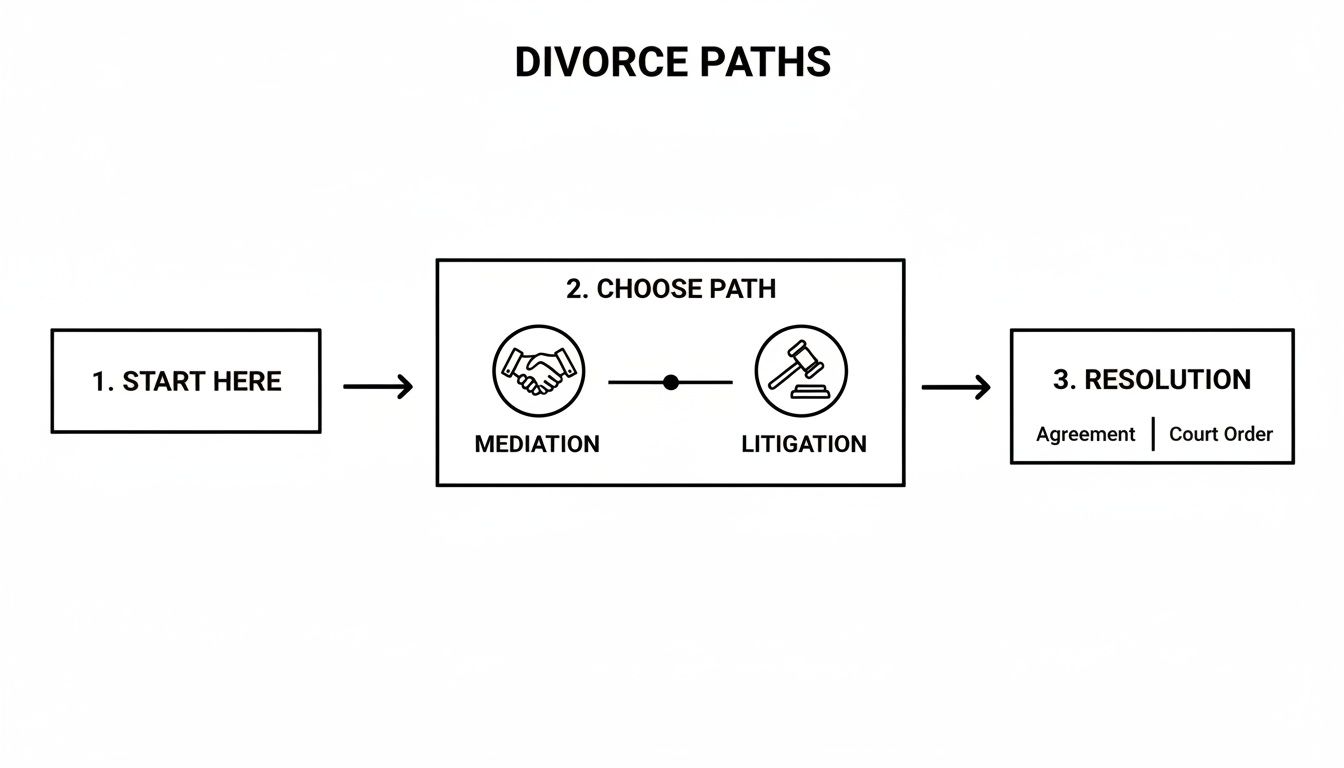
As you can see, while both paths end in a resolution, mediation is a much more direct, collaborative route. Litigation, on the other hand, often involves more complex and combative steps before you get to the finish line.
Step 1: Selecting the Right Mediator
First things first, you and your spouse—along with your attorneys—need to agree on a qualified mediator. A great mediator is a neutral third party, often a retired judge or a seasoned family law attorney who’s an expert in conflict resolution. Their job isn't to make decisions for you. Instead, they facilitate productive conversations and help you find that crucial common ground.
Here in Harris County, there's a deep bench of experienced mediators. Your attorney from The Law Office of Bryan Fagan will help you select someone with a solid reputation for being fair, patient, and effective. We want to ensure you have a guide who understands the nuances of your specific situation. This is a critical choice that really sets the tone for the entire process.
Step 2: Preparing for the Session
Success in mediation almost always comes down to preparation. Before the big day, you and your attorney will sit down to outline your goals and gather all the necessary financial paperwork—think bank statements, property appraisals, and retirement account information. The point isn't to build a case to "win," but to have all the facts at your fingertips so you can make clear, informed decisions.
Think of it like preparing for a major business meeting. You wouldn't walk in without knowing your objectives and having the data to back them up. The same principle applies here. Being prepared empowers you to negotiate with confidence.
We'll help you figure out your priorities—what is truly non-negotiable for you and your family as you move forward? This kind of clear-headed prep helps you stay focused on what matters most when emotions are running high. For a deeper dive, check out our guide on how to prepare for your divorce mediation.
Step 3: The Mediation Session Itself
When mediation day arrives, the setup is pretty standard. You and your attorney will typically be in one room, and your spouse and their attorney will be in another. This is often called "caucusing." The mediator moves back and forth between the two rooms, listening to each side's proposals, relaying offers, and helping bridge the gap.
This separation is actually a good thing. It dramatically lowers the tension and allows you to speak freely and candidly with your attorney without your spouse in the room. The mediator’s whole job is to manage the conversation, keeping it productive and laser-focused on finding solutions, not rehashing old arguments.
Step 4: Reaching and Finalizing an Agreement
Through a series of back-and-forth negotiations skillfully guided by the mediator, you and your spouse will work toward compromises on all the outstanding issues. The mediator is there to help you explore different options and creative solutions until you land on a consensus that both of you can live with.
Once you’ve reached an agreement on every single point—from the kids' holiday schedule to how you’ll divide the 401(k)—it all gets written down in a formal document called a Mediated Settlement Agreement (MSA). This isn't just a piece of paper; it's a detailed, legally binding contract that spells out every single term of your divorce settlement.
After you and your spouse both sign the MSA, it becomes irrevocable. That's a powerful word. It means neither of you can simply change your mind and back out of the deal. The signed MSA is then filed with the court, and a judge will use it to create your official Final Decree of Divorce. This final step officially closes your case, giving you the certainty and closure you need to start your next chapter.
Mediation: Your Shortcut to a Faster Resolution
When you're facing a divorce, the big question on everyone's mind is, "How long is this going to take?" It's a source of major anxiety for families right here in Atascocita and Humble. The truth is, the traditional court system can be agonizingly slow, often dragging things out for a year or even longer. Mediation offers a much more direct path, helping you get off the congested court highway and move on with your life.
Think of it this way: taking your divorce to court in Harris County is like being stuck in rush-hour traffic on I-69. You're just sitting there, inching along, with every hearing and legal motion adding more time to your frustrating journey. Mediation, on the other hand, is like finding a clear, open toll road that takes you straight to your destination. You're in the driver's seat, setting the schedule and controlling the pace.
Cutting Through the Courtroom Gridlock
Here's the hard reality: family court judges are juggling thousands of cases at once. Just getting a date for a simple hearing can take months, let alone securing time for a final trial. For busy parents and professionals in our Atascocita community, that kind of open-ended timeline isn't just an inconvenience—it's a recipe for prolonged stress and emotional exhaustion.
Mediation completely sidesteps this problem. It pulls your case out of the public courtroom and into a private, focused setting. Instead of waiting for a judge to tell you when they're available, you and your spouse simply pick a date that works for both of you. This one change can shrink a year-long ordeal into a matter of months.
The real power of mediation is that it puts you and your spouse back in control of the timeline. You’re no longer at the mercy of the court's backed-up calendar. That control gives you the certainty you need to finally start planning your future.
The Emotional Relief of a Quicker Process
A divorce that drags on doesn't just empty your bank account; it takes a massive emotional toll on everyone, especially the kids. The longer the conflict churns, the harder it is to build a healthy co-parenting relationship on the other side. That constant state of limbo can poison your work life, your mental health, and your ability to be the parent your children need.
By wrapping things up more quickly through mediation, you dramatically shorten that period of turmoil. It gives your family a chance to heal and adjust to the new reality much sooner. This is a core principle for us at The Law Office of Bryan Fagan—we've seen firsthand that a faster, more peaceful resolution is almost always a healthier one for the entire family.
The numbers don't lie. Data consistently shows that mediation for divorce in Texas is incredibly effective at speeding things up, with many cases finalized just a few months after the state's mandatory 60-day waiting period. In one major Texas county, for example, a remarkable 31.8% of family law cases were wrapped up in three months or less, a success largely credited to efficient processes like mediation. You can get more details on how Texas Family Code §6.702 and other factors impact these timelines.
Understanding the Costs of Mediation vs. Litigation
For families in Atascocita and Humble, one of the biggest sources of anxiety during a divorce is the financial unknown. You’re not just ending a marriage; you're dividing a life, and the fear of "how much is this going to cost?" can be paralyzing. The path you choose to finalize your divorce—mediation or litigation—will have a massive impact on your financial well-being.
Think of it this way: mediation is like sitting down with a financial planner to design a budget, while litigation is like handing over a blank check.

Choosing mediation is often one of the smartest financial decisions you can make. It’s a cooperative process designed to be efficient, which translates directly to lower costs. Litigation, on the other hand, is an adversarial process that can quickly become a financial black hole, with costs spiraling out of control.
Breaking Down the Costs of Mediation
In mediation for divorce in Texas, the primary costs are refreshingly straightforward and predictable. This clarity helps families budget effectively and avoid the sticker shock that often comes with a courtroom battle.
- Mediator Fees: The mediator is a neutral professional who charges either an hourly rate or a flat fee for the session. This cost is typically split evenly between you and your spouse, making it far more manageable than each of you paying your own lawyer to spend hours in court.
- Attorney Fees: Yes, you will still have your own attorney to advise and represent you, but their role is much more focused. Instead of endless court filings and hearings, your attorney's time is spent on preparation, providing legal counsel during the session, and reviewing the final agreement. It's about strategic hours, not billable months.
At The Law Office of Bryan Fagan, we believe in full transparency. Our goal is to provide practical, cost-effective solutions that protect your assets and allow you to preserve your family's financial resources for the future, not deplete them on legal battles.
The High Price of a Courtroom Battle
Litigation introduces a whole new world of expenses that simply don’t exist in mediation. When you go to court, you’re not just paying your attorney for their time; you’re funding a much larger, more complex—and often unpredictable—process.
These additional costs can quickly add up:
- Discovery Costs: This is the formal process of information gathering, which involves depositions (sworn testimony outside of court), subpoenas, and formal requests that generate significant billable hours.
- Expert Witness Fees: If you disagree on the value of a business, the family home, or need a child custody evaluation, you may have to hire expensive experts like forensic accountants or psychologists to testify.
- Multiple Court Appearances: Every temporary hearing, status conference, and motion requires your attorney to prepare for and attend court. Each one of those appearances adds to your final bill.
- Trial Preparation: If your case actually goes to trial, the costs can skyrocket. Preparing for a final trial is the single most labor-intensive and expensive part of any divorce.
Estimated Divorce Costs in Harris County
To put these differences in perspective, let’s look at some typical costs for families here in our community. The financial gap between a mediated agreement and a contested court battle isn't minor; it's substantial.
| Divorce Method | Typical Cost Range | Key Cost Factors |
|---|---|---|
| Mediation | $3,000 – $7,000 | Mediator's rate, number of sessions, complexity of assets, attorney review time. |
| Litigation (Contested) | $15,000 – $50,000+ | Number of court hearings, expert witness fees, length of discovery, trial preparation. |
| Collaborative Divorce | $7,000 – $25,000 | Professional team fees (attorneys, financial neutral, etc.), number of meetings. |
These numbers show why so many people are turning to more cooperative methods. For a family in Harris County, saving thousands of dollars can mean the difference between starting over with a healthy savings account or facing significant debt. You can explore more about the financial benefits of cooperative divorce methods in Texas.
Ultimately, mediation isn’t just about reaching a peaceful resolution—it's about making a sound financial investment in your own future. By keeping costs predictable and contained, you empower yourself to move forward with stability and confidence.
The Legal Power of Your Settlement Agreement
After hours of tough negotiations, reaching that final agreement feels like a massive weight has been lifted off your shoulders. But what really gives that piece of paper you sign its teeth? In Texas, this isn't just a gentleman's agreement or a handshake deal. It’s a legally binding contract, and its consequences are both profound and permanent.

The document is officially called a Mediated Settlement Agreement (MSA), and it's best to think of it as the foundational blueprint for your final divorce decree. Once you and your spouse have both signed it, Texas law makes that agreement binding and irrevocable. This is a critical detail for anyone in Atascocita and Humble to grasp.
"Irrevocable" is exactly what it sounds like—you can't just wake up the next morning with a case of buyer's remorse and back out. This feature of Texas law is designed to create certainty and finality, stopping the kind of endless disputes that can make divorces drag on for years. It ensures that all the hard work you invested in mediation actually leads to a solid, enforceable resolution.
From Agreement to Final Decree
The MSA itself isn't the final order from the court. Instead, it’s the legally enforceable contract your attorney will use to draft the Final Decree of Divorce. The decree is the official document the judge signs, which formally dissolves your marriage and turns the terms of your MSA into the court's official orders.
Because an MSA carries so much legal weight, it is absolutely essential that it’s drafted with precision and covers every single detail. A vague or incomplete agreement is a recipe for major legal headaches down the road. This is precisely why having skilled legal counsel isn't just a good idea—it's a necessity.
A signed Mediated Settlement Agreement gives you what the Texas Family Code calls an “entitlement to judgment.” In plain English, this means a judge must approve the agreement as it's written, provided it meets the basic legal requirements. It effectively takes the final decision out of the judge's hands and keeps it firmly in yours.
Why Attorney Review Is Non-Negotiable
Before your pen ever touches that MSA, having an experienced attorney from The Law Office of Bryan Fagan review it is the single most important safeguard you have. Our job is to protect your rights and make sure the agreement isn't just fair today, but that it's also practical and livable for your future.
We meticulously comb through the MSA to confirm a few key things:
- It’s comprehensive: Does the agreement address all assets and debts, from retirement accounts to the house? If you're unsure what's included, our guide on what is community property in Texas is a great place to start.
- The language is crystal clear: Is every term defined without any wiggle room? Ambiguity is what leads to future court battles over interpretation.
- It protects your long-term interests: Does the parenting plan actually work for your family’s real-life schedule? Is the property division truly equitable and not just a quick fix?
The high success rate of mediation for divorce in Texas is no secret; courts strongly favor it as a way to resolve cases with less conflict and cost. Data from Tarrant County in 2025 showed that this approach helped resolve 50.2% of family cases within just six months, which speaks volumes about its effectiveness. You can learn more about the positive impact of mediation in Texas family law cases.
That success, however, hinges on creating solid, well-drafted agreements. Our Atascocita attorneys are here to ensure the MSA you sign is one that will serve you and your family well for years to come.
How Our Atascocita Attorneys Guide You
Going through a divorce is one of the toughest things a family can face, but you shouldn’t have to do it alone. The Law Office of Bryan Fagan isn't just located in the Atascocita community; we're a part of it. Our goal isn't just to be your lawyer, but to provide real guidance, clarity, and genuine support when you need it most. We understand the specific worries that families here in northeast Harris County have, and we're focused on finding outcomes that protect your future.
Choosing mediation for divorce in Texas is really about choosing a smarter path. It’s about you and your spouse making the decisions for your life, instead of a judge who doesn't know you. It's about keeping the assets you've worked so hard for within your family, not draining them on a drawn-out court fight. Above all, it's about reducing the emotional toll on you and your children, giving everyone a chance to heal and move forward with respect.
Your Local Partner in a Peaceful Resolution
We build our entire approach around education and empowerment. We've seen it time and again: a client who understands the process is a client who makes confident decisions. When you partner with our Atascocita attorneys, we make it our job to walk you through every step. We’re here to listen to your story, figure out what's most important to you, and then build a strategy that puts your family’s well-being first.
We'll be right there with you to:
- Prepare You for Success: We don't just show up. We work with you to prepare for every mediation session, making sure you have all the financial documents and information organized to negotiate effectively.
- Protect Your Rights: The mediator is neutral, but we are not—we are 100% on your side. We provide the objective legal advice you need to make smart choices about property division, finances, and your kids.
- Ensure a Fair Agreement: Before you sign anything, we'll go over the Mediated Settlement Agreement with a fine-tooth comb. We make sure the wording is precise, complete, and legally solid to head off any problems down the road.
At The Law Office of Bryan Fagan, we see mediation as more than a legal checkbox. It’s a chance to build a stable foundation for your family's next chapter. Our job is to bring the legal skill and human support needed to make that peaceful resolution a reality.
Take the Next Step with a Free Consultation
If you live in Atascocita, Humble, or nearby and are thinking about divorce, you're bound to have questions. You deserve straight answers from a local attorney who understands what you're going through. We offer a free, no-obligation consultation at our Atascocita office where you can discuss your situation privately.
Let us show you how having a skilled and compassionate legal partner can change everything. Contact The Law Office of Bryan Fagan today and take the first step toward a more secure future.
Common Questions About Divorce Mediation
Divorce is full of unknowns, and even when you have a good grasp of the basics, specific questions are bound to pop up. People in Atascocita and Humble often ask us the same things, so let's tackle them head-on with some straight-to-the-point answers.
Do I Still Need a Lawyer if We’re Using a Mediator?
Absolutely, and this is a big one. Think of a mediator like a referee in a game—their job is to keep the conversation moving and fair, but they aren't playing for either team. They’re a neutral party, which means they cannot give you legal advice or advocate for your best interests.
That’s your attorney’s job. At The Law Office of Bryan Fagan, we're your personal coach and advocate. We get you ready for the mediation session, advise you during the negotiations, and carefully review the final Mediated Settlement Agreement (MSA). We make sure the agreement is solid, fair, and doesn't leave you vulnerable down the road. Going in without your own lawyer is a huge risk; you could unknowingly agree to terms that hurt you financially or compromise your rights as a parent for years to come.
What if We Can’t Settle Everything in Mediation?
That's perfectly fine—in fact, it happens all the time. Reaching a partial agreement is still a huge win. Maybe you iron out the entire property division but get stuck on the details of a possession schedule for the kids. You can sign a partial MSA covering everything you did agree on.
This is a smart move because it takes those settled issues off the table for good. You've narrowed down the fight, which saves a ton of money, stress, and time. The judge will only have to decide on the few remaining sticking points, making any court involvement much quicker and less painful.
A lot of folks think mediation is an "all or nothing" proposition. The truth is, every single issue you resolve in mediation is one less issue you have to pay a lawyer to fight about in court. Any progress is good progress.
Is Mediation a Requirement for a Harris County Divorce?
Technically, you don't have to mediate just to file for divorce. But practically speaking, yes. Judges in Harris County, and pretty much everywhere else in Texas, will order you to try mediation before they’ll even consider letting your case go to a final trial. It’s become a standard step in the local divorce process.
The smart play is to mediate early on your own terms, rather than waiting for a judge to force you into it. When you take the initiative, you control the timeline and the tone of the negotiations. This proactive approach almost always leads to better results and helps families close a difficult chapter with far less hostility. Choosing mediation for divorce in Texas from the outset is about taking control of your own future.
At The Law Office of Bryan Fagan – Atascocita TX Lawyers, we know you have questions. If you live in Atascocita, Humble, or anywhere in northeast Harris County, we invite you to come in for a free, no-pressure consultation. Let our local team give you the clear, straightforward answers you need to move forward. https://www.atascocitaattorneys.com