Skip to content
For fathers in Atascocita, Humble, and across northeast Harris County, the thought of a custody battle can be daunting. There's a persistent myth that courts automatically side with mothers, but as a local family law attorney, I'm here to tell you that this is no longer the reality in Texas. The law is clear: Texas family law is gender-neutral. Every single decision a Harris County judge makes boils down to one guiding principle: what is in the best interest of the child.
Arming yourself with knowledge and understanding the local process is the first and most critical step in protecting your relationship with your child. This guide is designed to help you, our neighbors in the Atascocita community, do just that.
Understanding Your Custody Rights as a Texas Father
Many of the fathers I work with come into our Atascocita office convinced the deck is stacked against them. It’s a completely understandable fear, but it's based on an outdated view of family law. A Harris County judge cannot base their ruling on whether you're the mom or the dad. What they will look at is who has been the primary caregiver, who provides stability, and who is most prepared to foster a healthy environment for the child.
Getting the Lingo Right: Key Custody Terms in Texas
First things first, it helps to speak the court's language. You'll quickly notice that in Texas, we don't really use the word "custody." Instead, the law breaks it down into two distinct concepts:
- Conservatorship: This is all about your rights and responsibilities as a parent. Think of it as decision-making authority. Who gets to decide which school in Humble ISD the child attends, what doctor they see, or matters of religious upbringing? That's conservatorship.
- Possession and Access: This is what most people call "visitation." It's the actual, court-ordered schedule that lays out when your child is physically with each parent—weekends, holidays, summer breaks, and so on.
Understanding these terms is a huge first step. A strong case isn't just about fighting for more time; it's about securing the legal authority you need to stay actively involved in every part of your child's life.
Joint vs. Sole Managing Conservatorship
By far, the most typical outcome in a Texas custody case is for the parents to be named Joint Managing Conservators. This doesn't always mean a perfect 50/50 split of the child's time, but it does mean both parents share the rights and duties of raising their child. It’s the court's way of saying that kids do best when both parents have a meaningful role.
Even in a Joint Managing Conservatorship, one parent is usually named the "primary" conservator. This is the parent who has the right to determine the child's residence (often within a specific area, like a school district) and who typically receives child support payments.
On the other hand, Sole Managing Conservatorship is much less common. This is where one parent gets the exclusive right to make nearly all major decisions. A court will only go this route in serious situations, usually involving a history of family violence, documented substance abuse, or severe neglect by the other parent.
For fathers living in communities like Atascocita, Fall Creek, and Kingwood, the journey to securing your parental rights begins with understanding how the law actually works. It's your involvement, your stability, and your dedication to your child that will make all the difference in court. At The Law Office of Bryan Fagan – Atascocita, our job is to make sure your story gets told and your rights as a father are fiercely protected.
The First Step: Establishing Legal Paternity

Before you can even begin to talk about custody schedules or decision-making rights, there's a foundational step you absolutely cannot skip: establishing legal paternity.
Here’s the bottom line for our clients in Atascocita and Humble: until the State of Texas officially recognizes you as the child's father, you have no legal ground to stand on. You can't ask a judge for custody or even guaranteed visitation rights. Everything starts here.
For fathers across Harris County, this can seem intimidating. But it’s a manageable process, and the right path for you really just depends on your current relationship with the child's mother.
The Acknowledgment of Paternity (AOP)
The simplest and most common route for unmarried parents is the Acknowledgment of Paternity (AOP). This is a straightforward legal form that both you and the mother sign, often right at the hospital after your child is born.
Signing an AOP does more than just get your name on the birth certificate. It's a powerful legal action that formally establishes your parental rights and your responsibilities, including the right to seek custody and the duty to provide financial support. When you and the mother are on the same page, it's an incredibly efficient way to secure your legal status from day one.
A Word of Caution: An AOP is a legally binding contract. While it’s not impossible to challenge it later, the process is difficult and has strict deadlines. You need to be 100% certain you are the biological father before you put your signature on that document.
When You Need a Court Order to Establish Parentage
But what if you never signed an AOP? Or what if there’s a disagreement about whether you're the father? In those cases, the path forward is through the court system by filing a Petition to Adjudicate Parentage.
This is a formal lawsuit filed with the Harris County family court that asks a judge to issue an order legally naming you as the father. The step-by-step process generally looks like this:
- Filing the Petition: Your attorney drafts and files the official lawsuit to start the case.
- Serving the Mother: The child’s mother must be legally notified that the suit has been filed.
- Genetic Testing: The court will almost always order a DNA test to get a definitive answer. The results provide the clear-cut evidence the judge needs to make a decision.
- The Final Order: Once the DNA results confirm you are the father, the judge signs an order making it official.
This court order grants you the exact same legal rights as a father who was married to the mother or one who signed an AOP. It’s the green light you need to then move forward with filing for custody and visitation. You can get a much deeper look into this process by reading our guide on how to establish paternity in Texas.
For any dad in northeast Harris County, getting this step right is non-negotiable. A mistake or a delay at this stage can set your entire case back. Working with a local family law attorney who knows the Atascocita courts ensures everything is handled correctly, protecting your rights from the very start.
How to Build a Winning Custody Case
Winning a custody case as a father in Texas isn't about courtroom drama. It's about meticulously building a case brick by brick, proving you are the stable, loving, and consistently involved parent a judge is looking for.
For a Harris County judge, the most convincing argument isn't what you say, but what you can show. Your job is to paint such a clear picture of your daily life with your child that your dedication is undeniable. This is where documentation becomes your best friend.
Document Everything: Your Parenting Journal
If I could give just one piece of advice to a father in Atascocita facing this process, it would be this: start a parenting journal today. This isn't a diary for your feelings; it's a factual, running log of your involvement that can become the single most powerful piece of evidence you have.
Think of it as the real-time proof that you are an essential, hands-on part of your child’s world. I recently worked with a father from Fall Creek whose journal was a game-changer. He methodically noted every trip to the local Kelsey-Seybold Clinic for checkups and logged every single parent-teacher conference at his daughter's Humble ISD school. On their own, these seem like small things, but together they created a mountain of undeniable proof of his commitment.
Make a habit of logging entries for things like:
- Possession Time: Note every single day and night the child is in your care.
- School Involvement: Who helps with homework? Who emails the teacher? Who chaperones the field trip? Write it down.
- Medical Care: Log every doctor's visit, who administers medication, and who handles dental appointments.
- Extracurriculars: Document who takes your child to soccer practice in Atascocita or their music lessons over in Kingwood.
- Daily Routines: Make a note of who handles meals, bath time, and bedtime stories.
This journal will become the backbone of your case. It provides a consistent, detailed pattern of care that words alone simply can't match.
Prove You're a Source of Stability
A judge's number one priority is the child's well-being, which means placing them in a safe and stable environment. You have to prove that you are that rock for your child. This goes beyond just being present; it's about showing you provide a secure foundation.
Start gathering documents like pay stubs, employment records, and proof you have a stable home, like a lease or mortgage statement. Courts in Texas value predictability and routine, as these are the hallmarks of a secure home life. The data backs this up, showing that judges often look for these markers of security. To strengthen your case as a father in Harris County, demonstrating stability is key: 74.3% of custodial fathers have full-time jobs, and 54.6% are 40 years or older—traits that signal a secure environment to the court. You can find more details in these child custody statistics for fathers.
My Advice: Your case won't be won with dramatic courtroom arguments. It's won in the quiet, consistent, and well-documented proof of your everyday commitment as a dad.
Your Evidence Checklist
Getting your evidence together is only half the battle; keeping it organized is just as critical. A clean, well-organized file allows your attorney to build the strongest possible case and present your story clearly and effectively.
Here’s a quick guide to help you start collecting the right materials for your case in Harris County.
Key Evidence to Gather for Your Custody Case
| Evidence Category | Specific Examples | Why It Matters to the Court |
|---|---|---|
| Parental Involvement | Your detailed parenting journal, photos of you and your child at school events or holidays, report cards, and emails with teachers. | This directly demonstrates your active role in your child’s daily life, education, and emotional well-being. |
| Financial Stability | Recent pay stubs, tax returns, bank statements, and proof of employment. | This shows the court you have the financial means to provide for your child’s needs, including food, housing, and healthcare. |
| Safe Home Environment | Photos or videos of your home (especially the child's bedroom), a copy of your lease or mortgage, and letters from neighbors or friends. | This provides tangible proof that you offer a safe, clean, and appropriate living space for a child. |
| Child's Well-being | Medical records, school attendance records, and statements from teachers, coaches, or counselors who can speak to your positive influence. | This third-party evidence reinforces that your child is thriving under your care, which is a key factor in the "best interest" standard. |
Building a winning case is a step-by-step process. It takes patience, diligence, and a focus on what really matters: showing your unwavering commitment to your child's future.
Navigating the Harris County Family Court Process
Stepping into the Harris County family court system can be intimidating. For fathers in places like Atascocita and Humble, it can feel overwhelming. But it doesn't have to be that way. Knowing what to expect can turn anxiety into a clear-headed strategy.
Your case officially begins when your attorney files an Original Petition in a Suit Affecting the Parent-Child Relationship (SAPCR). This is the legal document that kicks things off. Once it's filed, the other parent must be formally notified through a process called "service." It sounds confrontational, but it's just a required legal step to ensure everyone is officially involved.
The Initial Stages: What to Expect First
After the petition is filed and served, the court will likely schedule a Temporary Orders Hearing. This is one of the most important moments in your case. It is essentially a mini-trial where a judge makes temporary decisions on conservatorship, possession and access, child support, and even who gets to stay in the family home while the case moves forward.
Let's say you're a dad in Eagle Springs who has been the one handling school drop-offs, doctor's appointments, and bedtime stories. At this hearing, your lawyer would present your parenting journal, emails with teachers, and other proof to argue that you should be named the temporary primary conservator. These initial orders are powerful because they often set the tone for the final outcome.
One of the biggest mistakes I see is fathers thinking the first hearing is the final word. It's not. The Temporary Orders Hearing is about establishing a stable "status quo" for your child while the details of the case are worked out.
Why Mediation Matters So Much in Harris County
Before you ever get to a final trial, a Harris County judge will order you and the other parent to mediation. This is a requirement in almost every case. Mediation is a confidential meeting with a neutral third-party mediator whose entire job is to help the two of you find common ground and reach an agreement yourselves.
This is your chance to craft a parenting plan that actually fits your family's unique situation, rather than leaving it up to a judge who only knows you from a stack of paperwork. For many families right here in our community, the case ends here—with a successful mediation that saves an incredible amount of money, time, and emotional distress.
To get to that point, you need to build a strong foundation for your case from day one.
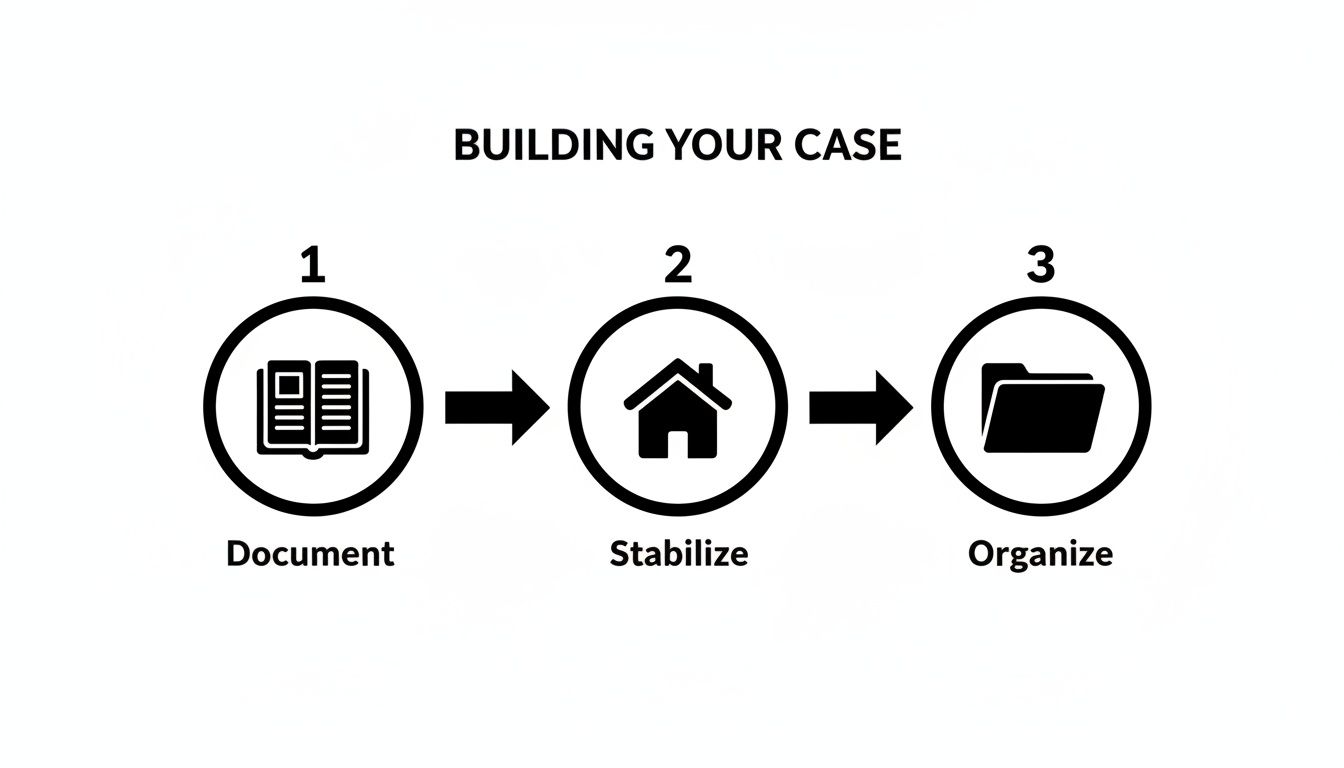
This process really is that straightforward. You document your role as a father, you create a stable environment for your child, and you organize all that proof so it can be presented effectively.
Preparing for Your Day in Court
If you and the other parent just can't reach a full agreement in mediation, you'll have to get ready for court hearings. This is where all that documentation and organization truly pays off. Knowing how to prepare for a custody hearing is essential. A judge at the Harris County Civil Courthouse needs to see clear, undeniable proof of your fitness and involvement as a parent.
When your moment in the courtroom arrives, remember these fundamentals:
- Look the Part: Dress professionally. It shows the judge you respect the court. Business casual is a good standard.
- Stay Calm and Respectful: Always address the judge as "Your Honor." Do not interrupt the judge or the other attorney.
- Answer the Question, Then Stop: Stick to the facts. Don't ramble or let your emotions take over when you're on the stand.
- Practice with Your Lawyer: You and your attorney should go over your testimony and evidence so you feel confident and prepared.
The court system is complex, but you shouldn’t have to learn it on your own. Having an attorney who knows the local Harris County judges and their tendencies can be a game-changer. At The Law Office of Bryan Fagan – Atascocita, our team is in these courtrooms daily, fighting for fathers from Atascocita to Kingwood. We’re here to guide you with the local expertise you deserve.
Tackling Common Hurdles Fathers Face in Custody Cases
Even though Texas law is gender-neutral, fathers often find themselves up against the same old arguments in a custody battle. Knowing what's coming is half the battle. If you anticipate these obstacles, you can build a strategy to overcome them and keep the court’s focus right where it should be: on what’s best for your child.
"He Works Too Much to Be the Primary Parent"
I hear this one all the time from hardworking dads in places like Atascocita and Humble. It’s a classic tactic: the other parent tries to frame your dedication to providing for your family as a negative.
The key is to show the court that your job provides critical stability and that you have a solid, reliable plan for your child's care while you're working. Don't just say it—prove it. Show evidence of your consistent employment. Then, lay out your support network. Is it a grandparent who picks them up from their Humble ISD school? A great local daycare in Atascocita? Do you have the flexibility to work from home when a child is sick? By doing this, you reframe your career from a liability into the very foundation of the secure life you offer your child.
Fighting Back Against False Allegations
Nothing is more stressful than being hit with false claims of anger issues, neglect, or substance abuse. Your first reaction might be anger, but the single most important thing you can do is remain calm and composed. An outburst will only make their claims look more credible.
Your response has to be methodical and built on facts. This is where that parenting journal becomes your most powerful tool. Accused of being an absent father? Your detailed log of every doctor’s appointment, parent-teacher conference, and soccer game you attended is your best defense. Facing accusations of substance abuse? Voluntarily submit to testing and let the clear, scientific results do the talking for you.
The most powerful answer to a false allegation is not a louder argument; it's a mountain of contrary evidence. Let the facts speak for you, and trust that a Harris County judge will see through attempts to manipulate the system.
As your case gets underway, a judge will put temporary orders in place to govern custody and visitation. It's vital to understand how these work. For any father navigating a difficult case, learning more about temporary custody orders in Texas is a crucial step in establishing stability for your child long before the final gavel falls.
Making Long-Distance Parenting Work
Northeast Harris County is a big place. It’s common for one parent to live in Atascocita while the other moves to The Woodlands, Kingwood, or even further out. That kind of distance can make a standard possession schedule a logistical nightmare. You need to walk into court with a plan that shows you've thought this through.
Instead of just pointing out the problem, come to the table with creative solutions that put your child's well-being first.
- Handle all the driving. Offer to do all the transportation for drop-offs and pick-ups. This shows the judge you're committed.
- Go for longer visits. If swapping every other weekend is too tough, propose extended holiday breaks and a bigger chunk of the summer.
- Lean on technology. Propose a schedule for regular video calls to stay connected and be a daily presence in your child’s life.
When you present a thoughtful, child-focused plan, you show the court you’re a dedicated father who is serious about maintaining a strong relationship, no matter the geography.
Ready to Fight for Your Child's Future?
You've just walked through the legal roadmap for Texas fathers fighting for their kids. From establishing paternity and gathering evidence to navigating the courtroom, it is a tough road, but it’s one worth traveling for your child.
The most important thing to remember is that you don't have to do this by yourself. At The Law Office of Bryan Fagan, we've dedicated our practice to helping fathers in Atascocita, Humble, and across northeast Harris County. We know what's at stake.
A good father deserves a fierce advocate. We're here to help you protect that relationship and build the future your child deserves.
Let's talk about your specific situation. We offer a free, no-obligation consultation right here at our Atascocita office. Think of it as a strategy session. We'll sit down, go over the details of your case, answer your questions, and map out a clear path forward. This is your chance to get real answers and build a solid plan with a team that knows the Harris County courts inside and out.
Common Questions I Hear from Fathers in Our Community
Over the years, I've sat down with countless fathers from right here in Atascocita, Humble, and the surrounding areas. While every family's situation is unique, a lot of the same worries and questions come up. Let's tackle some of the most common ones head-on.
Is It True That Texas Courts Favor Mothers?
That’s a myth. Let me be clear: Texas law is completely gender-neutral. The law strictly prohibits a judge from favoring a mother over a father simply because of their gender.
The entire case hinges on one central question: what is in the “best interest of the child?” The parent who can best demonstrate they provide a stable, safe, and loving environment is the one who has the advantage, regardless of whether they are the mother or the father.
I Wasn't Married to My Child's Mother. Can I Still Get Custody?
Absolutely. Your marital status has no bearing on your fundamental rights as a father. However, there's a crucial first step you must take: legally establishing paternity.
Once the court legally recognizes you as the father, you're on equal footing with any divorcing dad. You can petition for conservatorship, and the court will decide your case based on that same "best interest of the child" standard.
What Exactly Does "Joint Managing Conservator" Mean?
Think of it as co-parenting under the law. In Texas, making parents Joint Managing Conservators is the default and most common outcome. It means you and the mother are expected to share the rights and duties of raising your child. This includes making joint decisions on major issues like:
- Education choices
- Non-emergency medical and dental care
- Psychological treatment
Even when you're named joint conservators, one parent is usually designated the "primary" parent. This person has the exclusive right to decide where the child lives (within a certain geographic area) and is typically the one who receives child support.
What Should I Budget for a Custody Case in Harris County?
This is the "it depends" answer that no one likes, but it’s the truth. The cost is directly tied to the level of conflict.
If you and the mother can agree on most things and just need a lawyer to formalize it or guide you through mediation, your costs will be on the lower end. If your case is highly contested, involves serious allegations, and ends up in a courtroom trial, the expenses will be significantly higher.
The only way to get a realistic estimate is to sit down and talk through the specific facts of your case. We can lay out the potential paths your case could take and what the associated costs might look like during a free consultation.
Your bond with your child is everything. At The Law Office of Bryan Fagan – Atascocita TX Lawyers, our mission is to help local fathers protect that relationship. Let's talk about your situation. You can schedule a free, no-obligation consultation with our Atascocita legal team by visiting us at https://www.atascocitaattorneys.com.