The thought of losing your parental rights is, without a doubt, one of the most frightening and stressful situations any parent can face. In Texas, the legal process to permanently end the relationship between a parent and child—known as parental termination of rights—is a drastic measure reserved for only the most severe circumstances. If you're a parent in Atascocita, Humble, or anywhere in northeast Harris County facing this possibility, this guide is here to bring clarity to a confusing process and help you understand your rights and what comes next.
A Compassionate Guide for Atascocita Families

The bond between a parent and child is the foundation of family. Texas law recognizes this and treats the decision to break that bond with incredible weight and seriousness. Think of your parental rights as the legal threads that connect you to your child, giving you both privileges and profound responsibilities.
Terminating those rights severs every one of those threads—for good. It’s a complete and irreversible end to all legal ties. This means no more custody, no more visitation, and no more say in your child's education, healthcare, or upbringing. For our neighbors in the Atascocita and Humble communities, getting a firm grasp on this process is the crucial first step toward protecting your family.
Why Does Termination of Parental Rights Happen?
No matter the circumstances, parental rights can only be terminated by a court order. Even if a parent agrees to it, a judge must be fully convinced that taking such a life-altering step is truly in the child's best interest. The situations that trigger this process typically fall into two distinct categories:
- Voluntary Termination: This is when a parent willingly agrees to give up their rights. We often see this in cases of stepparent adoption, where it clears the way for a new, stable family unit to be legally formed right here in our community.
- Involuntary Termination: This is far more contentious. It happens when a court ends a parent's rights against their will, usually after a lawsuit is filed by the other parent, a concerned relative, or Child Protective Services (CPS) because of serious issues like abuse, neglect, or abandonment.
The Two Paths to Termination in Texas
The road to termination always follows one of two legal avenues. The first is voluntary relinquishment. In this scenario, a parent signs a formal legal document, an affidavit, stating they agree to give up their rights. This is a massive decision, and even with that consent, a Harris County judge still has the final say and must approve it, ensuring it truly benefits the child.
The second path is involuntary termination. Here, someone else has to file a lawsuit and prove two things to the court with "clear and convincing evidence"—a very high legal standard. They must show that the parent has committed a specific act that the law recognizes as grounds for termination and that ending the parent-child relationship is in the child’s best interest. It’s critical to remember that your legal rights are protected; the burden of proof is squarely on the shoulders of the person trying to take them away. In some of these cases, knowing how to establish paternity in Texas becomes a key factor, as it officially defines the legal relationship from the very beginning.
At The Law Office of Bryan Fagan in Atascocita, we know that nothing is more important than your relationship with your child. We are committed to providing our neighbors in northeast Harris County with the supportive guidance and strong legal advocacy needed during such a critical time.
You don't have to go through this alone. This guide is meant to be a practical resource you can lean on, breaking down complicated legal ideas into plain English. Our goal is to empower you with the knowledge you need to fight for your family's future. If you are facing this overwhelming situation, now is the time to get help. Schedule a free, confidential consultation with our Atascocita office to discuss your case and learn how we can stand by your side.
The Legal Grounds for Terminating Parental Rights
In Texas, the law sees the bond between a parent and child as fundamental. Courts don’t take severing that connection lightly, and they won’t do it without a compelling, legally sound reason. These specific justifications are called "grounds," and understanding them is the first step in figuring out where you stand.
The legal journey can go one of two ways: either by choice, or by a court order against a parent's wishes. For any family in the Atascocita or Humble area, it's critical to know the difference.
Voluntary Termination: A Path of Agreement
Sometimes, a parent makes the incredibly difficult choice to give up their legal rights willingly. This is known as voluntary termination. It most often comes up in the context of an adoption, especially a stepparent adoption.
Picture a common Harris County scenario: a mother remarries, and her new husband has been the real father figure in her child's life for years. The biological father might live far away, have very little contact, and ultimately agrees it’s best for the child to be adopted by the stepfather.
In a situation like this, the biological father would sign a legal document—an affidavit of relinquishment—formally stating his intent to give up his parental rights. But his signature alone isn't the final word.
A Texas judge still has to review the case and make an official ruling that ending the parent's rights is truly in the best interest of the child. The court’s first and last duty is to protect the child, ensuring the decision leads to a stable, secure future, not just an easy out for a parent.
Involuntary Termination: When the State Steps In
The more common and often heartbreaking path is involuntary termination. This is when a court ends a parent's rights against their will. This kind of case is typically started by the other parent, another family member, or, most often, by Child Protective Services (CPS).
For a court to take such a drastic step, the person or agency filing the lawsuit has to prove two things with "clear and convincing evidence"—a very high legal bar to clear.
First, they must prove the parent committed at least one of the specific acts laid out in the Texas Family Code. These are the only valid reasons for involuntary termination and include things like:
- Endangerment: Knowingly putting the child in physical or emotional danger.
- Abandonment: Leaving the child and failing to maintain contact or provide support for a certain amount of time.
- Failure to Support: Intentionally not paying child support for a year.
- Criminal Conduct: Being convicted of a serious crime and imprisoned, making it impossible to care for the child.
- Failure to Comply with a Court Order: Not following the steps in a court-ordered service plan, which is common in CPS cases.
That last point is a big one. If a parent in Humble is ordered by a judge to take parenting classes and go to substance abuse counseling but doesn't follow through, that failure can be used as a ground for termination. It's sometimes called "constructive abandonment," a concept solidified in Texas case law. One key court decision really drove home the point that a parent has to make a real, consistent effort to comply with court orders to keep their rights.
To clarify the distinction, let's break down the two paths.
Voluntary vs Involuntary Termination Grounds in Texas
This table summarizes the core differences between a parent willingly relinquishing their rights and a court terminating them against a parent's will.
| Aspect | Voluntary Termination | Involuntary Termination |
|---|---|---|
| Parent's Consent | The parent agrees and signs a legal affidavit to relinquish their rights. | The parent does not agree and actively fights the termination in court. |
| Who Initiates It? | Typically the parent themselves, often in coordination with an adoption (e.g., stepparent adoption). | Usually initiated by the other parent, a family member, or a state agency like Child Protective Services (CPS). |
| Legal Basis | The parent's sworn statement of relinquishment, plus a court finding that it is in the child's best interest. | The petitioner must prove a specific statutory ground (like endangerment or abandonment) and the best interest test. |
| Emotional Context | Often a painful but agreed-upon decision made for the child's stability. | Almost always a highly contentious, emotionally charged, and adversarial legal battle. |
| Evidence Standard | The court must be convinced termination is in the child's best interest, but the parent's consent is the foundation. | The petitioner must prove their case with "clear and convincing evidence"—a very high standard of proof. |
Understanding which path a case is on is crucial because it dictates the entire legal strategy, the evidence needed, and the fight ahead.
The All-Important Two-Part Test
Proving one of the legal grounds is only half the battle. After establishing a statutory reason, the petitioner must also convince the judge of the second part of the test: that termination is in the child’s best interest.
This is the single most critical piece of any termination case. The court will look at a whole host of factors to make this call, always putting the child's emotional and physical well-being first. It helps to have a grasp of the overall legal framework for parental rights and responsibilities, known as conservatorship in Texas, to see how courts view these relationships. The judge is essentially asking: Will this child be safer, more stable, and have a better shot at a healthy life if this parent is permanently removed from the picture?
For any parent facing this fight, knowing these legal standards is the foundation of a strong defense. The state can't just claim you're a "bad parent." They must prove, with solid evidence, that your actions fit a specific legal definition and that your child will be better off without you. It's a heavy burden to meet, and with the right legal help, it's a burden that can be challenged.
Navigating the Texas Court Process Step by Step
For any family in Atascocita or Humble, getting notice of a lawsuit that could sever your parental rights is a terrifying moment. The legal system can feel like an impossible maze, but knowing the path forward can make all the difference. Understanding the roadmap helps you regain a sense of control. A lawsuit for the parental termination of rights in Texas follows a very specific, structured process, and knowing what’s coming is the first step toward building your defense.
The whole thing gets started when someone files a Petition for Termination with the court. This is the official legal document that launches the case. It’s also important that the person filing knows the proper procedures for filing court documents in Texas. Once that petition is on file, the next move is to make sure the parent whose rights are at stake gets formal notice.
Step 1: Filing the Petition and Serving Papers
That formal notification is legally known as service of process. You can’t be sued in secret; the law demands that a copy of the lawsuit is physically handed to you, giving you a fair shot to respond. For a parent living in Harris County, this usually means a sheriff's deputy or a private process server shows up at your door with the papers.
Once you’re served, a legal clock starts ticking. You have a very specific amount of time to file a formal answer with the court. Simply ignoring the lawsuit is the single worst mistake you can make, as it almost guarantees the court will issue a default judgment against you, likely terminating your rights without you even being there.
Step 2: Temporary Orders and Ad Litem Attorney
Soon after the case gets underway, the court will hold a hearing to set temporary orders and will also appoint an ad litem attorney. Think of this person as the child’s own independent lawyer. Their only client is the child, and their sole job is to figure out what’s in the child's best interest. They'll talk to everyone involved—the child, the parents, teachers, and therapists—before making a recommendation to the judge.
Step 3: Meeting the High Burden of Proof
In a typical civil case, like a contract dispute, the winner just has to prove their side is "more likely than not" to be true. This is called a "preponderance of the evidence." But because taking away a person's rights to their child is so final and serious, Texas law sets a much higher bar: clear and convincing evidence.
This isn’t just a slight lean in one direction. It means the judge must have a firm belief or conviction that the allegations are true. They can’t just think it’s probably true; they must be left with no substantial doubt. It’s a powerful legal shield meant to protect the fundamental bond between a parent and child.
This high standard is the bedrock of every termination case. The person or agency suing you, whether it's the other parent or CPS, has the full responsibility to meet this tough standard of proof.
This flowchart breaks down the two-part test a judge must use in every single termination case.
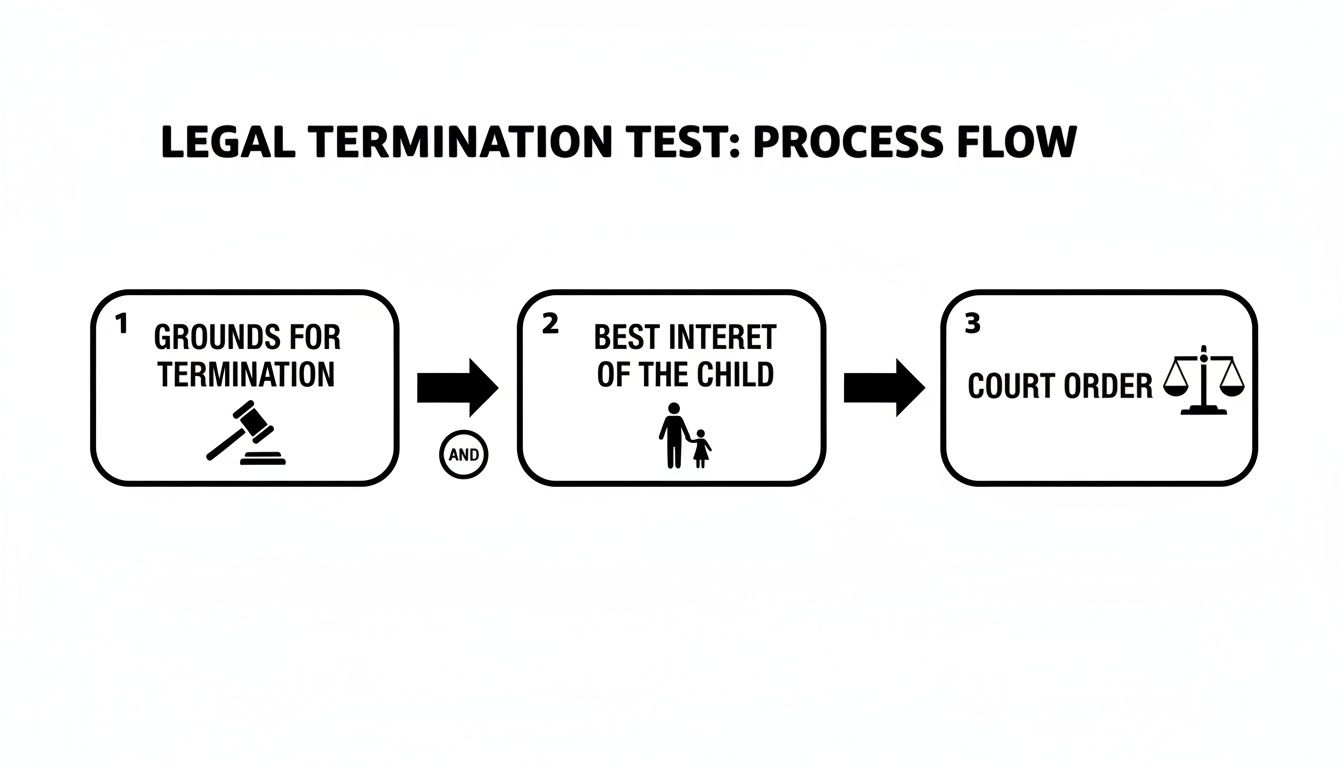
As you can see, the petitioner has to prove both a specific legal reason (a statutory ground) for termination and that ending the parent-child relationship is truly in the child's best interest. Proving one without the other isn't enough.
Step 4: Mediation and Final Trial
The court process isn't a single event but a series of crucial milestones. One of the first big showdowns is the temporary orders hearing. This is where the judge makes immediate, short-term decisions about where the child will live, who gets to see them, and what services or classes parents must start while the case moves forward. Being ready for this hearing is critical because its outcome often sets the tone for the entire case. You can find more on getting ready by reading our guide on how to prepare for a custody hearing.
After what can be months of investigations, exchanging documents, attending court-ordered mediation, and following the temporary rules, the case will head to a final trial if the parties can't reach an agreement. This is where both sides present all their evidence, call witnesses to the stand, and make their final arguments to the judge. This is the moment when having a seasoned attorney is absolutely non-negotiable. Your lawyer will be there to challenge the other side's case and weave your story into a compelling argument for why your parental rights must be protected.
This process is a marathon, not a sprint. Every single step, from that first petition to the final verdict, demands sharp attention to detail and a real-world understanding of Texas family law. If you are a parent in the Atascocita area staring down this challenge, please reach out to the Law Office of Bryan Fagan for a free consultation. We’re here to guide you through every stage and fight for your family.
The Role of CPS in Termination Cases
For many families in Atascocita and Humble, a parental rights termination case doesn't start in a family law court—it starts with a knock on the door from Child Protective Services (CPS). It's a moment that can turn your world upside down, but knowing what's happening and what your rights are is the first step toward protecting your family.
When CPS gets a report alleging child abuse or neglect, they are legally required to look into it. If an investigator decides a child is in immediate danger, they have the power to remove the child from the home right then and there. That single action kicks off a very serious and fast-paced legal battle.
The CPS Service Plan: Your Court-Ordered To-Do List
Once a child is removed, CPS will file a lawsuit, and a judge will put a service plan in place. It’s best to think of this as a court-ordered to-do list. This plan is specifically designed to address whatever problems led to the removal and, hopefully, get the family back together.
But make no mistake: a service plan isn't a list of helpful suggestions. It is a binding court order. Failing to complete every single task on that list can become the main reason a judge decides to terminate a parent's rights. For a parent in Harris County, a service plan often requires them to:
- Take parenting classes to develop new skills.
- Attend counseling or therapy to work through personal issues like trauma or anger.
- Complete substance abuse treatment, which usually involves assessments and regular drug testing.
- Show proof of stable housing and steady employment to prove you can provide a safe home.
You Have Rights During a CPS Investigation
Even when you're under the microscope of a CPS investigation, you still have fundamental rights. Just because CPS is involved doesn't mean your parental rights are automatically forfeit. You have the right to:
- Refuse to speak with an investigator until your lawyer is present.
- Prevent an investigator from entering your home without a court order.
- Receive a written explanation of the allegations made against you.
- Be represented by an attorney at all court hearings.
Using these rights isn't an admission of guilt. It's about making sure the process is fair and that your side of the story is told accurately. Calling an attorney the moment CPS first contacts you is the most important thing you can do.
The ultimate goal of the child welfare system should be keeping families together whenever it is safe to do so. The process is daunting, but having a skilled lawyer in your corner ensures you are treated fairly and gives you the best possible shot at reunification.
A Shift Toward Family Preservation in Texas
The system is slowly changing for the better. The Texas child welfare system has made a significant shift, leading to a major drop in the number of children CPS removes each year. For families in Harris County, this means there's now a greater focus on preserving the family unit and providing more opportunities to work things out before termination is even on the table.
This is a hopeful trend, showing that the state recognizes that kids thrive most when they can stay safely with their families. You can explore more about this shift and what it means for Texas families.
While this focus on preservation is good news, the risk of termination is still very real for parents who can't—or won't—follow their service plan. The stakes in a CPS case are as high as they get, and you need experience and skill to navigate the system successfully.
If you are a parent in Atascocita, Humble, or anywhere in northeast Harris County dealing with CPS, you don't have to go through this alone. The Law Office of Bryan Fagan is here to stand with you, protect your rights, and fight for your family. Schedule a free, confidential consultation with our Atascocita office today to learn how we can help.
What Happens After a Judge Terminates Parental Rights?
When a judge in Texas signs an order terminating parental rights, it's not just another legal document. It is one of the most final, life-altering decisions made in a family courtroom. For both the parent and the child involved, this order permanently redraws the family map, and understanding the fallout is critical for anyone in Atascocita and Humble facing this reality.
The ink on that order isn't even dry before the legal relationship between parent and child is completely and permanently severed. This isn't like losing custody or having your visitation suspended; it’s a full and irreversible end to the legal bond.
The Immediate Legal Consequences
The effects of a termination order are immediate and sweeping. Every right and responsibility that comes with being a parent is wiped away. This means you no longer have any legal right to:
- See or visit your child: Any court-ordered possession or access is gone.
- Make decisions for them: You lose all say in your child's schooling, healthcare, and religious upbringing.
- Inherit from each other: The child's legal right to inherit from you (and yours from them) is extinguished.
This finality is intentional. The court's goal is to create a clean break, allowing the child to move toward a stable, permanent new home without legal complications from the past.
What About Child Support?
This is a question we hear all the time: "Do I still have to pay child support?" The answer has two parts. The termination order stops all future child support obligations from that day forward. However, it does not erase any past-due support, also known as arrears.
For instance, imagine a parent in Harris County owes $5,000 in back child support when their rights are terminated. That $5,000 debt is still on the books. The Office of the Attorney General can and will continue to pursue collection of that amount, even though no new support will be added.
The Path Forward Is Usually Adoption
In nearly every case, the reason for terminating parental rights is to open the door for adoption. A loving adult is typically waiting to step into that parental role and make it legally permanent. For families in our Atascocita community, this often plays out in two ways:
- Stepparent Adoption: A stepparent who has become a true parental figure in the child's life can formalize that bond through adoption, creating a solid, legally recognized family.
- Adoption from Foster Care: In cases involving Child Protective Services (CPS), termination allows a child to be adopted by their foster family or another approved home, finally giving them the permanency they need and deserve.
Adoption is what provides the child with the lasting security and stability that the court has deemed to be in their best interest.
Is It Ever Possible to Get Your Rights Back?
For decades, the answer to this question was a hard and fast "no." But the legal ground has shifted slightly in recent years. Legislative reforms have carved out a very narrow path for the reinstatement of parental rights in specific, limited circumstances, especially for parents who have successfully turned their lives around after being incarcerated. This signals a more nuanced understanding that people can change and some family bonds might be worth salvaging. You can learn more about this significant legal development and how it's impacting Texas families.
While this new law offers a glimmer of hope, it's crucial to understand that reinstatement is incredibly rare and the legal hurdles are immense. For the overwhelming majority of cases, a termination order is exactly what it sounds like: the final word. The journey that follows is one of healing and adjustment, both for the parent who lost their rights and for the child starting a new chapter.
How An Atascocita Family Law Attorney Can Help
Going through a lawsuit for the parental termination of rights in Texas is an incredibly isolating experience, but you don't have to face it alone. This isn't just another legal case; it’s a fight for the future of your family. Having a skilled advocate in your corner can absolutely change the outcome. Think of an experienced attorney as both your shield and your guide—someone who ensures your side of the story is heard and your rights are protected at every turn.

Here at The Law Office of Bryan Fagan, we know exactly what’s at stake. We live and work here, and we're committed to helping our neighbors in Atascocita, Humble, and the surrounding northeast Harris County communities. Our job is to build a smart, strategic defense that fits the specific details of your situation.
Building Your Strongest Defense
So, what does that look like in practice? A good family law attorney provides critical support in several key ways:
- Challenging the State's Evidence: We don't just accept what CPS or the other party presents. We meticulously comb through every piece of evidence, looking for weaknesses, procedural mistakes, and holes in their argument to build a powerful defense for you.
- Negotiating with CPS: Dealing with caseworkers can be intimidating. We can step in and communicate directly with CPS on your behalf, making sure your rights are respected and pushing for solutions that keep your family together.
- Presenting Your Case Effectively: We help you tell your story. This means gathering the right documents and lining up witnesses who can show the court why terminating your rights is not what's best for your child. We make sure your case is presented in a clear, compelling, and organized way.
- Navigating the Harris County Courts: Our team knows the local court system inside and out—the procedures, the judges, the staff. That familiarity gives you a real advantage when your family's future is on the line.
Of course, when you're thinking about hiring a lawyer, cost is a major concern. It's common to wonder how much a lawyer consultation fee might be, and we believe in being upfront and transparent about that from the very beginning.
Your relationship with your child is the most important thing in the world. Our mission is to stand beside you, offering the compassionate support and tenacious legal defense you need to protect that bond.
Let us stand with you and fight for your family. We invite you to schedule a free, completely confidential consultation at our Atascocita office. We’ll sit down, listen to your story, walk you through your options, and explain exactly how we can help.
Common Questions About Terminating Parental Rights in Texas
When you're facing something as life-altering as the potential loss of your parental rights, it's natural to feel overwhelmed by questions and fear. To help you find your footing, let's walk through some of the most pressing questions we hear from our clients in Atascocita, Humble, and across the Houston area.
"Can they terminate my rights if I'm paying child support?"
Yes, they can. Paying child support consistently is a crucial part of being a parent, and courts certainly see it as a responsible action. But it doesn't give you a free pass.
Think of it this way: financial support is just one slice of the parenting pie. If a court finds that other serious issues exist—like proven endangerment or abandonment—it can still move to terminate your rights. The judge's final decision will always come down to what is in the best interest of the child, and money alone doesn't guarantee that.
"How long does a termination case actually take?"
There’s no simple answer here; the timeline really depends on the situation. If everyone is on the same page, like in a straightforward stepparent adoption where a biological parent voluntarily agrees to sign over their rights, the whole process might wrap up in just a few months.
On the other hand, contested cases are a different beast entirely. When Child Protective Services (CPS) is involved or the parties are fighting every step of the way, these legal battles can easily stretch out for a year or even longer before you get a final answer from the court.
The core principle guiding every decision in a termination case is the child's well-being. The court's primary duty is to ensure the child's physical and emotional needs are met in a safe, stable environment.
"What does 'best interest of the child' really mean?"
This is the most critical legal standard in Texas family law. It’s not just a phrase; it’s the lens through which the judge views every piece of evidence and testimony. To figure out what's in a child's best interest, Texas courts use a set of guidelines called the “Holley Factors.”
A judge will carefully consider a wide range of issues, including things like:
- The child's immediate and future emotional and physical needs.
- Whether the child is in any emotional or physical danger.
- The stability of the home life being offered.
- The actions (or inactions) of a parent that might damage the parent-child relationship.
Essentially, the court looks at the entire picture to determine which outcome will give the child the safest, healthiest, and most stable future possible.
At the Law Office of Bryan Fagan – Atascocita TX Lawyers, we know just how heavy these questions feel. If you are navigating this difficult process, you deserve clear, honest answers and a dedicated advocate in your corner. Contact us today for a free, confidential consultation to go over your specific situation. You can learn more about how we fight for families at our website: https://www.atascocitaattorneys.com.