Ending a parent's legal connection to their child is one of the most serious actions a Texas court can take. It’s a permanent decision that severs the legal ties, and it’s only considered in situations where it's absolutely necessary for the child's well-being—often involving severe circumstances like endangerment, neglect, or abandonment. For families in Atascocita, Humble, and northeast Harris County, understanding this process is the first step toward protecting your child and your future.
What Terminating Parental Rights Means in Texas

For families in Atascocita, Humble, and across northeast Harris County, the topic of terminating parental rights is incredibly heavy. This isn't just about filing papers; it's a profound, life-altering legal step that our local courts treat with the utmost gravity. When rights are terminated, it permanently ends all legal privileges, duties, and powers between a parent and their child.
This means the parent can no longer make decisions about their child's education, healthcare, or religious upbringing. It also severs their legal obligation to provide financial support. Because the decision is so final, Texas law requires an extremely high standard of proof before a judge will grant a termination.
In any Harris County family law case, the guiding star for the judge is always the "best interest of the child." A court will only agree to terminate parental rights if there is clear and convincing evidence that doing so is essential for the child’s physical and emotional well-being.
Ultimately, this legal action is designed to give a child a chance at a safe, stable, and permanent home. It frequently paves the way for adoption, often by a stepparent or another caregiver who has stepped up to fill the parental role. The first step in navigating this complex area is understanding the two distinct ways a termination can happen.
Voluntary vs. Involuntary Termination
In Texas, parental rights can be ended in two fundamentally different ways: a parent can choose to give them up (voluntary), or a court can order them to be taken away (involuntary). Each path involves different legal processes and carries its own emotional weight for everyone involved.
To make this clearer, let's look at a side-by-side comparison of how this plays out for families in our community.
Voluntary vs Involuntary Termination in Texas at a Glance
| Aspect | Voluntary Termination | Involuntary Termination |
|---|---|---|
| Parent's Consent | The parent willingly agrees to relinquish their rights, usually by signing a formal affidavit. | The parent objects, and another party files a lawsuit asking a judge to force the termination. |
| Common Scenarios | Often part of a planned stepparent adoption in an Atascocita family or when a birth parent decides to place a child for private adoption. | Typically arises from serious issues like child abuse, neglect, abandonment, or endangerment related to substance abuse or criminal activity in the Humble area. |
| Legal Burden | Even with consent, a judge must still be convinced that termination is in the child's best interest. | The person filing the suit must prove specific legal grounds for termination and prove it’s in the child's best interest. |
| Initiated By | The parent themselves. | Another parent, a grandparent, another family member, or the Texas Department of Family and Protective Services (DFPS). |
As you can see, the circumstances and legal hurdles are quite different depending on whether the termination is agreed upon or contested.
For many local families, these issues are tangled up with questions of legal parentage. Before you can terminate a father's rights, for instance, you first have to know who the law recognizes as the father. Our guide on how to establish paternity in Texas breaks down this crucial first step in detail.
Whether you are contemplating giving up your rights or are in a position where you must fight to keep them, understanding these core concepts is essential. Our goal is to offer clear, compassionate guidance to help you through this difficult process. If you're in the Atascocita or Humble area, you don't have to navigate this alone.
When Termination of Parental Rights is Involuntary
When a parent refuses to give up their rights, the situation shifts from a mutual agreement to a legal fight. This is called an involuntary termination, and it's one of the most serious and difficult proceedings in Texas family law. It’s not just a disagreement; it's a court battle where someone must convince a judge that severing the parent-child relationship is the only way to protect the child's future.
Texas courts don’t take this lightly. The law establishes an incredibly high bar, treating involuntary termination as an absolute last resort.
To succeed, the person asking for the termination (whether it’s the other parent, a grandparent, or DFPS) must satisfy a critical "two-prong test." Think of it as needing two keys to unlock a door. You must have both, or the door stays locked.
First, you have to prove the parent did something specific that the law recognizes as a valid reason for termination. Second, you must prove that ending their rights is truly in the child’s best interest. Proving one without the other is a non-starter; the case fails.
Prong One: What Are the Legal Grounds?
Texas law doesn't leave this to guesswork. The Texas Family Code lays out a very specific list of actions—or failures to act—that can serve as the legal foundation for termination. These aren't just vague complaints; they are concrete behaviors that show a parent is a danger to their child or simply can't provide a safe home.
In Harris County courts, we often see cases built on grounds like:
- Endangerment: Knowingly putting a child in a situation that threatens their physical or emotional health. This could mean exposing a child to domestic violence in a Humble home, allowing drug use in the house, or leaving a young child with an unsafe caregiver.
- Abandonment: Walking away from a child and showing no intention of coming back. This often involves a parent moving out of the Atascocita area, cutting off all contact, and failing to provide any financial support for an extended period.
- Neglect: A consistent failure to provide basic necessities like food, shelter, clothing, or critical medical care.
- Serious Criminal Behavior: Committing a crime that leads to a long-term prison sentence, making it impossible for the parent to care for their child.
These are just a handful of examples. The full list in the Texas Family Code Section 161.001(b)(1) contains 22 distinct grounds. The stakes are incredibly high. In fiscal year 2022 alone, the rights of parents to 7,198 children were terminated in Texas, which is more than 11% of the national total of 64,561. As a detailed report on Texas parental rights termination explains, each case requires "clear and convincing evidence" to move forward.
Prong Two: Is It in the Child’s Best Interest?
This is the most critical part of the entire case. Even if you prove a parent committed one of the acts listed in the statute, a judge will not terminate their rights unless it is also proven to be in the child's best interest.
A Harris County judge’s job is to look at the whole picture. They aren't just focused on what the parent did wrong; they are focused on what is right for the child's entire future—emotionally, physically, and developmentally.
To figure this out, courts rely on a set of guidelines called the "Holley Factors." These aren't a simple checklist but a framework for evaluating the child's world. The judge will consider things like:
- The child's current and future emotional and physical needs.
- Any immediate or future emotional or physical danger to the child.
- The parenting skills of the person trying to get custody.
- The stability of the home being offered to the child.
- The parent's actions (or inaction) that suggest the current parent-child relationship is unhealthy or damaging.
The Burden of Proof: "Clear and Convincing Evidence"
In most civil lawsuits, you only have to prove your case by a "preponderance of the evidence," which basically means it's more likely than not (think 51%) that what you're saying is true.
But because taking away someone's child forever is such a profound and final act, Texas law demands a much higher standard of proof: clear and convincing evidence.
This means the evidence must be so compelling that it gives the judge a "firm belief or conviction" that the allegations are true. It’s a deliberately heavy burden placed on the person filing the lawsuit, designed to protect the fundamental right to be a parent. Meeting this high standard is tough, and it’s why anyone in the Atascocita or Humble area facing this kind of case needs an experienced local attorney who understands exactly what it takes to present a winning case.
Navigating the Harris County Court Process: A Step-by-Step Guide
The legal road to terminating parental rights can feel overwhelming. It’s a path filled with complex procedures and strict deadlines. For families here in Atascocita and Humble, let's walk through the Harris County court system step-by-step, so you know exactly what to expect. Think of this as a roadmap—one that can demystify the process and show you where an experienced local attorney becomes your most important guide.
The journey starts with a single, powerful document: the Petition to Terminate the Parent-Child Relationship. This isn't just a form you fill out; it's a formal legal filing submitted to the Harris County District Clerk. It lays out the entire foundation of your case, detailing the specific legal grounds for termination and, most importantly, arguing why this drastic step is in the child’s best interest.
Step 1: Filing the Petition and Serving Papers
Once the petition is on file, you hit the first critical hurdle: service of process. This is the formal, legal way of notifying the other parent about the lawsuit. You can't just text them or mail a copy; they must be personally served with the court papers by a constable or a certified private process server.
This isn't just a technicality. It’s a constitutional requirement that ensures the other parent knows their rights are being challenged and has a fair chance to respond. If you get this step wrong, the entire case can grind to a halt before it even truly begins.
After service is complete, the court steps in and appoints an attorney ad litem for the child. This is a neutral, independent lawyer whose sole client is the child. Their job is to investigate the situation—meeting with the child, parents, teachers, and anyone else relevant—and then make a recommendation to the judge about what they believe is truly in the child's best interest.
Step 2: Gathering Evidence and Preparing for Court
With the initial players in place, the case moves into the discovery phase. This is the evidence-gathering stage, and it's where the real work of building a case happens. It's a methodical process where both sides can formally request information from one another using a few key tools:
- Requests for Production: Formal requests for documents, from financial records to text messages and emails.
- Interrogatories: Written questions sent to the other party, which must be answered in writing and under oath.
- Depositions: Out-of-court testimony where your attorney can question the other parent or key witnesses under oath, with a court reporter transcribing everything.
Discovery can be the longest part of the process, but it’s absolutely essential. This is where your attorney uncovers the facts and gathers the "clear and convincing evidence" needed to meet the incredibly high standard of proof required by Texas law.
The court needs to see a solid case built on three pillars: grounds, evidence, and the child's best interest.
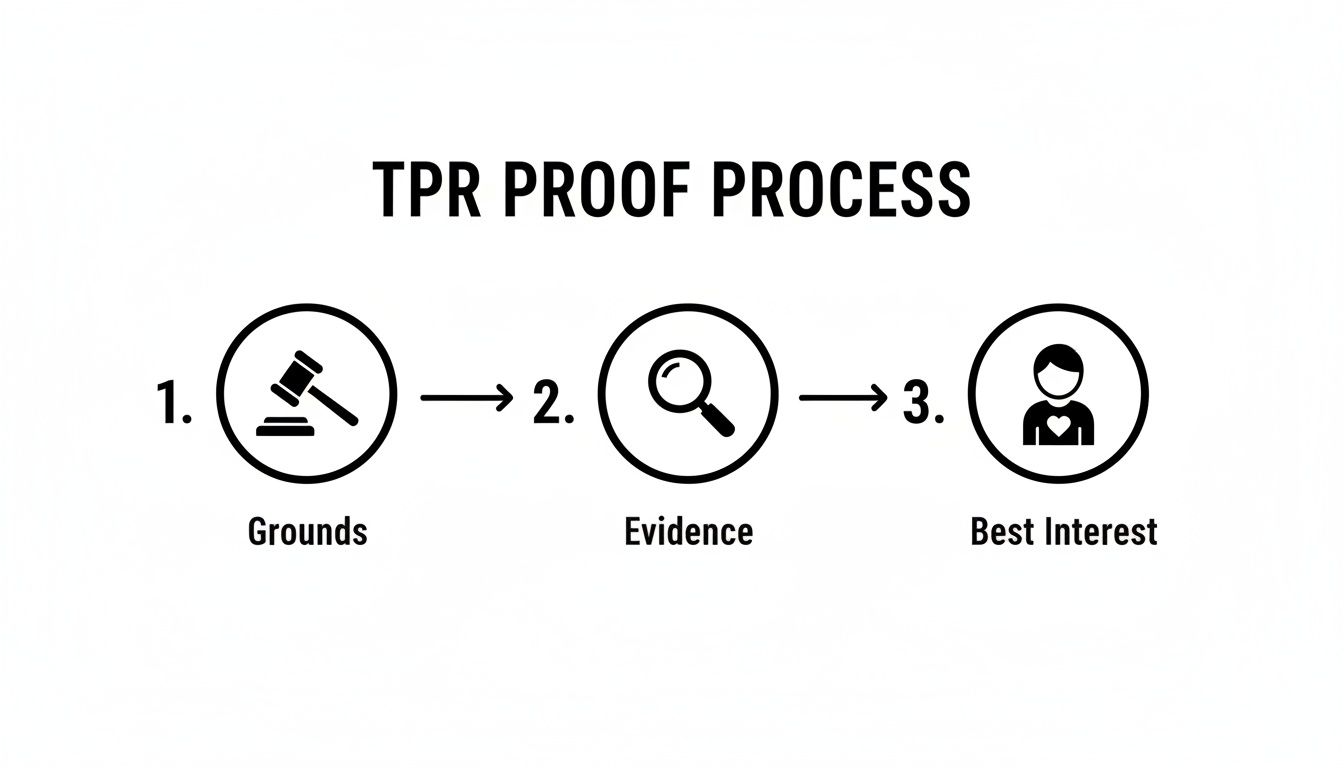
As you can see, you can’t win with just one or two of these. Your attorney must present a compelling argument for all three.
Step 3: Mediation and Final Hearing
Before you ever see a courtroom for a trial, most Harris County family court judges will require you to attend mediation. Here, you and the other parent will sit down with a neutral mediator who helps facilitate a conversation to see if a settlement is possible. Even in a high-conflict case like this, mediation sometimes leads to an agreed resolution, saving everyone the emotional and financial cost of a trial.
If mediation doesn’t resolve the case, the final step is the final hearing, or trial. This is where both sides present their evidence, call witnesses, and make their arguments directly to the judge. All the preparation, discovery, and strategy come to a head in the courtroom. Knowing how to prepare for a custody hearing is a huge advantage, as the skills needed to present a clear, persuasive case are very similar.
After hearing from both sides, the judge will weigh the evidence and make a final, legally-binding decision that will change your family’s future forever.
How Texas Child Welfare Reforms Could Impact Your Case
If you're a parent in Atascocita or Humble facing a potential termination of your rights, you need to know that the ground is shifting beneath your feet—and in a good way. The entire child welfare system in Texas has been undergoing a quiet revolution, moving away from a "remove first, ask questions later" mentality.
For years, the default response was often to separate families. But recent reforms and critical court decisions are pushing the system in a new direction. The new focus? Keeping families safely together whenever possible. This isn't just a policy tweak; it's a fundamental change in philosophy that could make all the difference in your case.
A New Focus on Family Preservation
The Texas Department of Family and Protective Services (DFPS), and the family court judges who hear these cases, are now strongly encouraged to exhaust every other option before taking the drastic step of termination. This means actively looking for creative, safe solutions that fix the underlying problems without severing the parent-child bond.
This approach comes from a growing understanding that yanking a child from their home, even a troubled one, creates its own deep trauma. The goal now is to give parents the resources and support they need to build a safe, stable home for their kids.
What does this mean in a real-world Harris County courtroom? A judge is now more likely to consider alternatives to termination. They might order specific services, create a safety plan with a grandparent living in Atascocita, or modify custody orders—as long as the child's immediate safety is secured.
The Numbers Tell the Real Story
This isn't just hopeful talk; the data is stunning. Texas has managed to dramatically reduce the number of children being pulled from their homes.
Consider this: In just six years, Texas has slashed the number of children removed by DFPS by an incredible 55%. The numbers dropped from 20,685 kids in 2018 to just 9,220 in 2024. At the same time, child fatalities from abuse and neglect fell by 53%, and the state's foster care population shrank by 47%.
These figures, highlighted in a detailed analysis of the reforms, prove that Texas can protect vulnerable children without reflexively breaking families apart. If you want to dig deeper into this transformation, you can read the full analysis on the child welfare revolution in Texas.
These aren't just statistics. They represent thousands of real families in communities like Humble and Atascocita who were given a chance to heal and stay whole.

What This Shift Means for You in a Harris County Courtroom
For any parent fighting a case about terminating parental rights in Texas, this evolving legal landscape is a game-changer. It means that judges in Harris County are often more willing to listen to arguments centered on rehabilitation, personal growth, and reunification.
An experienced local attorney who understands this systemic shift can build a powerful case that highlights your commitment to being the parent your child needs. This strategy might involve:
- Showing Proactive Effort: Presenting proof that you've already enrolled in counseling, parenting classes, or a substance abuse program without being forced to.
- Highlighting Your Support System: Bringing in testimony from family members and friends in our Atascocita community who can help you provide a stable home.
- Pushing for Alternatives: Instead of just defending against termination, we can proactively argue for less permanent solutions, like a temporary custody modification or a monitored return-to-home plan.
Knowing the bigger picture is vital. The courts are increasingly looking for reasons to support families, not tear them apart. With the right legal strategy, this cultural change within the system can open up a pathway to protect your rights and your family's future.
Defending Your Parental Rights and Finding Alternatives

Getting served with a petition to terminate your parental rights can make your world stop. It's a terrifying moment, but it's crucial to remember this: a petition is just the start of a legal battle, not the end. You absolutely have the right to fight back, to challenge every claim, and to show the court why keeping your family together is what’s truly best for your child.
The legal system gives you a voice. With a smart, strategic defense, you can push back against the claims being made. It all starts with putting the other side's case under a microscope.
The person or agency trying to terminate your rights has a very high mountain to climb. They must prove their case with "clear and convincing evidence"—a much tougher standard than in most civil cases. Your attorney's job is to poke holes in their arguments, question the credibility of their witnesses, and introduce evidence that tells a completely different story.
Building a Proactive Defense
Playing defense isn't enough; you have to go on offense. The most powerful way to fight back is to show the court, through your actions, that you are a dedicated parent who has made real, tangible changes. It’s about proving you’ve created a safe and nurturing home for your child right here in the Atascocita or Humble area.
Here are some concrete steps that can make a huge difference:
- Complete All Court-Ordered Services: If a judge or DFPS has required you to take parenting classes, anger management, or a substance abuse program, finishing them is non-negotiable. Get certificates, keep records, and document your progress every step of the way.
- Show Stability: Nothing speaks louder than having a steady job and a safe place to live. Prove to the court you can provide for your child. Keep pay stubs from your Humble-area employer and proof of your stable housing.
- Nurture Your Relationship: Use every opportunity the court gives you to be a positive force in your child's life. Be on time for every visit, show love and support, and stay actively involved.
A Harris County judge isn't just looking at mistakes you may have made in the past. They are looking at your actions today to decide what your child's future will look like. A consistent pattern of responsible behavior is your best argument.
Exploring Alternatives to Termination
Sometimes the best defense is proposing a better solution. Texas law has shifted to strongly favor preserving families whenever possible. This means judges are often open to alternatives that keep a child safe without taking the drastic, permanent step of termination.
One of the most powerful alternatives is a managed conservatorship. This arrangement allows a trusted relative—often a grandparent in Atascocita or a close family friend in Humble—to temporarily care for the child while you get back on your feet. It keeps your child in a stable environment with family, but it doesn't sever your legal ties. You remain the parent, and the door to reunification stays wide open. To propose this effectively, understanding the details of conservatorship in Texas is critical.
Defending your parental rights is an uphill battle that requires a proactive, strategic, and deeply personal approach. By challenging the evidence, showing your commitment through action, and presenting constructive alternatives, you give yourself the best possible chance to protect your family’s future. If you’re facing this fight, don't go it alone. We're here to help you build the strongest defense possible.
How an Atascocita Attorney Can Protect Your Family
Facing a legal fight over your child's future feels incredibly lonely, but you don't have to walk this path by yourself. For families in the Atascocita and Humble areas, having a local attorney who knows the ins and outs of the Harris County court system isn't just a benefit—it's absolutely critical for protecting your rights and your family.
A seasoned family law attorney does so much more than file paperwork. Think of us as your shield and your advocate. We handle the relentless communications with DFPS or the other side's lawyer, which can be exhausting and intimidating. We meticulously build your case, piece by piece, gathering the "clear and convincing evidence" Texas law demands—everything from witness statements to text messages and financial records. Our job is to tell your story in a way that the judge will truly hear and understand.
Strategic Guidance and Compassionate Support
We get it. The idea of terminating parental rights in Texas is a deeply emotional and personal ordeal. Our commitment is to offer you not just sharp legal representation but also steady, compassionate support through it all. When we work with clients, we make sure every conversation is protected. It's crucial to use platforms designed for confidential discussions, like those that offer secure virtual consultations for legal professionals.
An attorney provides objective support that you can count on, including:
- Evidence Collection: We'll methodically gather every document, interview key witnesses, and prepare you so you know exactly what to expect in court.
- Strategic Defense: We'll build a proactive defense against termination or craft a powerful argument explaining why termination is (or is not) in your child's best interest.
- Courtroom Advocacy: We will stand up for you and powerfully present your case at every single stage, from early hearings and mediation all the way to the final trial.
The stakes in these cases are simply too high to go it alone. If you're facing this challenge, please don't wait. The Law Office of Bryan Fagan offers free, confidential consultations at our Atascocita office. Let's sit down, discuss your situation, and explain how we can fight for the best possible outcome for you and your child.
Answering Your Questions About Terminating Parental Rights
If you're reading this, you’re likely facing one of the most difficult situations a family can endure. The idea of terminating parental rights brings up a whirlwind of questions and emotions. Let's walk through some of the most common concerns we hear from families right here in Atascocita and Humble.
Once a Judge Terminates Rights, Can They Ever Be Given Back?
This is often the first and most pressing question, and the answer is critical. In Texas, a court order that terminates parental rights is permanent and final. There is no "undo" button.
Think of it as the legal equivalent of a closed door that cannot be reopened. The finality is precisely why the law sets such a high bar and why judges only consider this step when no other option will protect the child.
The only sliver of an exception is if you can prove the order was granted because of fraud or a major legal mistake, but that’s an incredibly rare and uphill battle. For all intents and purposes, you have to operate as if the decision is forever.
How Long Does This Whole Process Take?
The timeline really depends on whether everyone is on the same page. If a parent is voluntarily giving up their rights, say, in a stepparent adoption where everyone agrees, the process can move relatively quickly—sometimes wrapping up in a few months.
It’s a completely different story for a contested, involuntary termination. These cases are complex legal battles that require a lot of investigation, gathering evidence, and multiple court dates. In the Harris County courts, it's not unusual for these cases to take a year or even longer to reach a final resolution.
The court’s one and only focus is the child's safety and well-being. The timeline will stretch as long as it needs to for the judge to be absolutely certain they have all the facts to make the right decision for the child's future.
Does Terminating Parental Rights Get Rid of Child Support Payments?
Yes, for future payments. When a judge signs a termination order, it severs all legal ties and responsibilities, including the duty to pay any future child support.
But here’s a key point many people miss: the order does not wipe out any past-due child support. Any amount that was owed before the termination order was signed (called "arrears") is still a legally enforceable debt that must be paid.
The legal landscape around these issues is also shifting. While Texas has historically been quick to file for termination to meet federal guidelines, the focus is increasingly on family reunification when possible. In fact, the number of children in foster care has dropped by 47%. You can review recent DFPS performance data on the child welfare system to see these trends for yourself. This evolving system makes having an experienced attorney who understands the nuances more critical than ever.
At The Law Office of Bryan Fagan – Atascocita TX Lawyers, we know how heavy these cases weigh on a family. We're here to offer our neighbors clear, compassionate, and expert legal guidance. If you're navigating this tough road, reach out to our Atascocita office for a free, completely confidential consultation to understand your options and protect your family's future. Visit us at https://www.atascocitaattorneys.com.