When you're planning a future with someone in Atascocita or Humble, the big conversations usually revolve around wedding venues and honeymoon spots. But the truly important talks, the ones that build a solid foundation, are often about finances. So, what is a prenuptial agreement, really?
Think of it less as a legal document and more as a financial blueprint for your marriage. It's a contract you and your partner create before you get married to lay out, in clear terms, how you'll handle property, assets, and even debts during your life together and if you ever part ways. It's a practical step for couples in our community to ensure they start their life together with clarity and mutual understanding.
A Practical Guide to Prenuptial Agreements in Texas

For couples all over northeast Harris County, a prenuptial agreement—often just called a "prenup"—is becoming a smart, proactive planning tool. It's not about planning for divorce; it’s about fostering open communication and mutual respect from the very beginning, much like you would with an estate plan to protect your family down the road.
At its core, a prenup is a specific type of legal agreement, similar to other personal family contracts. It simply allows you and your partner to set your own financial ground rules, giving you both clarity and security as you start your new chapter together here in the Atascocita area.
The Growing Importance of Prenups
Once considered something only for the ultra-wealthy, prenups have gone mainstream. They're especially popular with younger couples who are often getting married later, bringing their own careers, businesses, and assets into the relationship. In fact, a recent Harris Poll found that 15% of married or engaged Americans have signed a prenup. That's a huge leap from just 3% back in 2010.
This trend isn't about pessimism. It's about realism and a shared desire for financial transparency before saying "I do."
Here in Texas, a community property state, a prenup is especially powerful. Without one, the law generally assumes that most assets and debts you acquire during the marriage belong to both of you. In a divorce, a judge is tasked with dividing that property in a "just and right" manner.
A prenuptial agreement gives you and your partner the power to decide these matters for yourselves, rather than leaving them to a judge who doesn't know you or your unique circumstances.
Why Texas Law Makes Prenups So Valuable
The default rules in our state can lead to complicated outcomes. Let's say you own a small business in Humble or have a rental property over in Kingwood before you get married. A prenup is the tool that ensures those assets remain yours, no matter what happens.
It provides a step-by-step framework for:
- Defining Separate Property: You can explicitly list which assets—like an inheritance you expect or the home you already own in Atascocita—will not be considered part of the marital estate.
- Managing Debts: It clarifies who is responsible for debts each of you brings into the marriage, such as student loans or old credit card balances.
- Protecting Family Assets: A prenup can make sure a family business or property that's been passed down through generations stays within the family.
By tackling these conversations head-on, couples in Atascocita can build a stronger, more honest foundation for their marriage. It’s a practical step for anyone wanting to secure their financial future.
Why a Prenup is Smarter Than You Think for Harris County Couples
Let's be honest, the word "prenup" used to have a certain stigma. It conjured up images of billionaires and celebrity drama, something totally removed from the lives of everyday couples building a future in places like Atascocita, Humble, or Kingwood. But that perception is changing, and fast.
Today, a prenuptial agreement isn't about planning for failure; it's about planning for success. Think of it as a financial roadmap for your marriage—a way for you and your partner to get on the same page about money before you walk down the aisle. It's an act of mutual respect, sparking the kind of open, honest conversations that are the bedrock of any strong partnership.
Real-Life Reasons People Get Prenups
For most folks in northeast Harris County, the decision isn't about vast fortunes. It's about protecting tangible, important parts of their lives and bringing clarity to real-world financial situations.
Here are a few common, step-by-step scenarios we see all the time:
- You're a Small Business Owner: Maybe you've poured your heart and soul into a local shop in Atascocita or a growing contracting business. A prenup ensures your company remains your separate property, protecting your livelihood and your employees.
- A Family Inheritance is Involved: If you've received or expect to receive an inheritance, an agreement can make it crystal clear that those assets—whether it’s the family home in Humble or a financial legacy—are intended to stay within your family line.
- One of You Has Significant Debt: It's incredibly common to enter a marriage with student loans or credit card debt. A prenup can define who is responsible for those pre-existing obligations, preventing them from automatically becoming a shared marital burden.
- This Isn't Your First Rodeo: For those entering a second marriage, especially when there are kids from a previous relationship, a prenup is an essential tool. It allows you to protect assets you’ve specifically set aside for your children.
These aren't just hypotheticals; they are the realities for thousands of couples in our community. A thoughtfully drafted prenup provides incredible peace of mind by simply setting expectations from the start.
Building Your Marriage on a Solid Financial Footing
Viewing a prenup as a sign of doubt is missing the point entirely. It's actually a sign of incredible maturity. You're working together to establish the financial rules of your partnership while you're in a great place—cooperative, aligned, and deeply in love.
One of the most powerful things a prenup can do is provide security for a spouse who plans to make career sacrifices for the family. If one of you intends to leave a job to raise children, the agreement can outline specific financial protections, ensuring their immense non-monetary contributions are recognized and valued.
A prenup transforms a legal document into a tool for building trust. By openly discussing finances and creating a shared plan, you're aligning your goals for the future you'll build together.
This shift in thinking isn't just anecdotal. A growing number of divorcees regret not having one—statistics show that around 15% of recently divorced Americans wish they had signed a prenup. This has created a surge in demand, with over 50% of lawyers reporting more and more couples requesting them, particularly those marrying later in life with their own assets and debts.
In a community property state like Texas, this kind of proactive planning is especially smart. You can learn more about the growing acceptance of prenuptial agreements and see for yourself why the trend is catching on.
Ultimately, deciding on a prenuptial agreement is a deeply personal choice based on your unique circumstances. For modern couples right here in our community, it has become a smart, sensible, and even loving way to protect each other and start a marriage with absolute clarity.
If you're wondering what a prenup could look like for you and your partner, the best first step is a simple conversation. The team at The Law Office of Bryan Fagan is here to answer your questions in a supportive, confidential setting. Schedule your free consultation with our Atascocita office today to learn more.
What A Texas Prenup Can and Cannot Do
A prenuptial agreement is essentially a financial roadmap for your marriage. It’s a powerful document, but it's not a magic wand. Knowing exactly what you can include—and what you can't—is the key to creating a prenup that actually holds up in a Texas court. Think of it as setting the ground rules for your financial life together, custom-fit to your specific situation.
For couples here in Atascocita and the surrounding Humble area, getting this right from the start provides incredible peace of mind. Let's break down the practical powers and legal limits of a Texas prenup in plain English.
Defining "Yours, Mine, and Ours" Before You Say "I Do"
At its core, a Texas prenup allows you and your partner to step outside of the state’s default community property laws. Instead of letting a judge decide how your assets are split years down the road, you make those decisions yourselves, ahead of time.
This chart highlights the most common reasons couples decide they need this level of financial clarity.
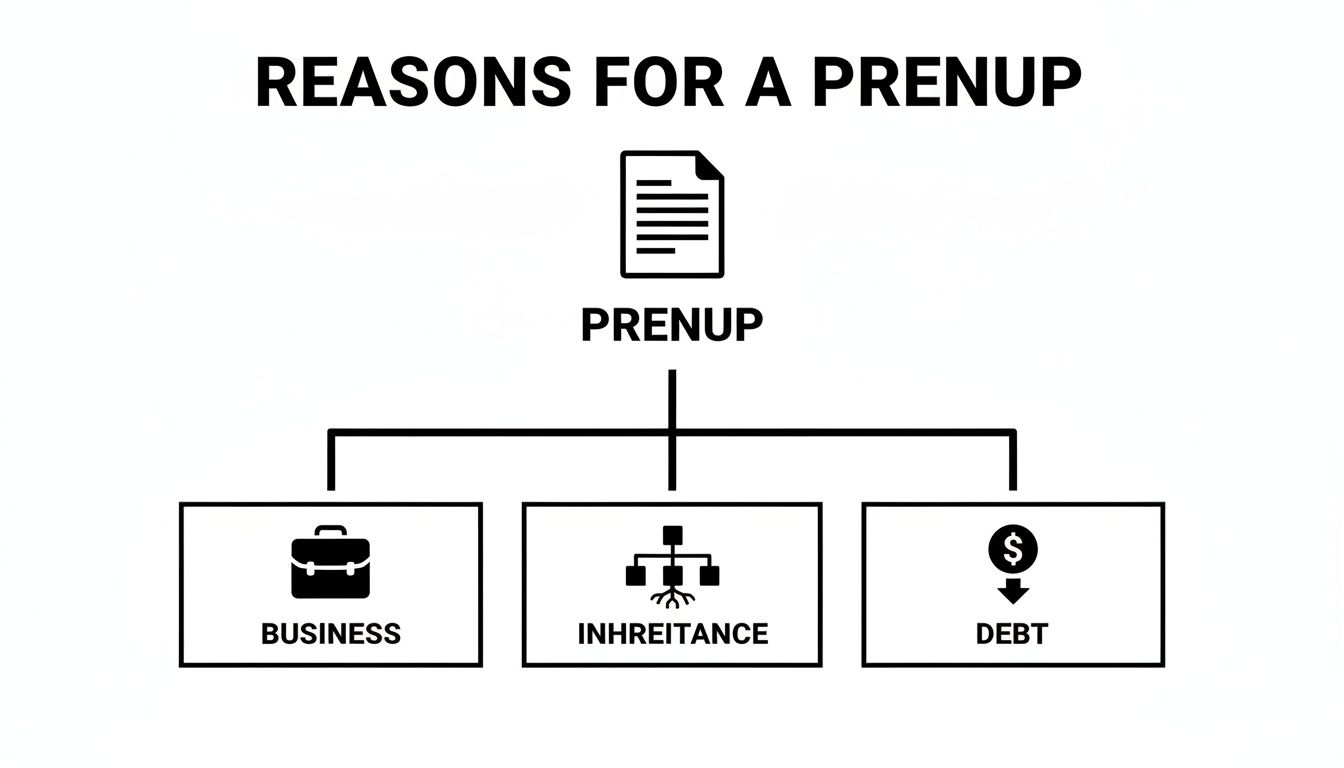
As you can see, the major drivers are usually protecting a business, keeping a family inheritance separate, or making sure one partner’s old debts don’t become a shared problem.
Here’s a look at what you can specifically control with a prenup:
- Separate vs. Community Property: You get to explicitly name which assets will remain separate property. For example, if you own a rental house in Kingwood before getting married, your prenup can state that the house, its equity, and any income it generates will always be yours alone.
- Management of Property: The agreement can spell out who gets to manage, control, buy, or sell certain assets during the marriage.
- Responsibility for Debts: You can make it crystal clear that pre-marriage debts—like student loans or a hefty car note—stay with the person who incurred them. This protects the other spouse from taking on financial baggage that isn't theirs.
- Spousal Support (Alimony): A prenup can pre-determine the terms of spousal support. You can agree to limit the amount or duration, or even waive it completely, which removes a major point of contention in a potential divorce.
- Business Protections: If you're a business owner in Harris County, a prenup is non-negotiable. It can prevent your spouse from claiming an ownership stake in your company, which could otherwise be treated as a community asset up for grabs. To learn more about this, check out our guide on how to protect assets during divorce.
A prenup gives you the power to write your own financial rules for your marriage. It replaces the state’s “one-size-fits-all” approach with a plan that truly reflects your unique life and circumstances.
To illustrate just how much a prenup can alter the financial landscape of a marriage, let's compare the default Texas rules with what you can customize.
Asset Division in Texas With vs. Without a Prenup
| Asset Type | Default Texas Community Property Rule (Without a Prenup) | How a Prenup Can Change It |
|---|---|---|
| Pre-Marital Home | The home itself remains separate, but any increase in value paid for with community funds (like mortgage payments from a joint account) can be subject to division. | Can designate the home and all its appreciation as the sole and separate property of the original owner, regardless of how the mortgage is paid. |
| Business Owned Before Marriage | The business itself is separate property, but its growth, profits, and increased value during the marriage are often considered community property. | Can state that the business, including all future growth and income, remains the owner's separate property, protecting it entirely. |
| Inheritance Received During Marriage | An inheritance is typically considered separate property, but if it gets commingled (e.g., deposited into a joint bank account), it can lose its separate character. | Can explicitly state that any inheritance received by either spouse will remain their separate property, even if accidentally commingled. |
| Retirement Accounts | Contributions and growth in a 401(k) or IRA during the marriage are community property and will be split upon divorce. | Can specify that each spouse’s retirement account remains their own separate property, protecting their individual nest eggs. |
| Income Earned During Marriage | All income, salaries, and wages earned by either spouse during the marriage are considered community property, subject to a 50/50 split. | Can define how income is treated—for instance, keeping it as separate property or designating a certain portion as community funds. |
This table shows the clear advantage of proactive planning. A prenup allows for precision where the law provides a broad, and often undesirable, default.
Understanding the Legal Boundaries
Now, for the flip side. Just as important as knowing what a prenup can do is knowing what it cannot. Texas law draws some very firm lines in the sand to protect fundamental rights, especially when children are involved.
A Texas prenup cannot:
- Determine Child Custody or Visitation: You simply cannot use a prenup to decide who gets the kids. A judge will always make custody decisions based on the child's best interests at the time of a separation, not based on a document signed years earlier.
- Waive or Limit Child Support: This is a big one. Child support is considered the right of the child, not the parents. It's against public policy to try and use a prenup to get out of future child support obligations.
- Include Unconscionable or Illegal Provisions: The agreement can't be shockingly unfair to one person, nor can it encourage illegal acts. A judge will throw out any clause they find to be "unconscionable."
- Violate Public Policy: A prenup can't include terms that actively promote or encourage divorce, or that go against public morals.
Sticking to these legal boundaries is what makes your agreement enforceable. By focusing your prenup on what it was designed for—clarifying financial rights and expectations—you and your partner can build a document that delivers real security and lets you enter your marriage with confidence.
How to Create a Legally Binding Texas Prenup
A prenup is more than just a piece of paper; it’s a legal contract. And like any contract, it’s only worth something if it can hold up in court. If you don't build it on a solid legal foundation, a Texas judge could toss it out, leaving you exactly where you started. For couples here in Atascocita, Humble, and across northeast Harris County, getting the legal requirements right is everything.

Crafting a valid Texas prenup isn’t just a matter of listing out your assets. It’s about following a specific legal process designed to make sure the agreement is fair, transparent, and willingly signed by both of you. Think of these rules as the pillars holding up your agreement—if one is weak, the whole thing can come crashing down.
The Non-Negotiable Rules for a Valid Texas Prenup
The Texas Family Code is crystal clear on what it takes to make a prenuptial agreement stick. The list isn't long, but every single item is non-negotiable. Miss one, and you risk the entire agreement being voided later on.
To be enforceable, your prenup must meet these conditions:
- It Must Be in Writing: A handshake deal or a verbal promise means nothing in the eyes of the law. Your entire agreement has to be a formal, written document.
- It Must Be Signed by Both Parties: Both you and your future spouse have to sign on the dotted line, showing you both agree to the terms. This absolutely has to be done before the wedding.
- It Must Be Voluntary: This is a big one. A judge will not enforce a prenup if one person was pressured, threatened, or tricked into signing. The agreement must be entered into freely, without any duress or what’s known as coercion in contract law.
- It Must Include Fair Financial Disclosure: Transparency is key. Both of you must lay all your financial cards on the table—assets, debts, everything. Trying to hide an investment account or downplay the value of a business is one of the fastest ways to get a prenup thrown out.
These requirements are all about ensuring that both people walk into the agreement with their eyes wide open, making a fully informed choice.
A valid prenup is a product of transparency and free will. The court's primary concern is ensuring that the process was fair and that both partners entered the agreement with a clear understanding of what they were signing.
Common Mistakes That Can Invalidate Your Agreement
Even couples with the best of intentions can stumble into pitfalls that put their prenup at risk. Knowing what these common mistakes are is the best way to steer clear of them.
One of the most common errors? Bad timing. Handing your partner a prenup the week of the wedding is a recipe for disaster. It creates a high-pressure situation, and a judge could easily view that as a form of coercion, making them question if the signature was truly voluntary.
Another major red flag is not having separate lawyers. While Texas law doesn’t explicitly require it, a court is far more likely to uphold an agreement where both partners had their own independent legal counsel. This proves that each person understood their rights and the full weight of what they were signing. Having one lawyer for both of you is a huge conflict of interest and a serious misstep.
By understanding these essential rules and common blunders, you can approach the prenup process with confidence. The smartest move you can make is to work with an experienced Atascocita family law attorney who knows the Texas Family Code inside and out. It’s the surest way to protect your future with an agreement that is fair, valid, and built to last.
Navigating the Prenup Process with Your Attorney
Thinking about a prenuptial agreement can feel overwhelming, but it's really just a series of clear, manageable steps. At The Law Office of Bryan Fagan – Atascocita TX Lawyers, we've walked countless couples from Atascocita and Humble through this exact journey. Our goal is to take something that seems intimidating and make it a straightforward process that brings you both financial peace of mind.
The whole thing is designed to encourage open conversation, ensuring you both feel secure and respected. It’s a team effort, from the very first chat to the final signature. Here is our step-by-step guidance for clients.
Step 1: The Initial Consultation
It all starts with a confidential, no-pressure conversation with one of our attorneys. This isn't about throwing legal jargon at you; it's about understanding your goals. We’ll listen to your unique circumstances, what you hope to accomplish with a prenup, and answer every question you have about how it can be shaped for your future. We want our Atascocita neighbors to feel understood and supported from the very first call.
Step 2: Full Financial Disclosure
Honesty is the bedrock of a strong marriage—and a legally sound prenup. The next step is for you and your partner to openly share all your financial information with each other. This means making a complete list of everything you own (assets), everything you owe (debts), and your income.
This step is absolutely critical for a valid agreement in Texas. It makes sure you're both making decisions with a full deck of cards, which prevents nasty surprises later on.
Step 3: Drafting the Agreement
Once we have a clear picture of your finances and what you've agreed upon, your attorney gets to work. We'll carefully craft each clause, turning your conversations and goals into a formal legal document that covers property, debts, and other financial matters.
This draft is the blueprint for your financial partnership. It’s a personalized document, not a generic template, designed to protect the unique interests of you and your future spouse.
We pay close attention to the details, making sure the language is crystal clear and every term lines up with Texas law. This creates a solid document built to last.
Step 4: Independent Review and Negotiation
This is a crucial step that ensures the whole process is fair. Your partner will need to take the draft we've created to their own independent attorney for review. This is so important because it gives them their own advocate, someone whose only job is to look out for their interests and make sure they understand exactly what the agreement means for them.
Their lawyer might suggest some changes, which kicks off a short negotiation phase. Don't worry—this back-and-forth is a normal and healthy part of the process. The aim is always to land on a final agreement that both of you genuinely feel is fair. This part of the process shows why having a trusted legal advisor is so important, much like when you're deciding on how to choose an estate planning attorney for other important life decisions.
Step 5: Finalizing and Signing the Prenup
Once all the terms have been ironed out and both attorneys have given the green light, it's time to make it official. The signing needs to happen well before your wedding day—this is key to avoiding any claim that someone was pressured or forced into it.
After it’s signed, your prenuptial agreement becomes a legally binding contract. It provides a solid financial foundation for your marriage, giving you a shared sense of clarity and understanding as you start your new life together. It's a smart investment that can save you from incredible emotional and financial stress down the road.
Clearing the Air: Common Prenup Myths Debunked
Let's be honest—misconceptions can stop couples in Atascocita from having a crucial, healthy conversation about their future. A prenuptial agreement is, at its core, a financial planning tool. But a few stubborn myths can make bringing it up feel like you're walking on eggshells. It's time to separate fact from fiction.
Think of it this way: this isn't about planning for failure. It's about building a secure future together on a foundation of total honesty and mutual respect.
Myth 1: Asking for a Prenup Means You Expect to Get Divorced
This is probably the most common and damaging myth out there, and it’s just plain wrong. Suggesting a prenup isn't a vote of no confidence in your relationship. It’s actually a sign of incredible maturity and proactive planning—the same kind of practical thinking that goes into buying life insurance or creating a will.
You don't get car insurance because you plan to get in a wreck on the Sam Houston Tollway, right? You get it for peace of mind, just in case. A prenup works the exact same way. It's a safeguard you hope you'll never need, but one that provides a huge sense of security for both of you.
Myth 2: Prenups Are Only for the Super-Rich
This idea is seriously outdated. While it's true that the wealthy use them, prenups have become an essential tool for everyday couples all over northeast Harris County. These days, it's normal for people to come into a marriage with their own assets, a small business, a growing retirement account, or even significant student debt.
Think about these real-world scenarios:
- You want to protect the house you bought in Humble before the wedding.
- You need to make sure a family inheritance passes to your kids, not a future ex-spouse.
- You want to keep your partner from being saddled with your pre-existing student loans if something goes wrong.
These aren't millionaire problems. They are practical financial issues that modern couples face right here in our community.
Myth 3: A Prenup Is Always Unfair to One Person
A properly drafted Texas prenup should be the exact opposite of unfair. It's designed to be a balanced document that protects both partners. In fact, if an agreement is wildly one-sided or "unconscionable," a judge can throw it right out. The whole process is built on transparency, requiring full financial disclosure and encouraging each person to have their own independent lawyer to ensure no one is taken advantage of.
A well-crafted prenup is an exercise in fairness. It empowers a couple to define their financial terms together, making sure both people feel secure and respected as they start their life as a married couple.
The cultural tide is definitely turning on this. What was once a taboo topic is now seen by many as a smart planning step. Younger generations, in particular, are viewing these agreements much more positively. A recent survey showed that overall support for prenups has reached 50%, with millennials and Gen Z showing even higher approval. This tells us that more and more people understand that financial transparency is a cornerstone of a strong partnership. You can dig into more data about the rising popularity of prenuptial agreements to see just how much things have changed.
Common Questions We Hear About Texas Prenups
When you start talking about a prenuptial agreement, it’s only natural for a lot of questions to pop up. For couples here in Atascocita, Humble, and our neighboring communities, getting solid answers is the first step toward feeling confident about the future you're building together.
Let’s walk through some of the most common questions we get at our firm. Our goal is to give you straightforward, real-world information in plain English about how these agreements actually work here in Texas.
Can We Use a Prenup to Decide Child Custody or Support?
This is probably one of the most frequent questions we're asked, and the answer is a hard no. In Texas, anything and everything related to your children—custody (which we call conservatorship), visitation, and child support—is decided based on what's in the child’s best interest at that moment.
You simply cannot sign away or pre-determine those rights in a prenup. A Texas judge will always have the final say to protect the child's well-being, and that responsibility can't be contracted away by parents years before a situation even arises.
What if We Move Out of Texas Someday?
Life can take you anywhere. A great job offer or the need to be closer to family might mean moving from Atascocita to another state down the road. The good news is that a prenup properly drafted and signed under Texas law is generally respected in other states.
This principle is rooted in the Full Faith and Credit Clause of the U.S. Constitution, which basically means states have to honor the legal proceedings of other states. That said, it's always a wise move to have an attorney in your new state give your prenup a quick review to make sure it aligns with local laws and remains as solid as the day you signed it.
Can We Change Our Minds and Update the Prenup After We're Married?
Absolutely. A prenup isn't carved in stone. If circumstances change or you both decide you want to do things differently, you can amend (change) or even revoke (cancel) your agreement after you're married.
To make any changes, you’ll need a new written agreement that both of you sign. This is often called a postnuptial agreement. It has its own legal hurdles to clear to be enforceable, so it's critical to work with an attorney to make sure your modifications are legally binding.
What's the Cost for a Prenup in the Atascocita Area?
The cost really depends on how complex your finances are and how much back-and-forth is needed to get everything just right. It’s an investment, for sure. But that investment is a fraction of the emotional and financial cost that can come with a messy, contested divorce.
We always encourage clients to see it as a one-time cost for long-term clarity and peace of mind. It’s about starting your marriage on a foundation of open communication and mutual respect.
Every couple's story is different, and you deserve advice that fits your unique situation. If you have more questions about what a prenuptial agreement is or how it could work for you and your partner, our team at The Law Office of Bryan Fagan – Atascocita TX Lawyers is ready to listen. We are proud to serve the residents of Atascocita, Humble, and northeast Harris County, providing compassionate and knowledgeable guidance. Schedule a free, confidential consultation at our Atascocita office today and let's talk about how we can help you build a secure future.