 Skip to content
When a loved one passes away, the key difference between an executor and an administrator comes down to one simple thing: an executor is personally chosen by the deceased and named in their will, while an administrator is appointed by a court when there is no will. This single distinction dictates who gets the legal authority to wrap up someone's final affairs here in Texas.
Your Will Determines Who Manages Your Estate
Dealing with the loss of a family member is tough enough on its own. For folks in Atascocita, Humble, and across Harris County, understanding the legal roles involved can prevent a lot of headaches and family arguments down the road. The whole executor vs. administrator question hinges on whether your loved one left a valid will.
Think of a will as your voice after you're gone. It’s your chance to name a trusted person—the executor—to make sure your final wishes are followed. If you don't have one, the Harris County probate court has no choice but to step in and appoint someone—an administrator—who must follow a strict, one-size-fits-all rulebook set by state law. At The Law Office of Bryan Fagan, we want our neighbors in the Atascocita community to feel supported and informed, not overwhelmed by legal jargon.
Executor vs Administrator Key Differences at a Glance
So, what are the practical differences for a family in our area? This table breaks down the main distinctions you'll encounter in the Texas probate system.
| Attribute | Executor | Administrator |
|---|---|---|
| How They Are Selected | Personally named by the deceased in a valid will. | Appointed by a Texas probate court based on legal priority. |
| Source of Authority | The will, once validated ("probated") by the court. | A court order, guided by the Texas Estates Code. |
| Primary Loyalty | To carry out the specific instructions in the will. | To follow Texas intestacy laws for asset distribution. |
| Flexibility | Often has more flexibility ("independent administration"). | Usually has limited powers and requires court supervision. |
It's a surprising fact, but nationwide, about 60% of adults don't have a will. This often leads to court-appointed administrators and can cause significant delays. When there's no will, Texas intestate estates have to follow a rigid line of succession, a process we can help your family navigate.
No matter what they're called, both executors and administrators are responsible for the crucial duties involved in comprehensive Estate Management, which is the formal process of overseeing and distributing a person's assets after they've passed away.
How Each Role Is Appointed: Will vs. Court
The biggest distinction between an executor and an administrator comes down to how they get the job. One path is paved by proactive planning, giving families in Atascocita peace of mind. The other is a rigid court process that takes over when no plan was left behind.
Ultimately, the presence of a valid will is the fork in the road. It dictates who manages an estate and under what set of rules.
Naming an Executor Through a Will
The only way to handpick an executor is by creating a valid Texas will. It’s a deliberate choice where you, not a judge, decide who is best suited to handle your affairs.
When you work with an estate planning attorney in Atascocita, you can name your primary executor and even list a backup or two. This creates a clear line of succession, so there’s no guesswork if your first choice can’t serve.
After you pass away, the person you named takes the will to the Harris County probate court. A judge reviews it to confirm it’s legally sound. Once the will is admitted to probate, the court issues a document called Letters Testamentary. This piece of paper is what officially empowers your chosen executor to act on behalf of your estate, giving legal teeth to the choice you made.
This flowchart shows the simple decision point that determines whether an estate gets an executor or an administrator.
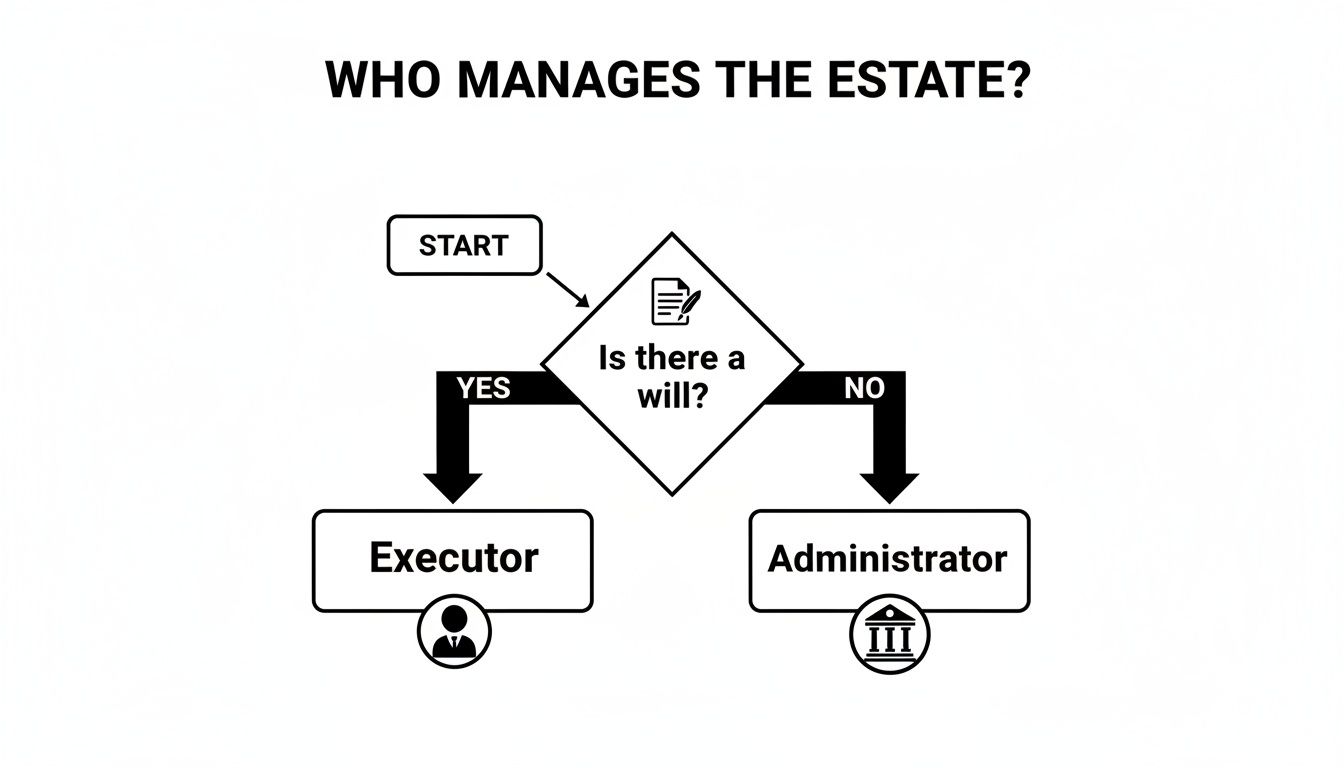
As you can see, a will leads straight to an executor you chose yourself. No will means the court is forced to step in and appoint an administrator.
Appointing an Administrator by Court Order
When someone dies without a will—what the law calls dying "intestate"—there's no chosen executor waiting in the wings. The family can't just pick someone to take over. Instead, the Texas probate court system has to appoint an administrator.
This is a reactive process that follows a strict legal hierarchy laid out in the Texas Estates Code. Typically, a close family member must file an application with the court to be considered.
By law, Texas courts must give preference to potential administrators in a specific order. This removes personal choice from the equation and substitutes a rigid, predetermined formula that doesn't account for your family's unique situation.
The court-mandated order of priority for appointing an administrator in Texas is:
- The surviving spouse. The spouse is always first in line.
- The principal beneficiary. If there’s no spouse, the person who stands to inherit the largest share of the estate is next.
- Any other beneficiary. After that, other heirs can apply for the role.
- The next of kin. If no beneficiaries are willing or able, the closest relative gets priority.
A Harris County judge holds a hearing to determine if the applicant is qualified and legally suitable. If everything checks out, the court issues Letters of Administration, the document granting the administrator legal authority. This court-driven process highlights the stark contrast: a will empowers your trusted choice, while intestacy leaves the decision entirely up to the legal system.
The difference isn't just procedural; it's about control and certainty. Planning ahead with a will allows you to place your estate in the hands of someone you trust. Failing to do so can create unnecessary stress and potential disputes as your loved ones navigate the court system to settle your affairs.
Comparing Duties and Authority in Harris County Probate
At first glance, an executor and an administrator seem to do the same job: settle a person’s estate. While that’s the shared goal, the source and scope of their authority couldn't be more different. For families here in Atascocita and Harris County, understanding this distinction is crucial because it directly shapes how fast, expensive, and stressful the probate process will be.
The simplest way to think about it is this: an executor gets their power from the will itself, while an administrator’s power comes straight from the Texas Estates Code and the probate court judge. This single difference sends the estate down one of two very different paths. An executor, carrying out the deceased's written wishes, can often act decisively. An administrator, however, is tethered to the court, needing permission for almost every step, which can stretch out the timeline and drive up costs.

The Freedom of an Independent Executor
Here in Texas, most well-written wills specifically create what’s called an “Independent Executor.” This is a huge advantage. This special status grants the executor the power to manage most estate business without running to a judge for a permission slip every time.
An Independent Executor has the authority to handle key tasks on their own, such as:
- Paying off the estate's debts and taxes.
- Selling property, like the family home in Humble, to cover expenses or to prepare for distribution.
- Gaining access to and managing financial accounts.
- Giving the remaining assets to the beneficiaries named in the will.
This autonomy makes a world of difference. Think about it: if an executor needs to sell a house to pay off final medical bills, they can just do it. They can list the home, accept a fair offer, and close the deal without getting bogged down in court hearings. This efficiency saves everyone involved—especially the beneficiaries—a great deal of time and money.
The Limitations of a Court-Supervised Administrator
An administrator simply doesn't have that kind of freedom. Because their authority is granted by the court, not a will, they operate under what's called a “dependent administration.” The name says it all—they are dependent on the court's supervision for almost every significant decision.
Before an administrator can sell a property, pay a large bill, or hand out any inheritance, they have to file a formal request with the Harris County probate court and wait for a judge to sign an order. This creates a frustrating, stop-and-go process that can add months, and sometimes years, to settling an estate.
The core difference is trust. A will is a declaration of trust in a chosen person, giving them the freedom to act independently. Without a will, the court has no choice but to step in with strict oversight to protect potential heirs, which results in a dependent administration.
Let's look at how this plays out in a real-world situation for a local family.
Scenario Comparison: Executor vs. Administrator
| Task | Independent Executor (with a Will) | Dependent Administrator (no Will) |
|---|---|---|
| Selling a Home in Atascocita | The executor can list the home, accept a fair market offer, and close the sale directly. They can act quickly to benefit the estate. | The administrator must file an application to sell, get an appraisal, notify all heirs, attend a court hearing, and get a judge’s signed order before they can even list the property. |
| Paying Final Bills | The executor can use estate funds to pay valid debts, like utility bills for a property in Kingwood, as they arise. | The administrator must formally present all creditor claims to the court for approval before they can write a check. This can delay closing the estate for months. |
| Distributing Inheritance | Once debts are paid, the executor follows the clear instructions in the will and distributes the assets directly to the beneficiaries. | The administrator must prepare a detailed final accounting, file it with the court, get a judge’s approval, and only then can they distribute assets according to rigid state intestacy laws. |
Ultimately, an executor's job is to follow the roadmap the deceased left for them. Their duties are laid out in the will, and while their power has limits—for example, it's critical to know Can an executor change a will?—they have a clear path forward. An administrator, in contrast, must navigate probate by constantly asking the court for directions, making for a much slower and more difficult journey.
If you find yourself in this situation and need help figuring out the next steps, our team can show you how to settle an estate as smoothly as possible.
Understanding Letters Testamentary and Letters of Administration
When a loved one passes away, you suddenly encounter a lot of unfamiliar legal terms. "Letters Testamentary" and "Letters of Administration" are two phrases that often cause confusion, but for families in Atascocita, Humble, and throughout Harris County, they are the practical keys to managing an estate.
Simply put, you can’t legally do anything without them. Both documents serve the same fundamental purpose: they are the official green light from a Harris County probate court, proving a specific person has the authority to settle the deceased's affairs. The only real difference between them is whether a valid will exists.

Letters Testamentary for Executors
When someone dies with a will and names an executor, that person must still get the court's approval. Once the judge validates the will, the court issues Letters Testamentary. This document is the executor’s official badge of authority.
With these letters in hand, the executor can finally get to work and carry out the instructions left in the will. This includes critical tasks like:
- Accessing the decedent’s bank accounts to pay bills.
- Selling property, like the family home in Atascocita.
- Speaking with creditors, mortgage companies, and other financial institutions.
Without this court order, banks and other entities won't grant access, leaving the estate's assets completely frozen.
Letters of Administration for Administrators
What happens if there's no will? This is legally known as dying "intestate," and in this situation, the court steps in to appoint an administrator. After this person is approved and officially appointed, the court issues Letters of Administration.
This document gives the administrator the same kind of power as an executor, but their playbook is different. Instead of following the deceased's wishes from a will, they must follow the strict inheritance rules set by Texas intestacy law.
The crucial takeaway is this: both documents are your official "permission slip" from the court. Letters Testamentary follow the instructions of a will, while Letters of Administration follow the instructions of Texas law.
This distinction can also create a timing difference. An executor’s authority technically begins at the moment of death, as granted by the will, which allows them to take immediate protective action for the estate. An administrator, however, has zero authority until the court formally issues those Letters of Administration.
Understanding which document you need is the first step in any probate matter. If you need help figuring out how to probate a will in Texas, our team can bring clarity to the process. Obtaining the correct letters is the most critical hurdle to clear when settling a loved one's final affairs.
The Risks of Dying Without a Will in Texas
When someone passes away in Texas without a will, it's known as dying “intestate.” This situation immediately takes all personal choice off the table. Instead of your wishes guiding what happens next, your entire legacy is handed over to a rigid, predetermined legal framework. For families here in Atascocita and Humble, this often results in outcomes the person never would have wanted, adding a layer of unnecessary stress and conflict to an already painful time.
Think of the state’s intestacy laws as a blunt, one-size-fits-all instrument. They don't have the capacity to understand your unique family dynamics, your close personal relationships, or your specific intentions. The court is forced to appoint an administrator who has no choice but to distribute your property according to a strict legal formula.
How Texas Divides Property Without a Will
The Texas Estates Code lays out a precise hierarchy for who gets what when there's no will. The distribution hinges entirely on which relatives survive you and whether your assets are classified as community property (anything acquired during your marriage) or separate property (assets you owned before marriage or received as a gift or inheritance).
This legal process can lead to some genuinely shocking and undesirable results:
- Married with children from that marriage: Your surviving spouse will inherit their half of the community property, but they only get a one-third life estate in your separate personal property. Your children inherit everything else. This could mean your spouse suddenly co-owns the family home with your children, creating a messy and complicated financial situation.
- Married with children from a different relationship: Your spouse keeps their half of the community property, but your children from the previous relationship inherit your entire half of the community property, plus two-thirds of your separate property. This can force your surviving spouse into co-ownership of assets they helped build and maintain with your children.
- Unmarried with children: Your children inherit your entire estate, split into equal shares. While that sounds simple enough, it completely ignores any specific needs, unique relationships, or verbal promises you may have made during your lifetime.
These formulas are ironclad and leave zero room for nuance. The court has no power to honor your wish to leave a special heirloom to a favorite grandchild or provide a larger share for a child with special needs.
The Inflexibility of a Court-Appointed Administrator
The problem goes deeper than just who gets what. An administrator is bound by the letter of the law and lacks the flexibility that an executor named in a will has. An executor can follow detailed instructions—like donating a portion of the estate to a local Atascocita charity or setting up a trust for a minor—but an administrator simply cannot. Their hands are tied; they must follow the legal script without exception.
Dying without a will means your family doesn't get to follow your wishes; they must follow the state's commands. Proactive estate planning is not just about distributing assets—it's an act of care that protects your loved ones from the cold, impersonal nature of intestacy law.
This lack of flexibility is a common source of friction and family disputes. For example, a will might direct an executor to distribute 70% of the assets to a charity and 30% to the family. An administrator has no such power and must rigidly follow the state's distribution formula, which often sparks arguments that end up in Harris County probate courts, where caseloads can exceed 10,000 annually. You can discover more insights about these court challenges from legal experts who handle these cases every day.
By simply drafting a will, you replace the state’s generic plan with your own. You ensure your property goes to the people you choose, in the manner you choose, all managed by an executor you personally trust. It’s a straightforward step that can prevent immense heartache and protect family harmony for your loved ones in Harris County.
Why Proactive Estate Planning Is Your Strongest Protection
When you dig into the Texas probate process, one thing becomes crystal clear: the difference between an executor and an administrator is the difference between having control and leaving things to chance. When you name an executor in a thoughtfully prepared will, you’re doing more than just checking off a legal box. It’s the single most impactful step you can take to shield your family from the stress, delays, and arguments that can bubble up during a court-supervised administration.
For those of us in Atascocita, Humble, and the greater Harris County area, getting your estate plan in order is a true act of looking out for your loved ones. It puts someone you trust in charge, with a clear map that you drew yourself. This path minimizes how much the court has to get involved, helps keep the legal bills in check, and makes sure your assets are handled just the way you wanted.
Take Control of Your Legacy Today
If you don't have a will, your estate is left to the impersonal rules of Texas intestacy law. This means a judge appoints an administrator who has to follow a strict, one-size-fits-all playbook. It's a process that can drag on, get expensive, and lead to results you never would have chosen for your family. By drafting a will now, you prevent these problems and ensure your voice is the one that matters, not a generic state statute.
This single step can save your heirs a significant amount of time and money. In fact, probate costs for even mid-sized estates can average between $20,000 and $50,000. You can discover more insights about these estate costs from legal experts.
A solid will delivers a kind of peace of mind that’s hard to put a price on. It ensures the person you trust most has the authority to settle your affairs with efficiency and compassion. We also have a detailed guide explaining how to avoid probate in Texas.
Your legacy is far too important to be left to chance. A will is your final gift to your family, giving them clarity and direction when they need it most.
Ultimately, the choice is yours. You can let the courts decide who will manage a lifetime of your work, or you can take control right now by creating a will that lays out your exact wishes. This decision is your best defense against the uncertainty of a court-managed process.
Secure your family’s future and make sure your wishes are honored. The dedicated team at The Law Office of Bryan Fagan – Atascocita TX Lawyers is here to help you craft a comprehensive estate plan. Schedule a free, no-obligation consultation with us today to take the first step.
Your Top Questions About Estate Roles in Texas Answered
When families in Atascocita and Humble face the probate process, a lot of practical questions come up. Getting straight answers can make a tough time feel a little more manageable. Here’s a look at the questions we hear most often at our firm.
Understanding these real-world differences between an executor and an administrator shows just how much impact a little bit of estate planning can have.
Can an Executor or Administrator Get Paid for Their Work?
Yes, absolutely. In Texas, both executors and administrators are entitled to be paid for their work. Taking on either role is a huge responsibility that demands careful record-keeping, constant communication with heirs, and juggling complex financial duties. The Texas Estates Code allows for "reasonable compensation" to acknowledge that effort.
A will can name a specific fee for the executor, but most don't. In that common scenario, Texas law treats both roles the same. The fee is usually a percentage of the estate's value and must be approved by a Harris County probate judge to make sure it's fair. In most cases, this fee lands somewhere around 2-5% of the estate's total value, though it can vary based on how complicated the estate is. You can learn more about how these fees are determined from legal guides specializing in Texas estate law.
What Happens if the Named Executor Can't Serve?
This is a great question, and it’s a scenario that a well-thought-out will prepares for. The best practice is to name not just a primary executor but also one or more alternate or successor executors.
If the first person on the list has passed away, is too ill to serve, or simply doesn't want the job, the role automatically passes to the next person named. This creates a clear chain of command and keeps the court from having to step in and appoint an administrator. It ensures the person you trusted is still in control. Without those alternates, the court has to treat it as if no one was ever named, kicking off a court-controlled appointment process.
How Does the Probate Timeline Differ?
The time it takes to get through probate in Harris County can be drastically different depending on whether you have an executor or an administrator. It all boils down to one thing: court supervision.
An independent executor can act swiftly, while a dependent administrator is tied to the court's calendar. This distinction is often the single biggest factor affecting how long it takes to settle an estate.
Here’s how that plays out in the real world:
- With an Executor: A properly drafted Texas will almost always creates an independent administration. This gives the executor the freedom to handle most estate business—like selling a house in Humble or paying off credit cards—without asking a judge for permission every time. That autonomy speeds things up immensely, often making it possible to close an estate in less than a year.
- With an Administrator: An administrator, on the other hand, is usually stuck in a dependent administration. This means they need court approval for just about everything. Want to sell the car? You have to file a motion and wait for a hearing. Need to pay a bill? Same process. All those extra steps can easily add months, and sometimes years, to the probate timeline.
At the end of the day, having a will that names an independent executor provides a faster, cheaper, and less stressful path for your loved ones.
Navigating the complexities of probate requires clear, compassionate guidance from a local attorney who understands the Harris County court system. At The Law Office of Bryan Fagan – Atascocita TX Lawyers, we are here to answer all your questions and help you protect your family’s legacy. Whether you need to probate a will or require assistance with an administration, we can help. Schedule your free consultation today by visiting us at https://www.atascocitaattorneys.com.


