When you're facing a divorce in Atascocita or Humble, money worries are often front and center. It's one of the biggest sources of stress, and a common question our attorneys hear is, "What exactly is spousal support in Texas?"
Legally, we call it spousal maintenance, and it's crucial for our community members to understand what it is—and what it isn't. Think of it as a temporary financial bridge, not a permanent paycheck. It’s designed to provide short-term help to a spouse who can't cover their basic living expenses right after the divorce.
Understanding the Purpose of Spousal Support in Texas
Divorce throws your life into upheaval, and for many families right here in our Atascocita community, the most pressing concern is financial. Often, one person was the primary breadwinner while the other dedicated their time to running the household and raising the kids. When that partnership ends, the spouse with less income or earning power can suddenly find themselves in a very tough spot.
This is precisely where spousal maintenance is meant to step in. It's not a penalty against one spouse or a reward for the other. Its purpose is specific and rehabilitative: to give the receiving spouse a fair shot at getting back on their feet financially.
The Philosophy Behind Texas Law
You should know that Texas has some of the toughest spousal maintenance laws in the entire country. Our state's public policy strongly favors self-sufficiency after a divorce. The courts see these payments as a temporary tool, not a long-term lifestyle. The idea is to give a spouse the time and resources needed to get the education or job skills to support themselves.
It’s helpful to think of it almost like a short-term training grant or a scholarship. The money is meant to help cover "minimum reasonable needs"—things like rent, utilities, and groceries—while that person prepares for their own financial independence.
The core idea behind spousal maintenance is to prevent an unfair financial outcome where one spouse is left without the ability to provide for their own basic necessities immediately following the divorce.
Before we dive deeper, here's a quick look at the essentials of Texas spousal support.
Spousal Support in Texas At a Glance
| Key Question | Quick Answer |
|---|---|
| What is it officially called? | Spousal Maintenance |
| Is it guaranteed in a divorce? | No. Eligibility is very strict and must be proven. |
| What's the main goal? | To provide temporary support for a spouse's "minimum reasonable needs." |
| How long does it last? | It's time-limited, usually based on the length of the marriage. |
| Is there a payment limit? | Yes. Texas law caps the monthly amount. |
This table gives you the basics, but the details are what really matter in any given case.
Key Things to Know Upfront
As you start learning about this, it helps to know the fundamental principles that guide judges in Harris County. Always keep these points in mind:
- It Is Not Automatic: Unlike child support, spousal maintenance is never a given. You have to actively prove you meet a very specific set of legal requirements.
- It Is Time-Limited: Any payments ordered by a court will only last for a specific, and often short, period of time that’s directly tied to how long you were married.
- It Has Payment Caps: The law puts a firm ceiling on how much money a judge can order one spouse to pay the other each month.
Making your way through these rules requires a solid understanding of your rights and a realistic perspective on what's possible. This guide will walk you through who qualifies, how payments are figured out, and what the process looks like for families in Atascocita, Humble, and our surrounding communities. For advice tailored to your unique situation, you can always schedule a free consultation with our Atascocita divorce attorneys.
How to Qualify for Spousal Maintenance in Texas
One of the toughest realities of Texas divorce law is that spousal maintenance is never a given. It's not an automatic right. Unlike in many other states, you have to prove to a judge that you meet a very specific, and frankly, strict, set of criteria before they will even consider it. For folks going through a divorce in places like Atascocita and Humble, clearing this first hurdle is often the biggest challenge.
The starting point for any request is proving that you won’t have enough property—including your own separate property—left over after the divorce to meet your “minimum reasonable needs.” Think of this as the foundational requirement. If you can show the court that you'll be in a financial deficit just covering basic living expenses, then you can move on to the next step.
From there, you have to prove why you're in that position by meeting one of the specific situations laid out in the law.
The Two Main Paths to Eligibility
For most people, there are really two main avenues to qualifying for court-ordered spousal maintenance. You must first pass that initial "minimum reasonable needs" test and then prove one of the following scenarios applies to you.
The 10-Year Marriage Rule: This is by far the most common path. To qualify this way, you must have been married for 10 years or longer and, at the time of the divorce, lack the ability to earn enough income to provide for your own basic needs.
The Family Violence Exception: This is a critical exception to the 10-year rule. If your spouse was convicted of (or received deferred adjudication for) a criminal act of family violence against you or your child during the marriage, you may be eligible. The act must have occurred within two years of filing for divorce or while the case is ongoing.
There are a couple of other, less common grounds, too. For instance, you might qualify if you have an incapacitating physical or mental disability that prevents you from working, or if you're the primary caregiver for a child of the marriage who has a similar disability. But for the vast majority of cases we see in Harris County, it comes down to the 10-year rule or the family violence exception.
What Does "Lacking Sufficient Income" Really Mean?
That phrase—"lacks the ability to earn sufficient income to provide for the spouse's minimum reasonable needs"—is the core of the issue, especially under the 10-year rule. A Texas court expects you to make a genuine effort to become self-sufficient.
You can't just tell the judge you can't find a job. You have to show them. This means proving you’ve been diligently looking for work or actively trying to get the training you need to re-enter the workforce.
Let's imagine a stay-at-home parent in Kingwood who left their career 15 years ago to raise the kids. They may have a college degree, but their professional skills are rusty and their industry has changed. To prove they can't earn enough, they would need to build a case. This could involve showing a log of job applications, proof of enrollment in a certification program at a local school like Lone Star College-Kingwood, or emails from potential employers. The court needs to see you’re trying.
This decision guide gives you a good visual of how a court thinks through these issues.
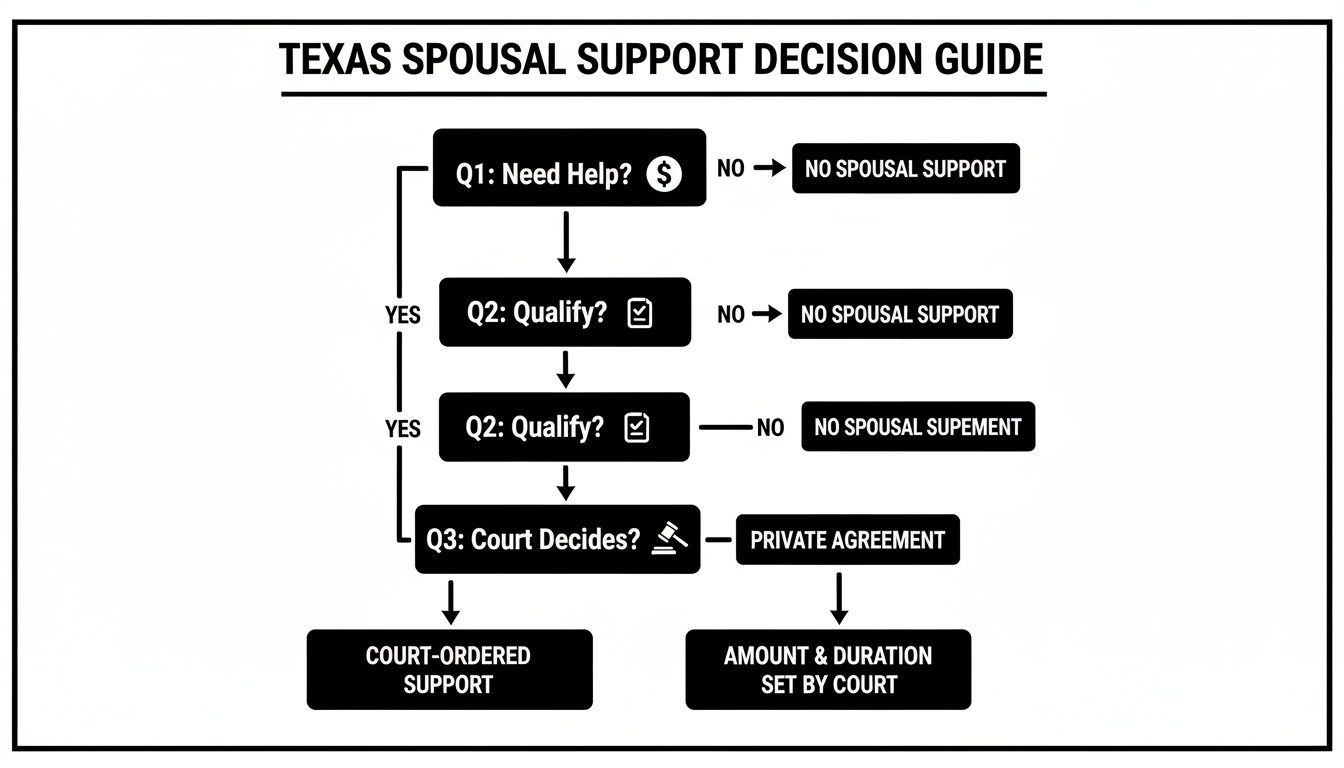
As you can see, even if you meet all the eligibility requirements, the judge still has the final say on how much support is paid and for how long.
Gathering Your Proof
Since the person asking for maintenance has the burden of proof, getting your documents in order is absolutely critical. You and your lawyer need to work together to present a compelling case that clearly shows why you qualify and need the support.
Key Documents to Collect:
- Financial Records: Bank statements, your spouse's pay stubs, old tax returns, and most importantly, a detailed monthly budget that lays out your expenses.
- Job Search Efforts: Keep a log of every job you apply for, save emails to and from recruiters, and hold onto any rejection letters you receive.
- Educational or Training Enrollment: Have proof of any classes or training programs you've signed up for to boost your earning potential.
- For Family Violence Cases: This is all about official records—police reports, court documents showing a conviction or deferred adjudication, and copies of any protective orders.
Figuring out if you meet these tough standards is the first step toward securing your financial future after a divorce. If you're looking at your situation and feeling unsure about where you stand, it's so important to talk to a family law attorney who handles these cases every day. The team at The Law Office of Bryan Fagan is here to help. Contact our Atascocita office today for a free, confidential consultation to talk through the specifics of your case.
Calculating Spousal Support Amounts and Duration
Once you've managed to clear the high bar for eligibility, the next questions are always the same: “How much money can I actually get?” and “How long will the payments last?” For families in Humble and Atascocita, getting a handle on these numbers is absolutely critical for planning a stable financial future after a divorce.
The Texas legal system is incredibly direct about the limits on spousal maintenance. You'll find strict caps on both the monthly payment amount and how long those payments can continue. This is intentional—it reinforces the core idea that this support is meant to be a temporary bridge, not a permanent arrangement.

The Maximum Payment Formula
When it comes to the dollar amount, Texas law sets a very clear ceiling. A judge can order the paying spouse to provide the lesser of two amounts:
- $5,000 per month, OR
- 20% of their average monthly gross income.
It’s crucial to understand that the court must choose the lower of these two figures. Let's say we have a spouse in Atascocita who earns an average gross monthly income of $15,000. While 20% of that is $3,000—which is well below the $5,000 cap—the absolute maximum award would be $3,000. It's not a choice between the two; it's a hard limit.
It's extremely rare for a court to award the maximum amount allowed by law. The final figure is almost always lower. The judge focuses on the receiving spouse's documented "minimum reasonable needs," not on the paying spouse's ability to simply pay the max.
Under Chapter 8 of the Texas Family Code, spousal maintenance has these strict caps to ensure it's a temporary measure, not a lifelong obligation. This rule is consistently applied, and we see it in court decisions through 2024 and expect it to continue through 2025. For instance, if a spouse earns $20,000 gross per month, the cap is 20% of that—$4,000—not the full $5,000. Judges look at the recipient's actual needs after considering property division and earning potential. You can get a deeper dive into how maximum support payments in Texas family law are determined.
Factors a Harris County Judge Considers
So, if the maximum isn't usually on the table, how does a judge land on the actual amount and duration? They don't just pull a number out of thin air. A Harris County judge is required by law to look at a whole host of factors to arrive at a decision that is fair and just for both sides.
This isn't a simple math problem; it's a careful balancing act based on the unique, real-life circumstances of your family. Before making a ruling, the judge will weigh everything.
The table below breaks down the key factors a Texas court will analyze. This gives you a good idea of just how comprehensive their evaluation is when determining spousal maintenance.
Factors Influencing Spousal Maintenance Awards in Harris County
| Factor Category | What the Court Considers | Example for an Atascocita Family |
|---|---|---|
| Financial Resources | The assets and separate property each spouse will have after the divorce. This includes income from employment, retirement accounts, and investments. | After splitting a home in Eagle Springs and their 401(k)s, does the requesting spouse have enough cash or income-producing assets to meet their basic living expenses? |
| Education & Skills | The education level and employment history of each spouse. The court also considers how long it might take for the requesting spouse to get skills for a job. | One spouse left a nursing career 15 years ago to raise children. The court will consider the cost and time needed for her to get re-certified and re-enter the workforce. |
| Marriage Duration | How long the couple was married. Generally, a longer marriage might justify a longer period of spousal support. | A couple married for 22 years is viewed very differently than a couple married for 11 years. The longer duration may lead to a longer support award. |
| Age & Health | The age, employment history, and the physical and emotional condition of the spouse asking for support. | A 58-year-old spouse with a chronic health condition that limits their ability to work full-time may receive support for a longer period than a healthy 40-year-old. |
| Homemaker Contributions | The court recognizes and values a spouse's non-financial contributions as a homemaker or their role in supporting the other spouse's education and career. | One spouse stayed home, managing the household and children, which allowed the other spouse to attend night school for an MBA and significantly increase their income. |
| Marital Misconduct | Evidence of actions like adultery or cruelty that contributed to the end of the marriage. This can definitely influence the judge's final decision. | If the paying spouse's affair and depletion of community funds led to the divorce, the judge might be more inclined to award maintenance to the wronged spouse. |
| Family Violence | Any documented history of family violence is taken very seriously by the court and can be a significant factor in the award. | If there is a protective order in place or a history of abuse, the court will likely factor this in when determining the need for and amount of support. |
Ultimately, the judge’s goal is to determine an amount that covers essential needs—think housing, food, and transportation—while giving the receiving spouse a reasonable runway to become self-supporting. Having a solid grasp of these factors can help you set realistic expectations as you navigate your divorce case in Atascocita.
Understanding the Strict Timelines for Support
If there's one thing we want our neighbors in Atascocita and Humble to understand, it's that court-ordered spousal maintenance in Texas is not a lifetime meal ticket. The law is crystal clear on this: it's meant to be a temporary, rehabilitative bridge to get someone back on their feet financially, not to create a long-term dependency. Because of this, Texas law puts very strict, definite end dates on how long these payments can last.
This philosophy is a world away from what you might see in other states, where alimony can sometimes be ordered for decades or even indefinitely. Here in Texas, the court's order for support is directly tied to how long you were married. A longer marriage can mean a longer potential duration for support, but even then, there are firm caps.
Getting a handle on these timelines is absolutely crucial for both spouses. It sets realistic expectations right from the start and reinforces the core idea that after a divorce, each person needs to work toward becoming self-sufficient.
Maximum Duration Based on Marriage Length
The Texas Family Code lays out a pretty straightforward schedule for the maximum length of time a judge can order someone to pay spousal maintenance. The key word here is maximum. A judge can, and often will, order a shorter period based on the unique facts of the case. The whole point is to give the receiving spouse a reasonable amount of time to get the education or job skills needed to support themselves.
The duration caps are directly scaled to the length of the marriage, which brings a level of predictability to what can be a very uncertain time. This structure is a huge help for families trying to plan their financial futures post-divorce. It’s also important to note these timelines have nothing to do with other legal deadlines, like the waiting period required for a divorce in Texas.
To make it simple, let's break down the maximum duration a court can order.
Texas Spousal Maintenance Duration Limits by Marriage Length
This table clearly shows the absolute longest a court can order spousal maintenance based on how many years the couple was married.
| Length of Marriage | Maximum Duration of Support |
|---|---|
| 10 to 20 Years | 5 Years |
| 20 to 30 Years | 7 Years |
| More than 30 Years | 10 Years |
Remember, these are the outer limits. A judge will look at all the circumstances to decide what duration is appropriate, up to these maximums.
When Spousal Maintenance Ends Early
On top of the statutory time limits, certain life events can cut spousal maintenance short. When one of these things happens, the obligation to pay stops automatically—no need to go back to court.
The obligation to pay spousal maintenance terminates automatically if the person receiving the payments remarries or if a judge finds that they are cohabitating with a romantic partner in a permanent home.
So, what does this mean in plain English? If the person receiving support gets married again, the payments stop. Period. The "cohabitation" rule is just as important. It kicks in when the receiving spouse starts living with a new romantic partner on a continuous, long-term basis.
Finally, the support order also ends if either the paying spouse or the receiving spouse passes away. These rules are absolute and just go to show, once again, how temporary this form of support is designed to be. Knowing these "off-ramps" is vital for managing your finances and expectations after your Harris County divorce is finalized.
Navigating the Legal Process in Harris County
Figuring out the legal system can feel overwhelming, but knowing what's coming can take a lot of the stress out of the process. If you live in Atascocita, your case will be handled at the Harris County Civil Courthouse, but the journey to get there starts with careful preparation. It's all about taking deliberate, strategic steps to build a solid case and secure your financial footing.

It all begins when one spouse files an Original Petition for Divorce. This is the official document that gets the ball rolling. For a more detailed look at this first step, our guide on how to file for divorce in Texas is a great resource.
Step-by-Step Guidance: From Filing to Final Orders
- Filing & Temporary Orders: Soon after filing, your attorney can ask the court for temporary orders. These are incredibly important because they can put immediate financial support in place while your divorce is ongoing. A judge can order your spouse to pay temporary spousal maintenance so you can keep up with bills until everything is finalized.
- Discovery & Information Gathering: Next up is the discovery phase. Think of this as the formal information-gathering stage. You and your spouse will be required to exchange financial documents under oath—things like bank statements, pay stubs, tax returns, and budgets. This evidence is absolutely critical to proving your need for support and your spouse's ability to pay it.
- Mediation & Settlement: The vast majority of divorce cases in Harris County settle in mediation. It's a confidential negotiation where a neutral third-party mediator helps you and your spouse work toward an agreement. If you can find common ground, you can avoid a trial.
- Trial (If Necessary): If you can't reach an agreement in mediation, the last step is a trial where a judge will listen to both sides and make a final, binding decision.
Spousal Maintenance vs. Contractual Alimony
It's crucial to understand that Texas law allows for two different kinds of post-divorce support. Which one is right for you really depends on whether you value flexibility or enforceability more.
The key difference lies in how they are created and enforced. One is a court order with serious legal consequences for non-payment, while the other is a private contract between you and your ex-spouse.
Let's break down the two options:
- Court-Ordered Spousal Maintenance: This is the type of support we've been discussing, the kind a judge orders when you've met the strict eligibility requirements in the Texas Family Code. Its biggest advantage is enforceability. If your ex-spouse stops paying, you can take them back into court, and a judge can hold them in contempt, which could mean fines or even jail time. The trade-off is that the amounts and duration are capped by law.
- Contractual Alimony: This is a support agreement you and your spouse reach on your own as part of your divorce settlement. Because it's a private contract, its main benefit is flexibility. You can agree to any amount for any length of time, well beyond what a court could order. The downside? If the payments stop, you can't use the court's contempt powers. You have to sue for a breach of contract, which is a much less powerful enforcement tool.
Choosing the right path is a major strategic decision. An experienced Atascocita family lawyer can walk you through the pros and cons of each, guiding you toward the outcome that best protects your future.
Get Answers from an Atascocita Spousal Support Lawyer
Trying to make sense of Texas spousal support laws on your own can be tough. It’s a complicated area of family law, and when you’re already dealing with the emotional weight of a divorce, adding legal stress to the mix is the last thing you need.
While this guide gives you a solid overview, every family’s story is different. The specific facts of your marriage—from your finances to your future needs—are what truly matter. Getting clear advice that’s built around your life is the only way to move forward with confidence.
Knowing where you stand is the first step. Whether you're the one who might need support or the one who might be asked to pay it, you need a clear-eyed legal strategy. A local attorney who knows the Harris County courts can look at your situation, tell you what a judge is likely to do, and help you understand what’s realistic.
Take Control of Your Future Today
The choices you make right now will echo for years. One of the most critical decisions is picking the right lawyer to have in your corner. If you need some help with that, our article on how to choose a divorce attorney is a great place to start.
Protecting your financial stability after a divorce isn't just about understanding the law; it's about applying it effectively to your specific situation with a strategy tailored to your goals.
If you’re in Atascocita, Humble, or anywhere in the northeast Harris County area, the team at The Law Office of Bryan Fagan is ready to help. We know the local courts, and we're committed to helping our neighbors get through these challenging times. You don’t have to do this by yourself.
We offer a free, no-obligation consultation right here at our Atascocita office. Let's talk through what's going on, map out a clear plan for your case, and give you the local, experienced support you deserve. Call us today to get the answers and help you need.
Answering Your Top Questions About Spousal Support
When you're dealing with divorce, you're bound to have questions. Spousal support, in particular, can feel confusing. Let’s cut through the noise and get straight to the point on some of the most common questions we hear from our clients right here in the Atascocita and Humble area.
Is Spousal Support Taxable in Texas?
This is a huge financial question, and the answer changed pretty dramatically a few years ago. Thanks to the federal Tax Cuts and Jobs Act, for any divorce finalized after December 31, 2018, the old rules no longer apply.
Here’s the bottom line now: Spousal support payments are no longer tax-deductible for the person paying. And on the flip side, the money is not considered taxable income for the person receiving it. It’s a clean break, financially speaking, but this shift is critical to keep in mind when negotiating your settlement.
What Happens If My Ex Stops Paying Court-Ordered Maintenance?
It's a scary thought, but a court order for spousal maintenance has real teeth. If your ex-spouse simply stops paying what the judge ordered, you have powerful legal recourse. You can take them back to court by filing what’s called a motion for enforcement.
Harris County judges do not take kindly to their orders being ignored. They can hold your ex in contempt of court, which can trigger some serious consequences:
- Stiff fines
- A judgment for all the back-due payments, plus interest
- An order forcing your ex to pay your attorney's fees for having to drag them to court
- In serious cases, even jail time until they get caught up
This is precisely why a formal court order is so much better than an informal handshake agreement. It gives you a real enforcement mechanism.
Can I Receive Both Spousal Support and Child Support?
Yes, absolutely. It's a common misconception that it's one or the other, but they are two completely different things in the eyes of the law. They serve different purposes and are calculated in completely different ways.
Think of it like this: Child support is for the kids. It’s calculated with a strict, guideline-based formula to cover their needs. Spousal support is for the spouse, intended to help them meet their own "minimum reasonable needs." A judge will look at all of a person's financial resources—including any child support they receive—when deciding if spousal maintenance is necessary, but one doesn't cancel out the other.
Can Spousal Support Be Changed After the Divorce is Final?
This is a "it depends" situation, and what it depends on is how the support was set up in the first place.
If you have court-ordered spousal maintenance, then yes, it can potentially be modified. Either person would have to prove a "material and substantial change" in their life circumstances, like an involuntary job loss or a major health crisis.
But if you have contractual alimony—something you both agreed to in a private settlement—a court generally can't touch it. The only way it could be changed is if you included specific language in the original agreement that allows for future modifications. It’s a small detail that can have massive consequences down the road, so it’s vital to get it right during the divorce.
Navigating the nuances of spousal support requires clear, compassionate guidance from a lawyer who understands both the law and the local Atascocita community. At The Law Office of Bryan Fagan – Atascocita TX Lawyers, we are committed to helping you protect your financial future. If you have more questions or need to discuss your specific situation, we invite you to schedule a free, confidential consultation at our Atascocita office. Let's build a strategy that works for you. Contact us today at https://www.atascocitaattorneys.com.