Skip to content

When people in Atascocita or Humble search for what to expect at a consultation with a family lawyer in Texas, they're usually not doing it on a calm, ordinary day. It's often after an argument that won't leave your mind, after papers were served, after you found out your child's schedule may change, or after you realized you can't keep guessing about what happens next.
You may be sitting at your kitchen table trying to decide whether calling a lawyer makes things “too serious.” In most cases, it does the opposite. A consultation usually brings structure to a situation that feels messy. Instead of replaying the same worries, you get a place to ask questions, sort facts from fear, and understand what Texas family law may require.
For many families in northeast Harris County, the hardest part is the uncertainty. You might not know whether your issue is mainly about divorce, custody, support, property, safety, or a court order that needs to be changed. You also may not know whether you even have enough information yet to talk to a lawyer. You do.
If you're still deciding who to meet with, this guide on how to choose a family lawyer in Atascocita, Texas can help you compare your options before that first appointment.
Taking the First Step Toward Clarity in Atascocita
At 9:30 at night, after the house finally gets quiet, many people in Atascocita decide to search for a family lawyer. The question usually is not just, "Do I need legal help?" It is, "What will happen if I call, and will that make everything harder?"
A consultation usually does the opposite. It gives shape to a problem that has started to sprawl into every part of your day. Instead of guessing, you sit down with someone who can sort the facts, ask the right follow-up questions, and explain what matters under Texas law.
At the Law Office of Bryan Fagan, Atascocita TX Lawyers, that first conversation is handled as a case evaluation, not a sales pitch. Our job is to listen carefully, spot the legal issues that may already be in motion, and explain what a Harris County case may look like if you decide to act. For some people, the answer is that a court filing may be needed soon. For others, the better next step is gathering records, protecting communication, or avoiding a mistake that could affect custody or property questions later.
If you are still comparing attorneys before setting that meeting, our guide on how to choose a family lawyer in Atascocita, Texas can help you evaluate your options in a practical way.
Practical rule: A consultation is a fact-finding conversation. It helps you make decisions with clearer information.
That matters in real life. A parent in Atascocita may need to know whether a sudden change in pickup routines is just a conflict to document or the start of a modification case. A spouse in Humble may need to understand whether moving money, leaving the home, or signing an informal agreement could create problems later. A grandparent may want to know whether Texas law gives them any path to ask for time with a child.
Clarity rarely arrives all at once. It usually starts with one calm meeting, one clear explanation, and one realistic next step.
The Purpose of Your First Meeting with a Family Lawyer
Think of the consultation the way you'd think about an appointment with a medical specialist. You're not there just to be told, “yes” or “no.” You're there to explain symptoms, answer follow-up questions, review records, and hear what paths may be available. A family law consultation works much the same way.
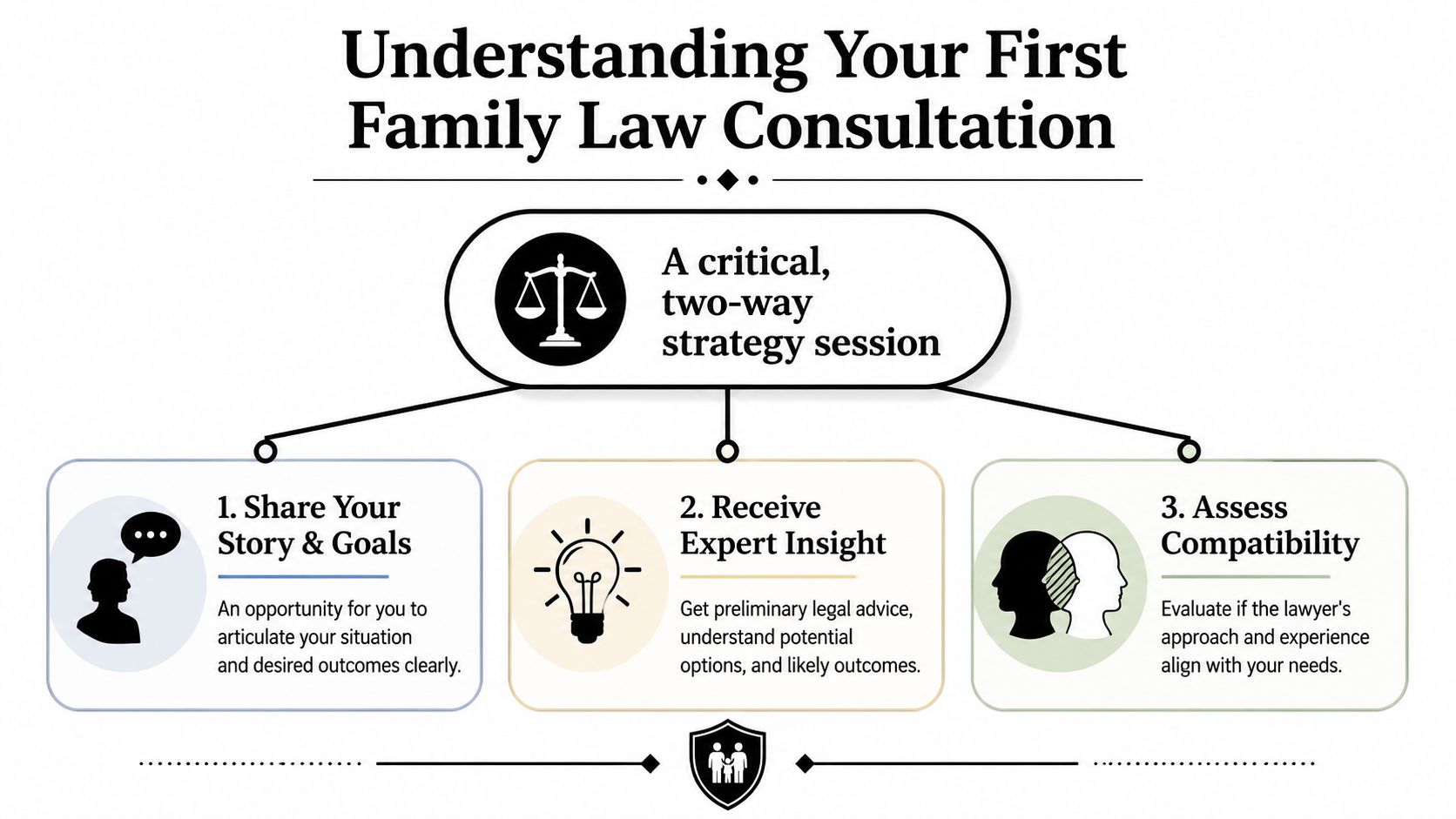
You tell your story and your goals
The first job in the meeting is yours. You explain what's been happening, what worries you most, and what result you want. That may sound simple, but many people come in carrying several legal issues at once.
Texas family law commonly involves divorce, child custody, child support, spousal support, property division, and modifications of court orders, so a consultation often serves as a screening session for more than one legal path at the same time, as noted in this Texas family law consultation overview.
You might begin by saying:
- “We're still living in the same house, but we're talking about divorce.”
- “There's already a custody order, but it isn't working anymore.”
- “I'm worried about support, school pickup, and who keeps the house.”
Those details help the lawyer see whether your issue is narrow or whether several pieces connect.
The lawyer gives an initial legal assessment
After hearing the basic facts, the attorney starts identifying legal questions. Which county may handle the case? Is there already a court order? Are there urgent issues involving possession of the children, support, or use of property? Are there missing records that need to be found before stronger advice can be given?
This part of the meeting isn't about promises. It's about informed first impressions based on what you bring and what you say.
Both sides decide whether the fit is right
Clients sometimes forget this part, but it matters a lot. You're evaluating the lawyer, too. Do they explain things clearly? Do they listen without rushing? Do they separate what's possible from what's unlikely?
If you're dealing with a possible divorce or custody dispute, some people also review service-specific information beforehand, such as divorce representation in Atascocita or child custody help in Atascocita, so the consultation feels more focused and less overwhelming.
The best first meeting usually ends with more clarity than certainty. That's normal. Clarity is what helps you take the next useful step.
How to Prepare for Your Consultation
Preparation doesn't need to be perfect. It just needs to be useful. The more organized your information is, the more specific the lawyer's early guidance can be.
A family law consultation is an evidence-intake and risk-triage meeting. The quality of the advice is strongly affected by how complete your records are, especially items like tax returns, pay stubs, bank statements, and property deeds, because those materials help a lawyer assess jurisdiction, deadlines, and likely dispute areas, as explained in this guide to what to bring to a first Texas family law consultation.
Start with the basics
Before you think about the complicated stuff, gather the core documents first.
| Category | Documents to Bring |
|---|---|
| Identity and court papers | Identification, any pleadings or motions already filed, existing court orders |
| Marriage and family records | Marriage certificate, prior divorce decree, children's birth records, adoption records |
| Financial records | Tax returns, pay stubs, bank statements, retirement account records |
| Property records | Property deeds, mortgage information, vehicle titles, major asset records |
| Child-related information | School information, childcare records, support orders, custody schedules |
| Communications and evidence | Relevant texts, emails, social media records, communication logs |
If you don't have every document, don't cancel the appointment. Bring what you do have, and make a list of what's missing.
Write down your timeline
Many people speak clearly about feelings but jump around on dates. Lawyers need both. A simple written timeline helps.
Include things like:
- When you married or separated
- When the children started living in a certain schedule
- When any police report, CPS issue, or court filing happened
- When support stopped, changed, or became disputed
- When major assets were bought, sold, or moved
A one-page timeline is often more helpful than a long emotional narrative.
Prepare your questions in advance
Stress makes people forget good questions. Write them down before the meeting. If you want a starting point, this list of questions to ask a divorce lawyer in Atascocita, TX can help you organize the issues you want covered.
Some people bring notes on their phone. Others prefer paper. Either works, as long as you can find it quickly during the consultation.
High-conflict cases need a different kind of preparation
Some consultations involve more than ordinary paperwork. If there's family violence, threats, emergency child safety concerns, stalking, or a flood of digital evidence, the way you prepare should change.
Recent family-law guidance has pointed out a gap in many basic checklists. Generic advice often tells clients to bring records, but it doesn't fully explain how to prepare when safety, urgency, or electronic evidence changes the meeting. In practice, those cases may require careful prioritizing of court papers, communication logs, and digital records so the lawyer can quickly identify urgent risks and what can be used in court.
If you feel unsafe, don't focus on making your evidence “perfect.” Focus on preserving it safely and getting legal advice quickly.
Useful steps for digital evidence include:
- Save original messages when possible. Don't rely only on cropped screenshots if the full message thread is available.
- Keep records in date order. That helps your lawyer understand context.
- Separate important items from background noise. A few key messages are often more useful than hundreds of random screenshots.
- Avoid editing or annotating the evidence itself. If you need notes, keep them in a separate document.
- Use a safe device and safe email access if privacy is a concern. Shared passwords or monitored devices can create risk.
If your situation involves urgent safety concerns, say that immediately when scheduling. That helps the office understand what kind of consultation setup may be most appropriate.
What Happens During the Consultation
You walk into the office carrying a folder, your phone, and a lot of worry. In many family law consultations, the first few minutes are simpler than people expect. At the Law Office of Bryan Fagan, Atascocita clients are usually met with a conversation that starts with your story, then gradually sorts that story into legal questions a Harris County court would care about.

A good consultation works a lot like laying papers out on a kitchen table. First, we need the basic pieces in view. Then we sort them into what affects custody, support, property, safety, deadlines, and immediate court action.
Your first job is to tell the story clearly
The meeting often begins with a broad question such as why you scheduled the appointment now. That timing matters. A case where no divorce has been filed is different from one already pending in Harris County. A parenting dispute with no court orders in place is different from a situation where one parent may already be violating an order.
From there, the lawyer narrows the discussion to the facts that shape legal options, including:
- Where you, the other person, and the children live
- Whether a case has already been filed
- Whether any court orders already exist
- How parenting time is working day to day
- How income, bills, and accounts are being handled
- Whether there is any urgent issue involving safety, access to children, or property
That process can feel more focused than some people expect. There is a reason for that. In family court, details are not just background. They are often the difference between a general concern and a problem a judge can address.
Expect questions that get specific fast
A lawyer may ask who takes the child to school, who covers health insurance, whether anyone has moved out, whether money has been withdrawn from a joint account, or whether a text thread changes the picture. Those questions are not meant to make you uncomfortable. They help identify what can be proved, what may need documents, and what should be handled first.
If you do not know an answer, say that. If you only know part of it, say that too.
Clear and honest beats polished every time.
At our Atascocita office, this part of the meeting is also where we start evaluating the practical path for a Harris County case. For example, if there is no order and the children's schedule has become unstable, the discussion may turn to temporary orders. If divorce is likely but finances are still mixed together, the conversation may shift to preserving records and avoiding steps that create problems later. The point is not to flood you with legal terms. The point is to identify the next right move.
The lawyer may also review what you brought, such as court papers, account statements, school records, or message history, and note what is still missing. If your meeting is virtual, privacy and reliability matter. Some clients compare tools like AONMeetings secure virtual consultations when they want a better sense of what a protected remote setup can look like.
Later in the conversation, many clients find it helpful to hear a short explanation like this:
Questions you should ask the lawyer
You are not there only to answer questions. You are also there to find out whether the lawyer explains things in a way that makes sense to you and whether the proposed next steps fit your situation.
Useful questions include:
- What legal issues do you see first in my case?
- What facts matter most if this ends up in Harris County court?
- What documents or records would help you evaluate this more fully?
- Do you see any immediate risk that needs action now?
- If I hire your firm, what usually happens in the first few weeks?
- How do you communicate with clients during the case?
- How are consultation fees, retainers, and billing handled?
- What should I avoid doing after this meeting?
A strong consultation should leave you with more than a general impression. You should walk out knowing what the problem is, what can wait, what cannot, and what the next step would likely be if your case moves forward.
Confidentiality and How Our Firm Evaluates Your Case
You may sit down for a consultation knowing the facts but still hesitate to say them out loud. That is common. In family law, people often worry that once they say something, they lose control of it.
At our Atascocita office, the first goal is to give you a place where you can speak plainly. A consultation works best when you do not trim away the uncomfortable parts of the story. Family cases are a lot like putting together a map before a storm. If one road is missing, the route can look safer than it really is.
What confidentiality means in practical terms
Confidentiality gives you room to be honest about the details that shape legal advice. That includes facts many people are embarrassed to mention at first, such as a prior court order, money moved between accounts, angry texts, a CPS concern, a new relationship, or a child who has already been missing school during the dispute.
Those details matter because family law advice is built on the full picture, not the polished version. If a Harris County judge may later see an issue as urgent, your lawyer needs to spot that early. If something could hurt your position, it is far better to discuss it privately in the consultation than to let the other side raise it first.
Some clients also need privacy in the way the meeting happens. If coming to the office is difficult or communication at home is not safe, remote options can help. If you are comparing privacy features for online meetings, this overview of AONMeetings secure virtual consultations shows the kind of protected setup legal clients often want.
How a case is evaluated at our Atascocita office
At the Law Office of Bryan Fagan – Atascocita TX Lawyers, case evaluation is not a sales pitch. It is a working assessment of three things. What is happening now, what Texas law allows, and what should happen next in a Harris County case.
That sounds simple, but it helps to break it down.
First, we listen for immediate pressure points. Is there a child custody exchange going badly? Has one spouse cut off access to money? Is there already a filing in Harris County with deadlines attached? A case with an active emergency looks very different from one that needs careful preparation before anyone files anything.
Second, we look at goals. Clients often come in saying, "I want full custody," or "I want to keep the house." Those are understandable starting points, but a lawyer's job is to test them against the facts, the court process, and what a judge is likely to care about. In that way, the consultation works like a home inspection before a purchase. You may walk in focused on the paint color, while the inspection needs to check the foundation first.
Third, we consider fit. Some cases call for quick filings and firm courtroom positioning. Others benefit from a calmer approach with strong documentation and fewer avoidable fights. Bryan Fagan's Atascocita team evaluates whether the firm can serve your case well, communicate in a way that works for you, and start with a plan that matches the actual risks instead of adding more stress than the situation already carries.
A useful consultation should leave you with a grounded view of your case, not false confidence.
If your situation appears headed toward divorce, part of that evaluation may include explaining the local filing path and early court steps. This guide to filing a divorce in Harris County gives a local reference point for what that process can involve.
Your Next Steps in Harris County
Once the consultation ends, a common reaction is one of two things. Relief, because they finally understand the outline of the problem. Or urgency, because they now see that something needs to happen soon. Both reactions are normal.
What usually happens after the meeting
If you decide to move forward, the next step is often a fee agreement and formal retention paperwork. After that, your lawyer may begin gathering additional records, preparing a filing, responding to an existing case, or organizing a strategy for temporary issues involving children, support, or property.
For Harris County families, local procedure matters. If your issue is divorce-related, it helps to understand the filing process early, including where the case may be filed and what the first court steps may look like. This guide to filing a divorce in Harris County gives a useful local starting point.

Focus on the next right action
You don't need to solve your whole case in one week. Usually, the right next step is narrower than people expect:
- Sign representation paperwork if you're ready
- Send the missing documents the lawyer requested
- Stop harmful communication that could complicate the case
- Preserve records and follow the advice you were given about safety or evidence
- Prepare for the first filing or response in Harris County if litigation is needed
If you came to this article searching for what to expect at a consultation with a family lawyer in Texas, the short answer is this. Expect to be asked for facts. Expect to discuss goals. Expect to leave with a clearer sense of your options than you had when you walked in.
If you're in Atascocita, Humble, or elsewhere in northeast Harris County and need help with a family law issue, criminal charge, civil dispute, or estate planning concern, schedule a free consultation with Law Office of Bryan Fagan – Atascocita TX Lawyers. A conversation can help you understand your options, protect your rights, and decide on the next step with confidence.