Skip to content
Losing a loved one is hard enough. Then the will is read, and something feels off. Maybe a child who always helped was cut out. Maybe a caregiver suddenly received most of the estate. Maybe the signature, timing, or circumstances just don’t fit what your family knows to be true.
If you’re searching for a contest a will lawyer atascocita texas, you’re probably not looking for legal theory. You’re looking for clarity. You want to know whether Texas law gives you a real path forward, what that path looks like in Harris County, and whether pursuing it will help your family or deepen the damage.
A will contest isn’t about hurt feelings alone. Texas courts won’t set aside a will just because it seems unfair. But the law does allow certain people to challenge a will when there’s a genuine legal problem, such as lack of mental capacity, undue influence, fraud, forgery, or improper execution. The difficult part is knowing the difference between a suspicious situation and a legally provable case.
Families in Atascocita, Humble, and northeast Harris County often come into this process carrying grief, anger, and uncertainty all at once. A careful lawyer helps sort those emotions from the evidence so you can make a sound decision.
Is Something Wrong with a Loved One's Will?
The call usually comes after the funeral. A family member says the will has been filed. Everyone gathers, expecting something that reflects years of conversations, relationships, and promises. Then the document is read, and the room goes quiet.
A son from Humble learns he’s been left out completely. A daughter in Atascocita sees that a new friend or caregiver inherited property she thought would stay in the family. A surviving spouse notices that the language in the will doesn’t sound like the person they knew. In that moment, people often ask the same question. “Can this really be valid?”
That reaction is normal. Grief makes every legal question feel heavier, especially when money, family history, and trust are mixed together. But Texas law does provide a formal way to challenge a will when there’s a valid reason to do so.
A will contest is a probate court case asking the court not to accept a will as valid, or to set aside a will that was already admitted to probate. It is not a chance to relitigate old family tensions or ask a judge to make a will “more fair.” It is a legal claim that must rest on recognized grounds and real proof.
Practical rule: If your concern is “this feels wrong,” that’s a reason to speak with a lawyer. If your concern is “this is unfair,” that alone usually isn’t enough to win.
Many families assume success means a dramatic courtroom victory. That’s not usually how these cases end. The success rate for overturning a will in court is very low, and many litigated will contests are resolved by agreement instead of a final judicial ruling. About 90% to 97% of litigated will contest cases are settled outside court rather than decided by judges, as noted in this discussion of Texas will contest deadlines and outcomes.
That matters because a good outcome may be a negotiated resolution, not a trial verdict. Sometimes that means preserving part of an inheritance. Sometimes it means correcting an executor’s approach. Sometimes it means reaching closure without tearing the family apart further.
If your loved one tried a homemade estate plan, it also helps to understand the risks that come with doing a will on your own. Informal drafting often creates exactly the kind of confusion that leads families into probate litigation.
When Can You Legally Contest a Will in Atascocita?
Not everyone can walk into Harris County probate court and object to a will. Texas law puts two threshold questions in front of every will contest.
First, do you have standing? Second, do you have valid legal grounds?
Who has standing
“Standing” means you have a legally recognized financial interest in the outcome. In plain English, the will has to affect you in a real way.
You may have standing if you are:
- A legal heir who would inherit if there were no valid will
- A beneficiary under an earlier will who lost an inheritance under a later document
- A spouse or child whose rights are directly affected
- Another interested party with a recognized stake in the estate
A common example in Atascocita is an adult child who expected to inherit under a prior estate plan, only to find out a last-minute will changed everything. If the child would receive property under an earlier will, or under Texas intestacy rules if the current will is invalid, that child may have standing to contest.
Someone with no financial interest usually won’t get past the courthouse door. Texas probate judges don’t entertain challenges based on opinion alone.
The legal grounds Texas courts recognize
Once standing is established, the next question is whether the facts fit a recognized ground for contesting the will. Texas courts generally look for one of four problems.
| Legal Ground | What You Need to Prove | Atascocita/Humble Example |
|---|---|---|
| Lack of testamentary capacity | The person signing the will did not understand what they owned, who their family members were, or what the will was doing at the time they signed it | A parent in Atascocita with serious memory decline signs a new will during a period of confusion |
| Undue influence | Someone pressured, manipulated, or dominated the person into making a will that does not reflect their free choice | A caregiver isolates an elderly Humble resident and appears in a new will with a large benefit |
| Fraud or forgery | The signature, document, or circumstances involved deception or a false signature | Family members question whether the signature on a late-stage will is genuine |
| Improper execution | The will was not signed and witnessed the way Texas law requires | A typed will appears, but the required witness formalities were not properly followed |
What these grounds look like in real life
Lack of capacity cases often turn on timing. A person may have had good days and bad days. The question isn’t whether they were elderly or had a diagnosis. The question is whether they had the required mental ability when they signed the will.
Undue influence is one of the most emotionally difficult claims because it often involves someone the family once trusted. The pattern can include isolation, dependence, control over transportation, control over medications, or unusual involvement in the drafting of the will.
A suspicious will doesn’t prove undue influence by itself. The court wants to see a chain of facts showing pressure, opportunity, and a result that doesn’t make sense without that pressure.
Fraud or forgery may involve a signature problem, a fake document, or a situation where the person signing didn’t know what they were signing.
Improper execution sounds technical, but technical defects matter in probate. A will must comply with Texas requirements. If it wasn’t properly executed, that issue can be central even when family members agree the decedent wanted certain outcomes.
What won’t support a will contest
Some facts create pain but not a legal case.
- Family disappointment: A parent can make choices that adult children dislike.
- Unequal gifts: Uneven distributions aren’t automatically invalid.
- Old grievances: Probate court won’t correct long-standing family conflict.
- Moral objections: Judges decide legal validity, not fairness in the abstract.
That’s often the hardest part for grieving relatives to hear. You may have every reason to feel hurt and still not have a will contest the court can grant. An honest lawyer should tell you that early.
Navigating the Harris County Probate Timeline and Process
A common Harris County scenario looks like this. A family attends the probate hearing, assumes they have plenty of time to sort through their concerns, and then learns weeks later that key records are harder to find, witnesses are harder to pin down, and the estate is already moving ahead. Grief slows people down. Probate deadlines do not.
In Texas, a will contest usually must be filed within two years after the will is admitted to probate. That can sound generous at first. In practice, it passes faster than families expect, especially when people need time to gather medical records, locate prior wills, and decide whether they are prepared for a legal fight.
A past-tense example helps. If a will was admitted to probate on June 1, 2023, the deadline would have been June 1, 2025. Dates matter in probate the way expiration dates matter on medicine. Once the deadline passes, the court may never reach the larger question of whether something was wrong with the will.
Why timing matters before the probate hearing
Sometimes a family should speak with counsel before the will is formally admitted. That is often true when relatives already know there are competing wills, serious concerns about mental capacity, or signs that someone is rushing a questionable document into court.
Early action can protect evidence and strengthen your position. It can also keep a bad situation from becoming harder and more expensive to fix later.
Many Atascocita families assume they have to wait until probate is finished before raising an objection. That is not always correct. In some cases, the better course is to raise the dispute while the court is still deciding whether the will should be admitted at all.
Readers who want the larger context may find it helpful to review how to probate a will in Texas. A contest makes more sense once you understand where the estate sits in the broader probate process.
What the process usually looks like
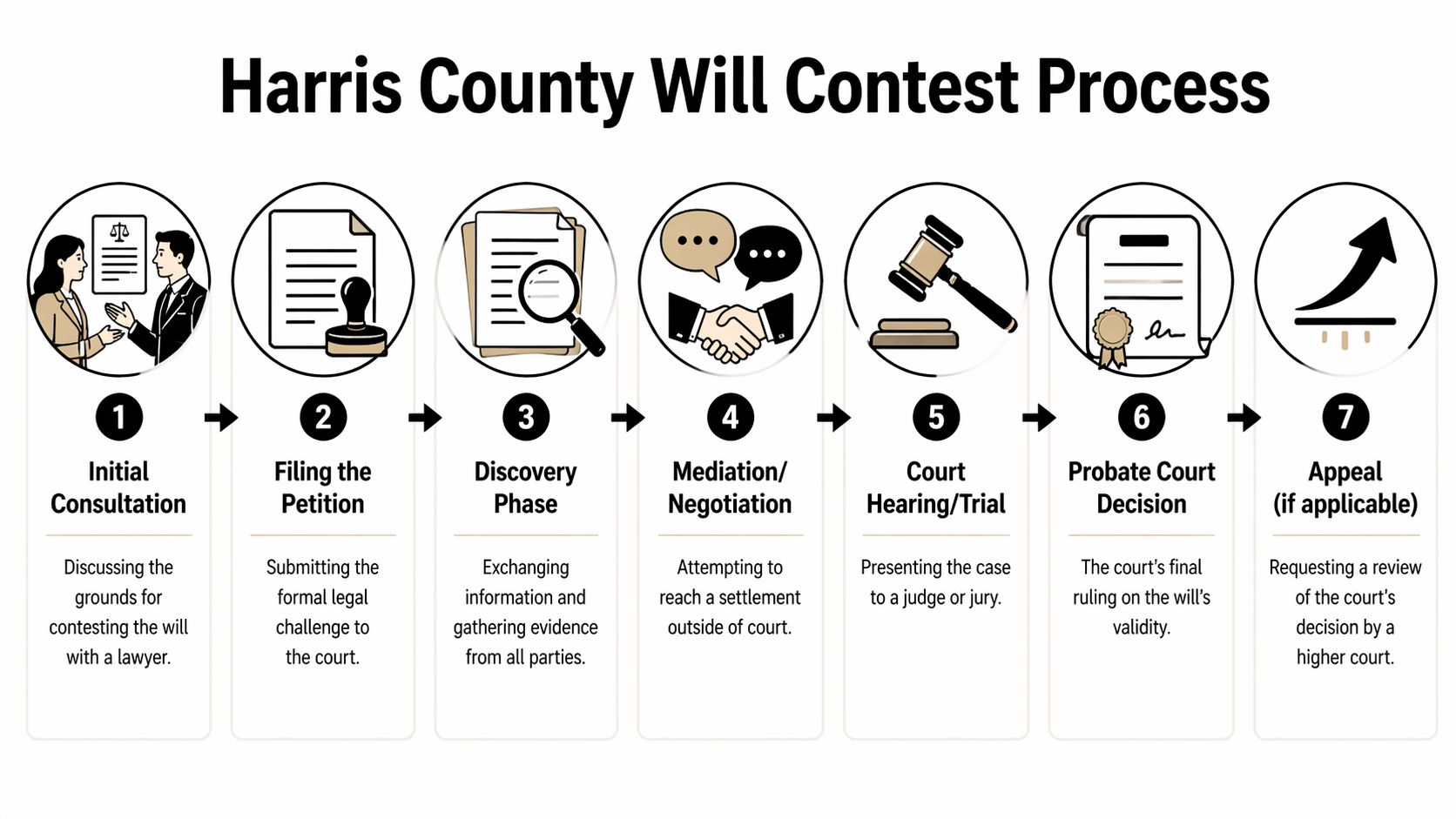
In Harris County, a will contest usually unfolds in stages.
Initial case review
A lawyer first looks at standing, likely legal grounds, and whether useful evidence probably exists. This first review often changes the conversation. Some families learn they have a stronger case than they feared. Others learn the facts are painful but may not support a contest.Filing the contest in probate court
The case starts with a formal pleading that explains who is challenging the will, why that person has the right to do so, and what legal basis supports the challenge.Notice to the people affected
Beneficiaries, executors, and other interested parties must be notified. At that point, the dispute becomes a court matter with deadlines, responses, and consequences.Discovery
This is the evidence-gathering phase. Lawyers request medical records, prior estate documents, communications, financial records, and testimony from witnesses. For many families, the overall situation often becomes clearer during this process. Costs also frequently begin to rise.Mediation or settlement discussions
Many will contests do not end with a trial. They end with a negotiated resolution after both sides have seen the strengths and weaknesses of the evidence. That result is often more practical than a courtroom battle, especially when the estate is modest and the emotional cost is high.Trial
If no agreement is reached, the court decides whether the will is valid. Depending on the issues, that decision may be made by a judge or a jury.Possible appeal
Some cases continue if a party believes the court made a legal error. Appeals are limited and can add more delay and expense.
What surprises families during the case
Probate litigation rarely moves in a straight line. Families often expect one hearing, one ruling, and a quick answer. Harris County probate cases usually work more like a series of checkpoints.
Several points cause confusion:
- The estate may keep functioning: Certain estate tasks can continue while the contest is pending.
- The executor may still act: Filing a contest does not automatically stop every estate activity.
- Agreement among relatives is not enough: Even if several family members believe the will looks wrong, the court still requires proof.
- Settlement is often a sound result: Resolving the case through agreement is common, and for many families it is the outcome that best protects both the estate and the relationships that remain.
Mediation often decides the real outcome
Mediation matters because it forces everyone to confront reality. A judge can rule on validity. A mediated agreement can address the practical problems underneath the lawsuit, including delay, legal fees, uncertainty, and family strain.
That may mean redistributing assets. It may mean agreeing on how expenses are paid. It may mean one side withdraws after the records do not support the suspicion that started the case. Those are not failures. In many Harris County disputes, that is what success looks like.
For families in Atascocita and nearby communities, this is the hard balance to keep in view. A will contest may be justified and necessary. It can also consume time, money, and emotional energy. A careful lawyer should help you judge both sides of that equation early, so you can make a sound decision before the case starts running the family instead of the other way around.
What Proof Do You Need to Contest a Will in Texas?
The person challenging the will carries the burden. That’s one of the hardest truths in probate litigation.
If you contest a will, the court starts from the position that the document is valid if it appears to have been properly executed. You must bring enough evidence to overcome that presumption. Suspicion, family stories, and emotional certainty won’t carry the case by themselves.

Evidence depends on the claim
Different legal grounds require different kinds of proof.
For lack of capacity, lawyers often look for medical records close to the signing date, notes from treating physicians, medication records, and testimony from people who saw the decedent’s condition firsthand. In an Atascocita case, that might include hospital records, memory-care documentation, or observations from neighbors and relatives who noticed confusion.
For undue influence, the evidence usually comes from patterns rather than one dramatic moment. Lawyers may examine who arranged the will signing, who drove the decedent to appointments, whether access to family was restricted, and whether financial activity changed sharply before death.
For fraud or forgery, the focus may turn to handwriting, document authenticity, witness credibility, and how the will surfaced in the first place.
For improper execution, the analysis often centers on the document itself and the testimony of those present when it was signed.
The legal tools that uncover proof
Individuals often find it challenging to gather this evidence on their own, especially while grieving. A lawyer can use formal discovery tools to force the exchange of information.
As part of discovery, attorneys use depositions, interrogatories, and subpoenas for medical and financial records, and they may work with experts such as neurologists or forensic accountants. That matters because the burden of proof rests on the party contesting the will, as explained in this discussion of proof and discovery in Texas will contest cases.
Here’s what those tools mean in plain English:
- Depositions: Sworn interviews taken before trial. These let lawyers question witnesses, caregivers, family members, and sometimes the attorney who prepared the will.
- Interrogatories: Written questions the other side must answer under oath.
- Subpoenas: Formal demands for records from banks, hospitals, clinics, or other third parties.
Strong will contests are built from records and testimony that line up with each other. One suspicious fact rarely wins the case alone.
What families should start collecting
Even before a lawyer issues subpoenas, families can help preserve useful information.
- Dates and timelines: Write down when the new will appeared, when health declined, and when major relationship changes occurred.
- Names of witnesses: Identify neighbors, relatives, church friends, caregivers, and medical providers who observed the decedent.
- Documents already in hand: Save texts, emails, letters, calendars, and copies of earlier wills.
- Financial clues: Note unusual transfers, changes in account access, or abrupt shifts in who controlled bills and appointments.
Why timing changes the quality of evidence
Evidence fades. Memories soften. Records become harder to locate. Witnesses move away or become reluctant. In capacity and undue influence cases, the most persuasive proof is often tied tightly to the period around the signing of the will.
That’s why families shouldn’t wait for perfect certainty before seeking legal advice. A consultation doesn’t commit you to filing suit. It helps you learn whether the evidence trail is still warm enough to investigate properly.
Understanding the Costs and Outcomes of a Will Contest
A daughter in Atascocita sits at her kitchen table with two worries at once. She wants to know whether her father’s final will was legitimate, and she needs to know what it may cost to challenge it. Those questions usually arrive together in Harris County probate disputes, and they should.
A will contest is not only a legal case. It is also a decision about time, family relationships, stress, and money. Filing suit can protect an inheritance or expose wrongdoing, but it can also shrink the estate if the fight goes on too long. That is why a careful cost-benefit review matters before anyone rushes into court.
Texas probate litigation usually involves attorney fees, filing fees, deposition costs, record collection costs, mediation fees, and sometimes expert witness expenses. In a capacity case, for example, a doctor may need to review medical records or testify about how the decedent’s condition affected judgment around the date the will was signed. In an undue influence case, the work may focus more heavily on depositions, financial records, and witness testimony about pressure or isolation.

How families should think about cost
Probate litigation works a lot like home repair after storm damage. The first question is not only, “Can something be fixed?” It is also, “What will it take, and is the likely result worth the expense?” A will contest with strong documents, reliable witnesses, and a meaningful estate may justify the investment. A contest driven mainly by suspicion or anger may not.
That does not mean families should stay quiet if something feels wrong. It means they should get clear advice early, before legal fees and conflict begin to pile up.
A good consultation should help you answer practical questions such as:
- How large is the estate, and what amount is in dispute?
- Is there an earlier will that may control if the newer one is set aside?
- Are there enough records and witnesses to prove the claim?
- Is the executor continuing to manage estate property responsibly during the dispute?
- Is settlement realistic, or is a trial more likely?
If the dispute overlaps with concerns about how the estate is being managed while the case is pending, families often also need advice about executor representation in Atascocita probate matters.
Fee arrangements vary
Many probate litigators bill by the hour and require a retainer up front. Some matters may be handled with a different arrangement depending on the facts, the size of the estate, and the strength of the claim. That is one reason fee discussions should happen early and in plain language.
Ask how the lawyer bills for court appearances, depositions, mediation, expert review, and trial preparation. Ask who pays out-of-pocket expenses as the case moves forward. Ask what happens if the case settles quickly and what happens if it turns into a long fight.
Families comparing attorneys sometimes look for expert will and trust lawyers to better understand the range of services and experience available, but the most useful next step is still a case-specific review of your facts.
Outcomes are rarely as simple as “win” or “lose”
Harris County will contests often end in one of three places.
- The will is admitted and upheld. The challenger does not meet the burden of proof.
- The will is set aside. An earlier valid will may control, or the estate may pass under Texas intestacy rules.
- The parties reach a settlement. They agree on a practical resolution without asking the court to decide every issue after trial.
Settlement is common for a reason. Trials are expensive, public, and emotionally draining. Mediation is often where the most progress is made because both sides can weigh the risk of continuing against the value of reaching closure. For many families, a successful result is not a dramatic courtroom ruling. It is an agreement that preserves more of the estate, reduces future fees, and lets people stop reliving painful events.
That point matters more than many people expect.
A strong lawyer does not treat settlement as a sign of weakness. In probate court, settlement is often the smartest way to protect both the estate and the people tied to it.
The practical question to ask first
Instead of asking only, “Can I contest this will?” ask, “What is the most sensible path for my family and this estate?” Sometimes that path is filing suit quickly to preserve rights. Sometimes it is pushing hard toward mediation once enough evidence is gathered. Sometimes it is deciding that a painful case is still too thin or too costly to pursue.
Clear advice should leave you with more than legal theories. It should leave you with a plan you can live with.
Why You Need a Contest a Will Lawyer in Atascocita Texas
People sometimes think they can handle a will contest by filing paperwork, showing up in court, and telling the judge what happened. In reality, that approach almost always collapses under the rules of probate procedure and evidence.
Self-representation in a will contest has a near-zero success rate, and weak evidence or missed deadlines can derail a case before it really starts. In Harris County probate court, success becomes realistic only when someone knows how to investigate the claim, frame the legal grounds, and negotiate from a position of preparation.
Local knowledge matters in probate disputes
A lawyer who regularly works in this area doesn’t just know Texas probate law in the abstract. They understand the habits of Harris County probate practice, the pace of local courts, and the kinds of records and experts that often matter in these disputes.
That local familiarity can help with things like:
- Court procedure: Knowing how filings, hearings, and probate deadlines play out in Harris County
- Evidence development: Identifying what records to pursue and which witnesses are likely to matter
- Strategic advantage: Recognizing when a case should be pushed toward mediation and when it should be prepared for trial
- Executor issues: Advising executors and beneficiaries whose duties continue while litigation is pending
If you’re also dealing with questions about the fiduciary side of the case, an executor representation attorney in Atascocita may be part of the bigger probate picture.
What to ask in a consultation
A first meeting should leave you more grounded, not more overwhelmed. Bring documents, names, dates, and any earlier wills you have. Then ask direct questions.
- Do I have standing: Ask whether you have a legal financial interest sufficient to bring the claim.
- What ground fits best: A lawyer should identify the strongest legal theory instead of throwing every theory into one petition.
- What evidence can realistically be obtained: Some cases feel strong emotionally but are difficult to prove.
- Is settlement likely: A practical probate lawyer should talk openly about negotiation, not only trial.
- How are fees handled: Ask whether the matter is hourly, retainer-based, or potentially contingency-based.
Some families also want background on how to evaluate legal counsel more broadly. A consumer-oriented guide to expert will and trust lawyers can help people understand the kinds of experience and services that matter in estate disputes.
The Law Office of Bryan Fagan – Atascocita TX Lawyers handles probate and estate litigation matters for families in Atascocita, Humble, and Harris County, including disputes involving challenged wills and related executor issues. The key is not just hiring any lawyer. It’s finding one who can tell you, candidly, whether your case is strong enough to justify the fight.
Common Questions About Contesting a Will in Harris County
Can I contest a will if I was completely disinherited
Yes, sometimes. Being left out of a will does not automatically give you a winning case, but it may give you standing if you would inherit under a prior will or under Texas intestacy law if the challenged will were invalid.
What if the will has a no-contest clause
A no-contest clause can complicate things, but it doesn’t automatically bar every challenge. Whether it applies depends on the language of the will and the facts of the dispute. If you’re a beneficiary considering a challenge, this is one of the first issues a probate lawyer should review.
What happens to estate assets while the contest is pending
It depends on the stage of probate, the powers of the executor, and whether the court enters orders limiting certain actions. Some estate administration may continue while the dispute is pending, but contested distributions and asset handling often become more sensitive once litigation starts.
How long does a will contest take
There’s no fixed answer. Some disputes resolve relatively early through document review and negotiation. Others take much longer because records are disputed, family members disagree sharply, or the case moves through mediation and trial. The more conflict there is over evidence and control of the estate, the longer the process usually feels.
Can multiple wills exist at the same time
Families often discover several versions of estate planning documents. That doesn’t necessarily mean all of them are valid. A later valid will may revoke an earlier one, but if the later will is successfully challenged, an older will may become important again. This is one reason families should preserve every version they can locate.
How do I choose the right lawyer for a will contest
Look for someone who handles probate disputes, explains the risks clearly, and gives you a realistic view of costs and outcomes. If you want a broader consumer perspective, this guide on top factors that influence how clients choose a law firm offers useful questions to consider during your search.
If you believe something is wrong with a loved one’s will, don’t wait until key records disappear or a filing deadline passes. Law Office of Bryan Fagan – Atascocita TX Lawyers works with families in Atascocita, Humble, and throughout Harris County to evaluate will contests, explain probate options in plain English, and pursue practical solutions through litigation or settlement when appropriate. Schedule a free consultation at the Atascocita office to talk through your situation and find out what steps make sense now.