Skip to content
You’ve just lost someone you love. Then, amid funeral arrangements, family calls, and paperwork, you learn that the will names you as the executor.
For many people in Atascocita, that moment feels like two things at once. It feels like an honor because someone trusted you with their final wishes. It also feels heavy because you may have no idea what comes next, what the court expects, or what mistakes could put you at risk personally.
That uncertainty is normal. An executor’s job in Texas isn’t just clerical. It carries legal duties, deadlines, and the obligation to act carefully for other people’s benefit. If you’ve started searching for an executor representation attorney atascocita tx, you’re probably looking for more than forms. You’re looking for guidance, protection, and a steady way forward.
A Trusted Honor or a Heavy Burden? Your First Steps as an Executor in Atascocita
The phone has barely stopped ringing after the funeral. A relative asks when belongings will be handed out. Someone else wants access to the house. Then you open the will and see your name as executor.
For many Atascocita families, that moment changes the kind of grief you are carrying. You are no longer only mourning. You are also responsible for protecting a legal estate, answering to the probate court, and keeping peace among people who may already be tense.

That is why this role can feel heavy so quickly. An executor in Harris County is often expected to make careful decisions before anyone else understands what has to happen first. If you move too fast, you can create personal risk. If you wait too long, property can disappear, bills can pile up, and family suspicion can grow.
A good way to view the first few days is this. You are stepping into the role of temporary caretaker and recordkeeper, not referee, not property distributor, and not family banker. Your job at the start is to protect the estate so the probate process can begin on solid ground. If you are unsure about the difference between these probate roles, this guide on the difference between executor and administrator gives helpful context.
That protective mindset matters more than many people realize. A house may need new locks. A vacant vehicle may need to be secured and insured. Jewelry, firearms, cash, and important papers may need to be gathered and documented before misunderstandings start. If the family later holds an estate sale, even pricing decisions can create conflict, which is why a resource like the Ultimate Estate Sale Pricing Guide can be useful for understanding how personal property is valued.
Your first priority is protection
Before you worry about who gets what, focus on preserving what exists.
- Find the original will and store it safely: The original document often matters in probate.
- Secure real estate and valuables: Lock the home, protect vehicles, and make a written inventory of important items.
- Collect key papers: Death certificates, deeds, insurance information, bank statements, loan records, and recent bills are a strong starting point.
- Pause distributions and informal agreements: Family members should not remove property based on memory, assumptions, or verbal promises.
- Get legal advice early: Early guidance helps you avoid mistakes that can later look like favoritism, delay, or mishandling of estate assets.
One mistake I see often is a well-meaning executor trying to keep everyone happy in the first week. That usually creates more risk, not less. The safer approach is calm, documented, and deliberate. When an executor has legal representation early, that lawyer is not just filing paperwork. The lawyer helps create a buffer between you and avoidable liability, and between the family and a dispute that could have been prevented.
Being named executor does not require you to have every answer today. It requires you to protect the estate, keep good records, and get help before a small error turns into a personal problem.
Understanding Your Fiduciary Duties as a Texas Executor
An executor is a fiduciary. In plain English, that means the law expects you to put the estate’s interests and the beneficiaries’ interests ahead of your own convenience, preferences, or assumptions.
A simple way to think about it is this. You’re holding someone else’s property in trust while you carry out their final instructions. You don’t get to improvise. You have to act with care, honesty, and good records.
Executor versus administrator
Texas makes an important distinction between an executor and an administrator. If the deceased left a valid will and named you, you may serve as the executor. If there’s no will, or no qualified executor is available, the court may appoint an administrator instead. That difference matters because Texas probate guidance on executor and administrator roles explains that executors are named in the will and often operate under independent administration with minimal court oversight, while administrators are court-appointed for intestate estates and face constant supervision, which can lead to longer and more expensive settlements.
If you want a plain-language breakdown of that distinction, this explanation of the difference between executor and administrator is a helpful place to start.
Independent and dependent administration
Here’s where many families get confused. Probate in Texas is not one single process. The amount of court supervision can differ a great deal.
| Feature | Independent Administration (Preferred) | Dependent Administration (More Court Control) |
|---|---|---|
| Who usually serves | Executor named in a will | Often an administrator or a disputed estate |
| Court involvement | Minimal ongoing oversight | Frequent supervision and approvals |
| Speed | Generally faster | Generally slower |
| Cost pressure | Often lower because there are fewer court steps | Often higher because more court involvement is required |
| Flexibility | More practical for routine estate tasks | More restrictive |
For many Atascocita families, this distinction affects not only timing but stress. Less court supervision usually means fewer procedural hurdles, but it also means the executor must be disciplined and accurate.
What property are you actually responsible for
Not every asset passes through probate. Some property may transfer outside the estate, depending on title or beneficiary designations. Other assets are part of the probate estate and must be inventoried, managed, and distributed through the proper process.
As executor, you need to determine what belongs in which category before you act. That’s one reason family members often get frustrated. They may assume every account or every item in the home is “theirs already,” when the legal answer may be more complicated.
Your core duties in practice
An executor’s work usually includes:
- Filing the will with the court: This starts the formal process.
- Obtaining authority to act: In a will-based probate, that usually means receiving Letters Testamentary.
- Identifying estate assets: Real property, bank accounts, personal property, business interests, and more.
- Protecting property: Homes, vehicles, valuables, and records need to be preserved.
- Communicating with heirs and beneficiaries: Silence creates suspicion. Clear updates reduce conflict.
- Handling claims and obligations: Debts, taxes, and valid expenses must be addressed before distribution.
- Distributing property correctly: You must follow the will and Texas law, not family pressure.
Practical rule: If you’re ever choosing between what’s easiest and what’s best documented, choose what’s best documented.
One practical challenge is valuing personal property before a sale or distribution. If the estate includes jewelry, collectibles, or household goods, a resource like the Ultimate Estate Sale Pricing Guide can help you think more carefully about how items are evaluated before decisions are made.
The Texas Estate Administration Timeline from Start to Finish
You may get a call on a Tuesday morning from a bank, a funeral home, and a cousin who wants to know when the house will be cleaned out. That is often how probate begins for an executor in Atascocita. Fast, emotional, and full of requests before you even have legal authority to act.
The safest way to handle the process is to see it as a sequence with gates. You do not open the next gate until the one before it is handled and documented. That approach protects the estate, and it protects you.
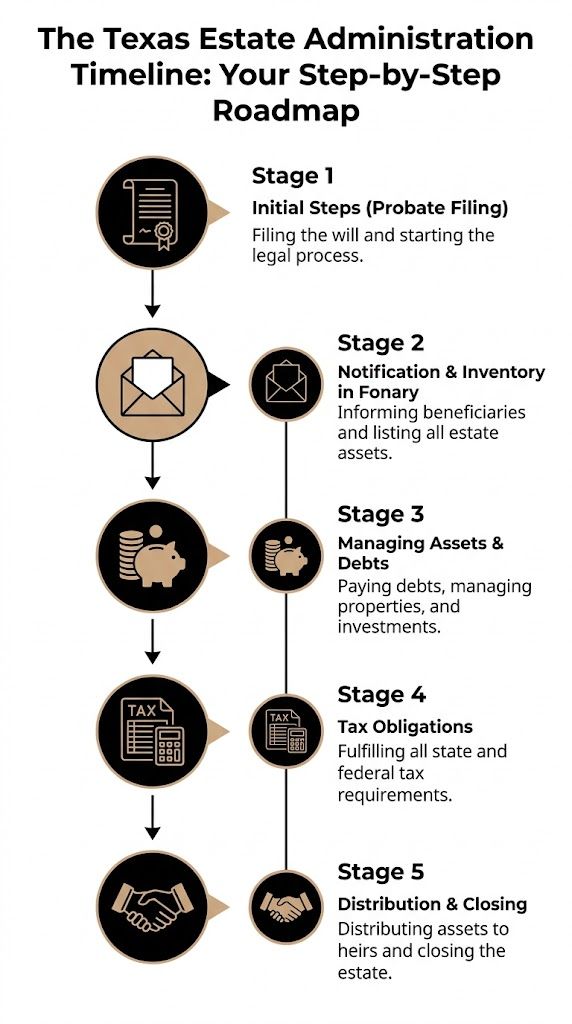
In Harris County, some estates move quickly. Others slow down because of real property, missing records, tax issues, or conflict among beneficiaries. The point is not to race. The point is to act in the right order so you do not create personal risk by trying to be helpful too soon.
Step one begins with filing and proof
The first stage is getting the case opened with the probate court. That usually means locating the original will, confirming basic family and asset information, and preparing the filing that asks the court to recognize the will and appoint the executor.
You will also need supporting records. Families often discover right away that institutions want certified copies of the death certificate, and this guide on what information is on a death certificate in Texas explains why different agencies ask for different details from that record.
Until the court appoints you, caution matters. You may be the person named in the will, but naming and authority are not the same thing.
Step two is appointment and legal authority
After the hearing, if the court approves the will and your appointment, you can receive Letters Testamentary. Those letters work like your proof of authority. Banks, title companies, and other institutions often will not speak with you in a meaningful way until you have them.
This is also the point where your personal exposure becomes more real. Once you have authority, people assume you can act. Texas law also expects you to meet deadlines and follow procedure.
The Texas State Law Library probate guide for estate executors explains key notice requirements, including deadlines related to creditors after Letters Testamentary are issued. Missing a deadline can create problems for the estate and, in some situations, for the executor personally.
Step three is getting control of the facts
This stage is often slower than families expect because the estate on paper and the estate in real life are not always the same.
An account may have a beneficiary designation and pass outside probate. A vehicle title may still list someone who died years ago. A house may be the estate’s largest asset, but it may also need insurance review, repairs, or a decision about whether it should be sold. Before you promise distributions or agree to family requests, you need a clear picture of what exists, what belongs to the estate, and what does not.
That usually means gathering and reviewing:
- Real estate records: deeds, tax statements, mortgage information, HOA records
- Financial account documents: bank statements, brokerage statements, beneficiary designations
- Insurance and retirement information: policy details, claim forms, payout instructions
- Personal property information: vehicles, firearms, jewelry, tools, collections, business equipment
- Debts and recurring expenses: utilities, credit cards, medical bills, funeral expenses, property costs
If you want a more local sense of pacing, this overview of how long probate takes in Texas explains why some administrations close faster than others.
Step four is paying the right obligations in the right order
Once you know what the estate owns and what claims may exist, the next job is handling expenses, debts, and tax-related matters. At this stage, many executors feel squeezed. Beneficiaries may ask why they cannot receive their share yet. Creditors may sound urgent. Neither side gets to set the legal order.
A simple way to understand this stage is to picture the estate as a separate pot of money and property that must be measured before it is divided. If you hand out assets too early and a valid claim appears later, you may have to explain why you reduced the estate before its obligations were settled.
A careful executor does not distribute first and sort it out later. A careful executor confirms what must be paid, what can be challenged, and what should be reserved before making distributions.
Step five is distribution and closing the estate
Only after the estate is ready should you transfer property to beneficiaries or heirs. Sometimes that means writing checks. Sometimes it means preparing deeds, signing vehicle transfer paperwork, collecting receipts, or arranging the sale of a home.
Closing the estate is not just the final task on a list. It is the point where your records matter most. If someone later questions what happened, your file should show when money came in, what was paid out, why decisions were made, and how each distribution matched the will or Texas law.
A typical administration often follows this order:
- File the probate case and gather core records
- Receive court appointment and Letters Testamentary
- Identify, secure, and value estate assets
- Address notices, claims, expenses, and taxes
- Make distributions and complete closing steps
Where the timeline often slips
Delays usually come from a few recurring problems. Real estate needs attention before it can be sold. Financial records are incomplete. Family members disagree about what was promised. None of those issues are unusual in Harris County.
What matters is your response. Slow down, document each decision, and get legal advice before taking a step that cannot easily be undone. Probate is not only about finishing the paperwork. It is also about keeping you from becoming the person blamed for a preventable loss.
Navigating Common Probate Complications in Harris County
Most probate matters don’t become courtroom battles. But many do become tense. In Harris County, estates can get complicated when grief, money, property, and old family disagreements all meet at the same time.

One sibling may think you’re moving too slowly. Another may think you’re favoring someone else. A creditor may contact you with documents you’ve never seen before. A house in Atascocita may need repairs before it can be sold, and no one agrees on what it’s worth.
When family conflict enters the process
A will contest or beneficiary dispute often begins with suspicion, not evidence. Maybe one relative says the deceased was pressured into changing a will. Maybe someone claims property is missing. Maybe a beneficiary believes the executor should have sold an asset sooner.
In Harris County, these conflicts are not unusual. According to Harris County probate dispute guidance, probate disputes often arise from breach of fiduciary duty, and inaccurate asset inventories can escalate 25% of independent administrations into more costly, court-supervised proceedings, prolonging closure by 6 to 12 months.
That point matters for executors because many disputes aren’t about theft. They’re about documentation. If your inventory is incomplete or unclear, beneficiaries may assume the worst.
Local examples that cause trouble
A few situations come up often in northeast Harris County:
- A homestead with changing market value: Family members disagree about whether to keep it, sell it, or how to value it.
- Blended family dynamics: Children from different relationships may read the same will very differently.
- Personal property with emotional value: Furniture, jewelry, firearms, or family keepsakes can trigger sharper disputes than bank accounts.
- Late-discovered debts: Medical providers, lenders, or other claimants may appear after the family thought everything was settled.
Good records calm families. Poor records invite allegations.
What helps when problems start
Executors usually protect themselves best by staying procedural. That means keeping written logs, using valuations when needed, responding through formal channels, and resisting the urge to “just work it out” with side agreements.
If a dispute is brewing, focus on these habits:
- Use written communication: Verbal updates are forgotten or misquoted.
- Preserve valuation support: Appraisals, statements, and receipts matter.
- Treat beneficiaries consistently: Even small differences in communication can look like favoritism.
- Don’t mix estate money with personal money: Separate accounts and records are essential.
Harris County probate courts deal with both routine estates and contested matters. When an estate starts in a simple lane but veers into conflict, the executor often needs legal support not just to move the file forward, but to avoid becoming the target of the dispute.
Why You Need an Executor Representation Attorney to Protect You
Many people assume a probate lawyer is there mainly to prepare forms and attend a hearing. That’s part of the job, but it overlooks its true benefit. For an executor, legal representation is often about protection first.

An executor can face personal exposure for mistakes. That risk is easy to underestimate, especially if you’re trying to help your family and keep costs down. But the role carries legal consequences. According to Atascocita probate guidance on executor risk, a primary but often overlooked reason to hire an attorney is personal liability protection, and 40 to 50% of probate cases involve complexities that increase this risk.
What an attorney actually shields you from
A good executor representation attorney does more than “handle probate.” The attorney helps you avoid decisions that can later be framed as negligence, self-dealing, favoritism, or delay.
That protection often includes:
- Deadline control: Missing notice requirements or filing obligations can create avoidable problems.
- Process discipline: Lawyers help you act in the correct order, especially before any distribution happens.
- Communication management: Beneficiaries and creditors often become less aggressive when communication is formal and documented.
- Dispute prevention: Many conflicts can be reduced before they become lawsuits.
- Court compliance: If the case becomes more complicated, you won’t be trying to learn procedure under pressure.
For local families looking for focused probate help, this page on an estate administration lawyer in Atascocita offers a useful overview of what representation can look like in practice.
Why executors make mistakes without realizing it
Most executor mistakes don’t happen because someone is dishonest. They happen because someone is grieving, rushed, or relying on assumptions.
A few examples:
- Paying one bill too early because it looks urgent
- Letting a relative remove personal property before inventory is complete
- Failing to document the condition or value of real estate
- Giving uneven updates to beneficiaries
- Waiting too long to get advice after a conflict starts
Here’s a short video that helps illustrate why legal guidance matters in estate administration:
The real benefit is peace inside the family
An attorney also creates emotional distance in a good way. Instead of the executor becoming the family’s sole point of pressure, a lawyer can put structure around the process. That can preserve relationships when emotions are already strained.
When an executor has counsel, the attorney doesn’t replace the executor. The attorney helps the executor carry the responsibility safely.
If you’re searching for an executor representation attorney atascocita tx, that usually means you’ve already sensed the truth. This role is not only about honoring a loved one. It’s also about protecting yourself while doing it properly.
Your Executor's Checklist and Questions for Your Attorney
You may have spent the last few days answering family texts, looking for keys, and trying to figure out which papers matter. That is usually the point when an executor realizes this role is part paperwork, part judgment call, and part risk management. Good organization helps your attorney do more than file documents. It helps your attorney spot liability issues early, keep the estate on track, and reduce the chance that a misunderstanding turns into a dispute.
Start by gathering what you can locate confidently. Do not guess, and do not fill gaps with assumptions. If something is missing, tell your attorney that plainly. A missing document is usually easier to address than an inaccurate one.
Documents to gather first
- Original will and any codicils: These set the legal starting point for probate.
- Certified death certificates: Banks, insurance companies, and title offices often ask for them.
- Basic identity information: Your ID, contact details, and the names and contact information for heirs and beneficiaries.
- Property records: Deeds, mortgage statements, vehicle titles, lease documents, and storage unit information.
- Financial records: Recent bank statements, brokerage statements, retirement account information, and check registers.
- Insurance information: Life, homeowners, auto, umbrella, and other active policies.
- Debt information: Credit card statements, medical bills, personal loans, tax notices, and recurring household bills.
- Tax records: Recent income tax returns and any correspondence from taxing authorities.
- List of valuables and access points: Jewelry, firearms, collectibles, business equipment, safes, passwords, and digital account information.
If you are unsure whether an asset belongs to the estate, include it in your file and ask. It is safer to over-collect at the start than to discover an account or item after distributions have already been discussed.
Keep one running file
Use one binder, one folder system, or one secure digital vault for everything related to the estate. Save letters, screenshots, bills, receipts, appraisals, and notes from phone calls. Write down who said what, and when.
That record can protect you.
An executor in Harris County often has to explain decisions months after they were made. Clear notes help show that you acted carefully, treated beneficiaries fairly, and handled estate property with the attention the law requires.
Questions to ask a probate attorney
Bring practical questions, not just legal ones. A good consultation should leave you with a clearer process and a better sense of where personal risk may be hiding.
- What probate process fits this estate, and why?
- What should I do in the next seven days, and what should I avoid until you review the file?
- What deadlines or court requirements apply in Harris County for this case?
- What property should be secured, insured, or valued right away?
- How should I communicate with beneficiaries so updates are consistent and documented?
- What records should I keep for reimbursements, expenses, and any estate account activity?
- Are there warning signs that could lead to a will contest, accounting dispute, or conflict over personal property?
- Which assets may pass outside probate, and which ones still need my attention as executor?
- How do you help protect executors if a family member later claims something was handled unfairly?
- How are legal fees, executor reimbursement, and any compensation typically handled?
Ask how the attorney helps you document decisions and reduce personal exposure. That answer often tells you more than a general promise to "handle probate."
Do not overlook compensation and reimbursement
Executors also need clear advice about money paid to the estate, money paid from the estate, and money spent out of pocket while handling estate business. Texas law may allow compensation and reimbursement in some situations, but those issues should be handled carefully, documented well, and discussed early with counsel.
That matters for two reasons. First, beneficiaries often watch compensation questions closely, especially if family tensions already exist. Second, poor documentation can create the appearance of self-dealing even when the executor acted properly.
A careful executor treats compensation the same way they would treat any other estate transaction. With records, transparency, and legal guidance before money changes hands.
Guidance and Peace of Mind for Atascocita Executors
Serving as executor can feel lonely at first. You may be grieving, sorting through paperwork, and fielding questions from relatives who expect answers right away. The role is manageable, but it’s not casual. Texas law expects care, accuracy, and follow-through.
For families in Atascocita, Humble, and nearby parts of northeast Harris County, probate often intersects with real-life local issues. Homes need attention. Personal property has both market value and sentimental value. Relatives may live in different places and want updates on different timelines. The executor stands at the center of all of it.
The most important point is simple. You don’t have to carry the legal burden alone. Good guidance helps you honor the person who named you, protect the estate, and reduce the chance that your effort turns into personal liability or unnecessary family conflict.
If you’ve been named executor and you’re unsure where to begin, start with three things. Secure property. Gather records. Get advice before making distributions or informal agreements. Those early choices often shape whether the process stays orderly or becomes much harder than it needs to be.
A careful executor doesn’t need to have every answer immediately. A careful executor needs a clear process, solid documentation, and support when complications arise. That’s how you protect both the estate and yourself.
If you’ve been named executor and need clear local guidance, schedule a free consultation with Law Office of Bryan Fagan – Atascocita TX Lawyers. The firm serves Atascocita, Humble, and families across Harris County with compassionate probate and estate administration support, helping executors move forward with confidence while protecting their loved one’s legacy and their own peace of mind.