When you're not married to your child's other parent in Texas, the law starts with a very clear, and often surprising, default position. At the moment of birth, the mother is automatically given sole legal and physical custody. The father, on the other hand, has no legal rights at all until paternity is officially established.
This means a father can be completely involved—providing care, support, and love—but without taking legal action, he has no official say in major decisions and no guaranteed time with his child. It's a challenging reality for many families in our Atascocita community, but it's the starting point from which a stable future can be built.
Your Rights as an Unmarried Parent in Atascocita

Trying to figure out parenting rights when you were never married can feel like navigating a maze without a map. Many folks right here in Atascocita, Humble, and the surrounding northeast Harris County area are shocked to learn that Texas law doesn't treat unmarried and married parents the same way. For an unmarried mother, the law automatically makes her the sole managing conservator, giving her the exclusive right to make critical decisions for the child.
For an unmarried father, this can be incredibly unsettling. You might be paying for everything and spending half your time with your child, but without a court order, you have zero legally protected rights. This is a critical point that can't be overstated. The good news? Texas provides a very direct legal path to secure your rights and create a stable, predictable future for your child.
The Path Forward is a SAPCR
The legal tool designed specifically for this situation is called a Suit Affecting the Parent-Child Relationship, or SAPCR (we pronounce it "sap-sir"). Filing a SAPCR is the formal step-by-step process of asking a Harris County judge to define the rights and responsibilities for your family. Think of it as a single, comprehensive lawsuit that gets everything on the record at once, providing clarity for everyone involved.
A SAPCR accomplishes several essential goals:
- Establishes Paternity: It legally confirms who the father is, which is the cornerstone for all of a father's rights.
- Sets Conservatorship (Custody): It spells out who gets to make important decisions for the child (medical, educational, etc.).
- Creates a Possession Order (Visitation): It lays out a clear, enforceable schedule detailing when the child will be with each parent.
- Orders Child Support: It calculates the financial obligations for both parents to ensure the child’s needs are consistently met.
This entire process isn't about picking a "winner." It's guided by one single, powerful principle.
The "Best Interest of the Child" Standard
In Texas, every single decision a judge makes in a custody case—from visitation schedules to who makes medical choices—is filtered through the "best interest of the child" standard. This isn't just a phrase; it's a legal test that forces the court to consider the child's emotional and physical well-being, their present and future needs, and the stability of their home life above all else.
Securing Your Role as a Parent
Filing a SAPCR is what turns your personal parenting arrangement into a legally protected relationship. Whether you're a mother in Atascocita who needs to formalize child support or a father in Kingwood who wants to guarantee you'll see your child on weekends, this is the process that makes it happen.
While the starting line is different for unmarried parents, the law absolutely supports the active involvement of two loving parents once the right legal steps are taken. If this is the situation you're in, please know you aren't the first to walk this path. The team at The Law Office of Bryan Fagan – Atascocita TX Lawyers is here to help our neighbors in the Atascocita community figure out their next steps. To get some clarity on your specific situation, we invite you to schedule a free, no-obligation consultation at our Atascocita office.
How to Legally Establish Paternity in Texas
For an unmarried father in Texas, everything starts with legally establishing paternity. It's the absolute bedrock of all your parental rights. Without it, you have no legal standing for custody or visitation, no matter how much you're a part of your child's life. This process is what turns your biological link into a legally protected relationship.
Think about a dad living right here in Humble. He's been there since day one, changing diapers and celebrating milestones. He wants his name on the birth certificate and the legal right to weigh in on his child’s school, doctor, and upbringing. To secure these fundamental rights, he has two primary paths he can take.
The Acknowledgment of Paternity: The Cooperative Path
The simplest and most straightforward route is for both parents to sign a voluntary Acknowledgment of Paternity (AOP). This is a sworn legal document where the mother and father agree that the man is, in fact, the child's biological father.
Often, this form is presented to parents right at the hospital after the baby is born. Signing it is a huge legal step with permanent consequences, so it's critical to be 100% certain about paternity before putting pen to paper. Once signed and filed, it carries the same legal weight as a court order.
- When is it a good choice? This is the perfect option for parents who are on the same page and working together.
- What does it do? It legally makes the man the father, which allows his name to be added to the birth certificate.
- What does it not do? An AOP on its own doesn't create orders for custody, visitation, or child support. You still need to file a SAPCR to get those enforceable rights and duties hammered out.
For a closer look at the AOP form and what it entails, you can get more details as you learn more about how to establish paternity in Texas.
The Court-Ordered Path: Proving Paternity
What happens when parents don't agree? Or if one parent is simply refusing to cooperate? The other parent can file a SAPCR and ask the court to step in and order genetic (DNA) testing. A judge will order the mother, child, and alleged father to submit samples for testing. It’s a very common and direct process.
If the DNA test comes back showing the man is the father with at least a 99% probability, the judge will sign an order legally naming him as the father. From there, the court can move forward with making the necessary decisions about custody, possession schedules, and financial support.
What is the "Presumption of Paternity"?
Sometimes, Texas law will automatically presume a man is the father, which can really simplify things. For unmarried fathers, this is a big deal, as it helps bridge the gap between being a dad and being a legal dad under the Texas Family Code.
For example, a key presumption kicks in when an unmarried father and the child's mother live together continuously and he presents himself as the father for the first two years of the child's life. This comes from Section 160.204 of the code, and it's designed to give legal weight to fathers who are actively involved from the start.
No matter how you get there—whether through a cooperative agreement or a court order—establishing paternity is the non-negotiable first step. It’s the key that unlocks the courthouse doors, giving you the ability to ask a judge to protect your right to be a parent.
Whether you are an Atascocita mother trying to formalize child support or a father from a nearby community who wants to lock in your visitation rights, your journey begins here. If you're not sure which path is right for your family, our team is here to help.
Understanding Your Rights: Conservatorship and Possession Orders
Once you’ve legally established paternity, the next step is to define each parent's role in the child's life. This is where the court steps in to create a clear framework for your rights and responsibilities.
In Texas, we don’t really use the term "custody." Instead, the law talks about conservatorship. Think of it as the legal blueprint for who gets to make the big decisions for your child—everything from where they go to school to what doctor they see. It sounds a bit formal, but its job is to make co-parenting predictable and stable for families in our Atascocita community.
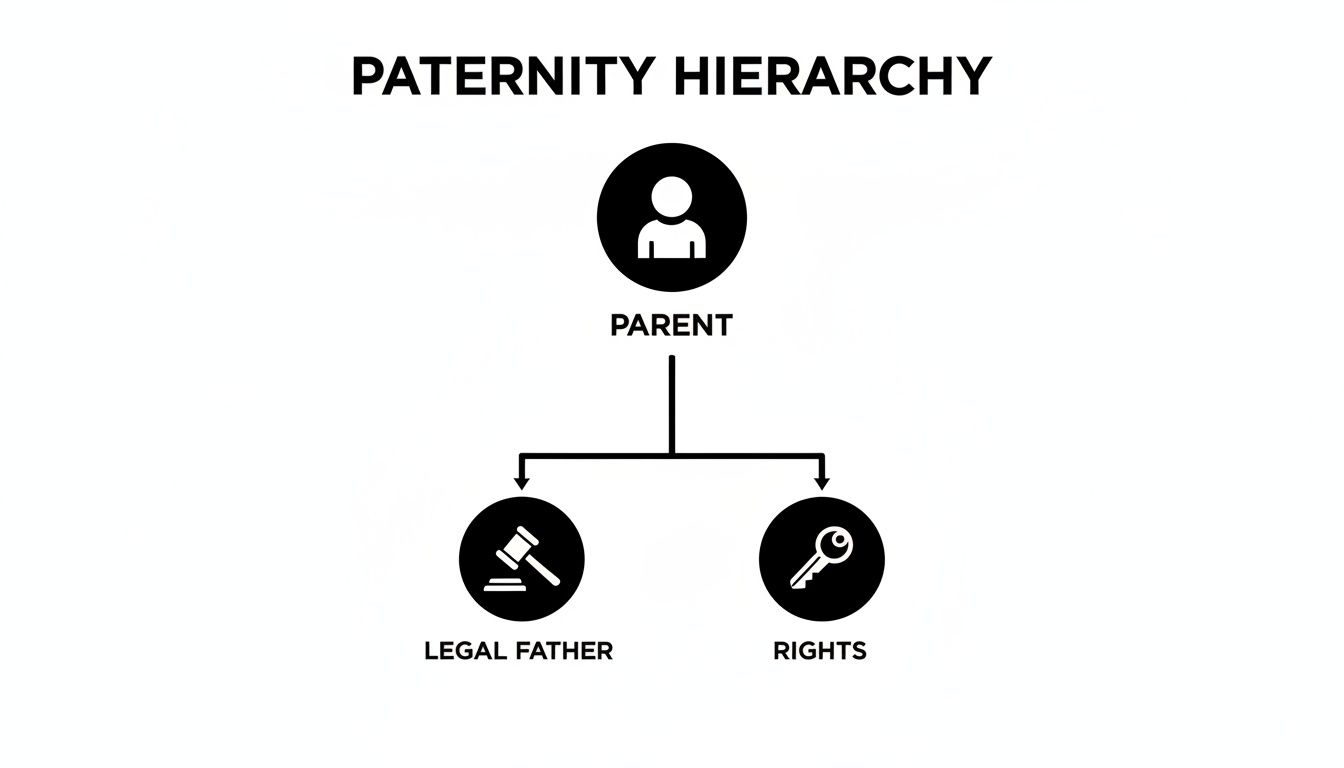
This journey from parent to legal father is what unlocks your enforceable rights under the law.
Joint vs. Sole: What Kind of Conservator Will You Be?
When it comes to unmarried parents in Atascocita and across Harris County, the court starts with a strong presumption: that a Joint Managing Conservatorship (JMC) is what’s best for the child. This is by far the most common outcome.
Being named Joint Managing Conservators doesn't automatically mean a 50/50 split of time with your child. What it does mean is that both parents share the rights and duties of raising their child. You'll typically make major decisions together, though the court will usually designate one parent who has the exclusive right to determine the child's primary residence.
A Sole Managing Conservatorship (SMC) is much rarer. This arrangement is typically reserved for tough situations, like a history of family violence, child neglect, or serious substance abuse. In an SMC, one parent gets the exclusive right to make almost all major decisions, while the other parent is named the "Possessory Conservator" with more limited rights.
In the eyes of Texas law, your marital status has nothing to do with your ability to be a great parent. The court’s primary focus is always on fostering a healthy relationship between the child and both parents, which is why joint conservatorship is the standard.
To better understand how these roles function, this table breaks down the typical division of rights and responsibilities.
Conservatorship Roles for Unmarried Parents in Texas
| Right or Responsibility | Joint Managing Conservator (JMC) | Sole Managing Conservator (SMC) |
|---|---|---|
| Child's Primary Residence | One parent is designated to establish the child's residence, often within a specific geographic area. | The SMC has the exclusive right to determine the child's primary residence without geographic restriction. |
| Medical Decisions | Rights are often shared, but one parent may have the "tie-breaker" vote after consulting the other. | The SMC has the exclusive right to consent to medical, dental, and surgical treatment. |
| Educational Decisions | Both parents typically have the right to make decisions about the child's education after consulting each other. | The SMC has the exclusive right to make all educational decisions. |
| Child Support | The parent who does not determine the child's residence (the "non-primary" parent) usually pays child support. | The Possessory Conservator (the non-SMC parent) pays child support to the SMC. |
| Access to Records | Both parents have the right to access medical, dental, psychological, and educational records. | Both the SMC and Possessory Conservator can access records, but the SMC controls decision-making. |
| Receiving Child Support | The parent designated as the child's primary residence is the one who receives child support payments. | The SMC is the parent who receives child support payments. |
This table provides a general overview, but every court order is tailored to the specific circumstances of the family.
The Possession Order: Your Visitation Calendar
After settling conservatorship, the court will issue a Possession Order. This is simply the official Texas term for your visitation schedule. It’s a detailed calendar that lays out exactly when the child will be with each parent, eliminating confusion and potential arguments down the road.
For most parents living within 100 miles of each other, Texas law provides a default schedule called the Standard Possession Order (SPO). It’s designed to be a fair and reliable starting point.
Here’s a quick look at what the SPO usually includes:
- The non-primary parent has the child on the first, third, and fifth weekends of the month.
- Major holidays like Thanksgiving and Christmas are alternated between parents each year.
- A 30-day possession period is included for the summer break.
Many families I've worked with in the Humble and Atascocita areas find that the SPO's clear structure helps them co-parent more effectively. The court can also order an Expanded Standard Possession Order (ESPO), which gives the non-primary parent a bit more time—usually by adding overnight visits on Thursdays during the school year.
For a more detailed explanation of the rights and duties involved, you can get more information by learning about conservatorship in Texas.
Ultimately, these orders are about creating a stable, predictable world for your child. Understanding the key difference between conservatorship (your rights) and possession (your time) is the first step toward navigating this process with confidence.
Calculating Child Support and Medical Support

One of the most common questions we get from unmarried parents in Atascocita is, "Can I still get child support if we were never married?" The answer is absolutely, yes. Once paternity is established and a SAPCR order is in place, the court will address the financial support needed to raise your child.
It's important to remember that these orders aren't about rewarding one parent or punishing the other. They exist for one reason: to ensure the child's needs are met. Typically, the parent who doesn't have the exclusive right to choose the child's primary home (often called the non-primary conservator) is the one ordered to pay child support.
How Texas Calculates Child Support
Texas keeps things pretty straightforward by using a percentage-based formula. This system creates consistency for families, whether you're in Harris County or anywhere else in the state. The calculation starts with the paying parent's net monthly resources.
So, how do you find that number? First, the court looks at all of the parent's gross income—wages, salary, bonuses, overtime, you name it. From that total, they subtract specific things like social security taxes, federal income tax (calculated as if they're a single person with one exemption), and the cost of the child's health insurance premium. What's left over is the net resource figure used for the calculation.
After that, a standard percentage is applied based on how many children the order covers:
- 1 Child:20% of net resources
- 2 Children:25% of net resources
- 3 Children:30% of net resources
- 4 Children:35% of net resources
- 5 or more Children:40% of net resources
Keep in mind, these percentages can be adjusted if the paying parent is already legally responsible for supporting other children from a different relationship.
Let's look at a quick example. Say a father in Humble has net monthly resources of $4,000 and he has one child with his former partner. Based on the guidelines, his child support payment would be $800 per month (20% of $4,000). This money goes to the primary parent to help with everyday expenses like housing, food, and clothes.
Providing for Healthcare Needs
Child support covers the day-to-day stuff, but what about doctor visits and braces? Texas law also requires parents to handle their child’s medical and dental needs. This is a separate, but equally critical, part of the financial picture.
Usually, the court will order one parent to provide health insurance for the child. This responsibility often falls to the parent who can get affordable coverage through their job. If that's not an option for either parent, the child might be enrolled in a government program like Medicaid.
The costs don't stop at the monthly premium, though. Any out-of-pocket medical expenses—think co-pays, deductibles, and prescriptions—are typically split right down the middle (50/50) between the parents, unless the judge decides on a different arrangement. The parent paying for the insurance policy often gets a credit for that expense in their child support calculation.
Getting the financial side of your custody order right is vital for your child’s security. If you’re trying to navigate securing or paying child support, you don't have to do it alone. Schedule a free consultation at The Law Office of Bryan Fagan's Atascocita office, and let us help you protect your child’s financial future.
What to Do When Your Custody Order Needs to Change or Isn't Being Followed
Life doesn't stand still. The court order that made perfect sense for your family a few years ago might feel completely out of sync with your reality today. It's important to remember that a custody, visitation, or child support order isn't set in stone. It's a living document that's meant to evolve as your children grow and your family’s circumstances change.
Many parents here in the Atascocita and Humble area find themselves needing to update their order after a major life event. The good news is, Texas law anticipates this and provides a clear path for making those necessary adjustments.
When Can You Change a Custody Order in Texas?
To successfully modify your existing order in a Harris County court, you can't just ask for a change because you want one. You have to prove two specific things to the judge:
- There has been a material and substantial change in circumstances since the original order was signed.
- The change you're asking for is in the best interest of the child.
This two-part test is designed to create stability for children by preventing parents from running to court for every minor disagreement. The change has to be significant.
So what counts as "material and substantial"? While it's a broad legal term, it typically covers situations like these:
- Job changes or a parent moving. Maybe a parent in Humble gets a promotion that requires constant overnight travel, making the current possession schedule impossible. Or perhaps one parent needs to relocate for work.
- The child's wishes. Once a child turns 12, they have the right to speak with the judge in chambers (privately) to express their preference about which parent they want to live with.
- A parent's new life situation. Things like a remarriage can introduce a new stepparent and stepsiblings, which can certainly change the dynamic in the home.
- A child’s evolving needs. As kids get older, their needs change. A child might develop new health concerns, require special educational support, or become deeply involved in an extracurricular activity that conflicts with the old schedule.
Sometimes, the law itself changes, which can be grounds for a modification. For example, recent updates to the Texas Family Code have expanded the standard possession schedule, giving some non-primary parents more time with their kids. This legislative shift can absolutely be considered a material and substantial change, opening the door to update an older order to better serve a child's best interests.
What Happens When an Order Is Ignored?
It’s one of the most frustrating things a parent can go through: the other parent simply decides not to follow the court's order. Maybe they consistently show up late for exchanges, refuse to let you have your court-ordered time, or just stop paying child support.
You don't have to put up with this. Your custody order is a legally binding document, and you have powerful tools to enforce it.
If the other parent is violating the possession schedule, you can file an enforcement action. In this legal filing, you'll need to detail every single violation with dates, times, and specifics of what happened. A judge can hold the other parent in contempt of court, which can lead to serious consequences like fines, jail time, and an order forcing them to pay your attorney's fees. The court can also grant you make-up visitation time for any periods you were wrongly denied.
When it comes to unpaid child support, the state gets involved with just as much force. The Office of the Attorney General can suspend a non-paying parent's driver's license, place a lien on their property, or even intercept their tax refunds. Being ready for these proceedings is critical, and knowing how to prepare for a custody hearing can give you a major advantage.
At the end of the day, protecting your child’s stability is what matters most. Whether that means updating an old order to fit your family’s new reality or holding the other parent accountable, the law is on your side.
Handling modifications and enforcements requires a precise legal strategy. If your circumstances have changed or you're dealing with a co-parent who won't follow the rules, it's time to take action. Reach out to our Atascocita office to schedule a consultation, and let’s talk about how we can protect your rights and your child's well-being.
Why You Need an Atascocita Family Law Attorney
Let's be honest: trying to navigate the Texas Family Code on your own is a recipe for disaster, especially when your relationship with your child hangs in the balance. The system is a maze of strict deadlines, confusing forms, and legal jargon that can trip up even the smartest person.
This is why hiring an experienced local family law attorney isn't just a good idea—it's absolutely critical for protecting your family's future.
Many parents try to go it alone, thinking they can save money or that their situation is "simple." But this often leads to mistakes that can't be undone. A missed deadline or a poorly filled-out form isn't just a simple mistake; it can permanently weaken your case in the eyes of a Harris County judge.
Avoiding Common and Costly Mistakes
Think of an attorney as your guide and your shield. They know the terrain and can help you avoid the common pitfalls that can sink your case.
- Flawed Paperwork: Legal orders need to be airtight. A possession schedule with vague language or an unenforceable child support agreement just creates more conflict down the road.
- Emotional Decisions: It’s impossible to be objective when your kids are involved. It's easy to make rash decisions out of anger or frustration, which rarely helps your case. An attorney provides a calm, strategic perspective when you need it most.
- Missed Opportunities: A seasoned lawyer understands the local courts and what specific judges want to see. They can build a powerful case for your goals, whether that's securing a 50/50 schedule or fighting for the right to make decisions about your child's education.
Trying to handle a custody case yourself is like performing surgery on a loved one with only a first-aid manual. The stakes are just too high, and the potential for causing permanent damage is very real. A skilled attorney ensures the process is handled with precision and care.
At The Law Office of Bryan Fagan – Atascocita TX Lawyers, we're deeply rooted in the Atascocita and Humble communities. We know the local court system inside and out, and we approach every family's situation with the focus and compassion it deserves. We'll be right there with you, from establishing paternity all the way through fighting for your child's best interests in court.
You don't have to walk this path alone. Your parental rights and your child's well-being are far too important to leave to chance.
Take the first step. Contact The Law Office of Bryan Fagan – Atascocita TX Lawyers today to schedule a free, no-obligation consultation at our Atascocita office. Let us help you lay the groundwork for a stable, secure future for your family.
Got Questions? We've Got Answers
When you're navigating a custody situation as an unmarried parent in Atascocita or Humble, it's natural to have a lot of questions. Let's tackle some of the most common ones we hear from parents just like you.
We Agree on Everything. Do We Really Need a Court Order?
Yes, you absolutely do. This is a big one. A handshake deal or even a signed agreement you get notarized is not legally enforceable in Texas.
Think of it this way: without a formal court order signed by a judge, your agreement is built on a foundation of trust. If that trust breaks down, so does your entire arrangement. A court order turns that handshake deal into an ironclad contract, providing the stability your child needs and protecting both parents' rights with predictable, enforceable schedules and support.
Does the Mother Automatically Get Custody in Texas?
That’s probably the biggest myth in Texas family law. The answer is a hard no. The law is completely gender-neutral and flat-out prohibits a judge from picking a winner based on who is the mom and who is the dad.
The court's one and only focus is the "best interest of the child." The starting point for every judge is the assumption that having both parents involved as Joint Managing Conservators is what's best, unless someone can prove a good reason why that wouldn't work—like a history of family violence or substance abuse.
I'm the Father, But I'm Not on the Birth Certificate. What Are My Rights?
This is a critical situation. If you are not on the birth certificate, you legally have no parental rights. None. It doesn't matter how involved you are or if you've been paying for everything since day one. In the eyes of the law, until paternity is established, you can't enforce visitation or make legal decisions for your child.
The first step is to file a Suit Affecting the Parent-Child Relationship (SAPCR) to get the ball rolling. This process will legally establish you as the father, often through a simple DNA test. Once a judge signs that order, you are the legal father, and the court can then create enforceable orders for custody, visitation, and support.
Going through this process can feel overwhelming, but you aren't on your own. The dedicated team at The Law Office of Bryan Fagan – Atascocita TX Lawyers is here to bring clarity to your situation. Schedule your free consultation today and take the first step toward securing your family’s future.