When you start thinking about estate planning, the word ‘probate’ inevitably pops up, and frankly, it can sound intimidating. For families in Atascocita and Humble, planning for the future is about protecting loved ones. Probate is the formal court process Texas uses to validate a will and supervise how a person’s assets are distributed after they die. It’s no wonder so many families look for ways to sidestep it to save time, maintain privacy, and reduce costs.
At The Law Office of Bryan Fagan, we understand that you’ve worked hard to build a legacy for your family. Our goal is to provide clear, step-by-step guidance to help our neighbors in northeast Harris County navigate these important decisions with confidence.
What Is Probate and Why Texas Families Avoid It
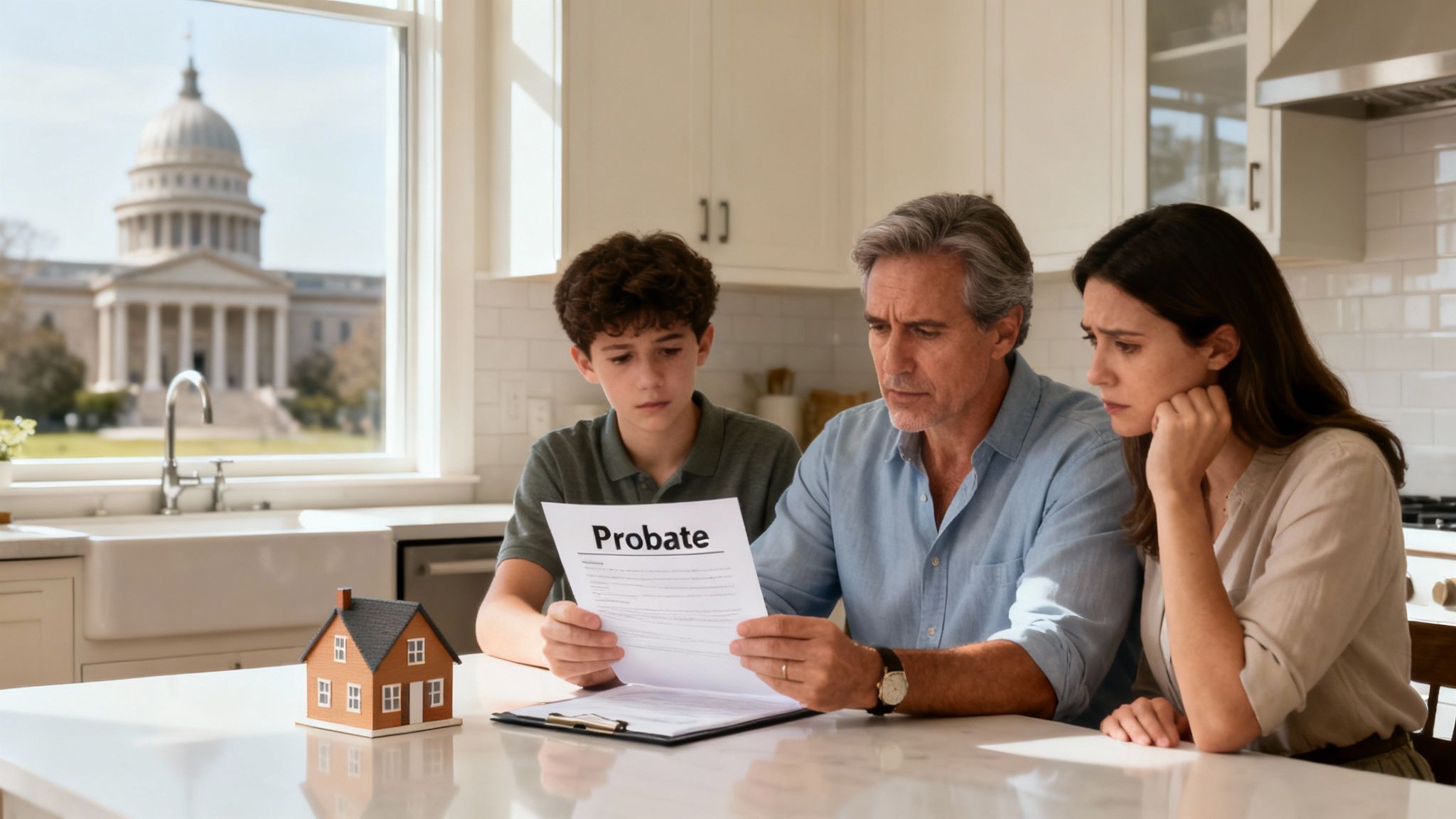
Here in Atascocita, we’re all about family, privacy, and common sense. When a loved one passes away, the last thing you want to deal with is a drawn-out, public legal process. That’s often what probate feels like.
While sometimes unavoidable, probate often adds a layer of stress during an already tough time. It is the official court proceeding where a judge—right here in Harris County—formally recognizes a person’s death and authorizes someone to manage their estate.
This process involves validating the will (if there is one), appointing an executor, creating a detailed inventory of assets, paying off any outstanding debts, and, finally, distributing the remaining property to the right heirs. It serves a purpose, but many families in Humble and across northeast Harris County have very good reasons for wanting to keep their affairs out of the courthouse.
The Major Downsides of the Probate Process
For most folks, the drive to avoid probate boils down to three big issues that can really affect the legacy you’re trying to build. Understanding these drawbacks is the first step toward a smarter estate plan that protects your Atascocita family.
It Can Be Time-Consuming: Don’t expect probate to be a quick affair. Even a simple, uncontested case in Texas can easily take six months to a year to wrap up. If anything gets complicated—a family member contests the will, for example—it can drag on for much longer, leaving your loved ones waiting.
It Is a Public Record: This is a big one for many people. Once a will is filed for probate, it becomes a public document. Anyone can go to the Harris County courthouse and look up the details of your estate, from what you owned and its value to who got what. Most families would much rather keep their financial business private.
It Can Be Expensive: Probate isn’t free. There are court costs, attorney’s fees, and sometimes fees for the executor. All of these expenses are paid from the estate’s assets, which means there’s less left for your beneficiaries. The more complex the estate, the higher the bill.
For many people, estate planning is not just about distributing assets—it’s about making the transition as smooth and private as possible for the next generation. Avoiding probate is a key strategy to achieve that peace of mind.
Ultimately, while probate is the standard path for many estates, it’s definitely not the only one. With proactive planning, you can set up legal tools that allow your property to pass directly to your loved ones, with no court intervention needed. This guide will walk you through the practical, effective ways to avoid probate in Texas, helping you ensure your legacy is handled precisely the way you want.
If you’re curious about what the standard court process involves, you can learn more about how to probate a will in Texas in our detailed guide.
Using Revocable Living Trusts for Privacy and Control
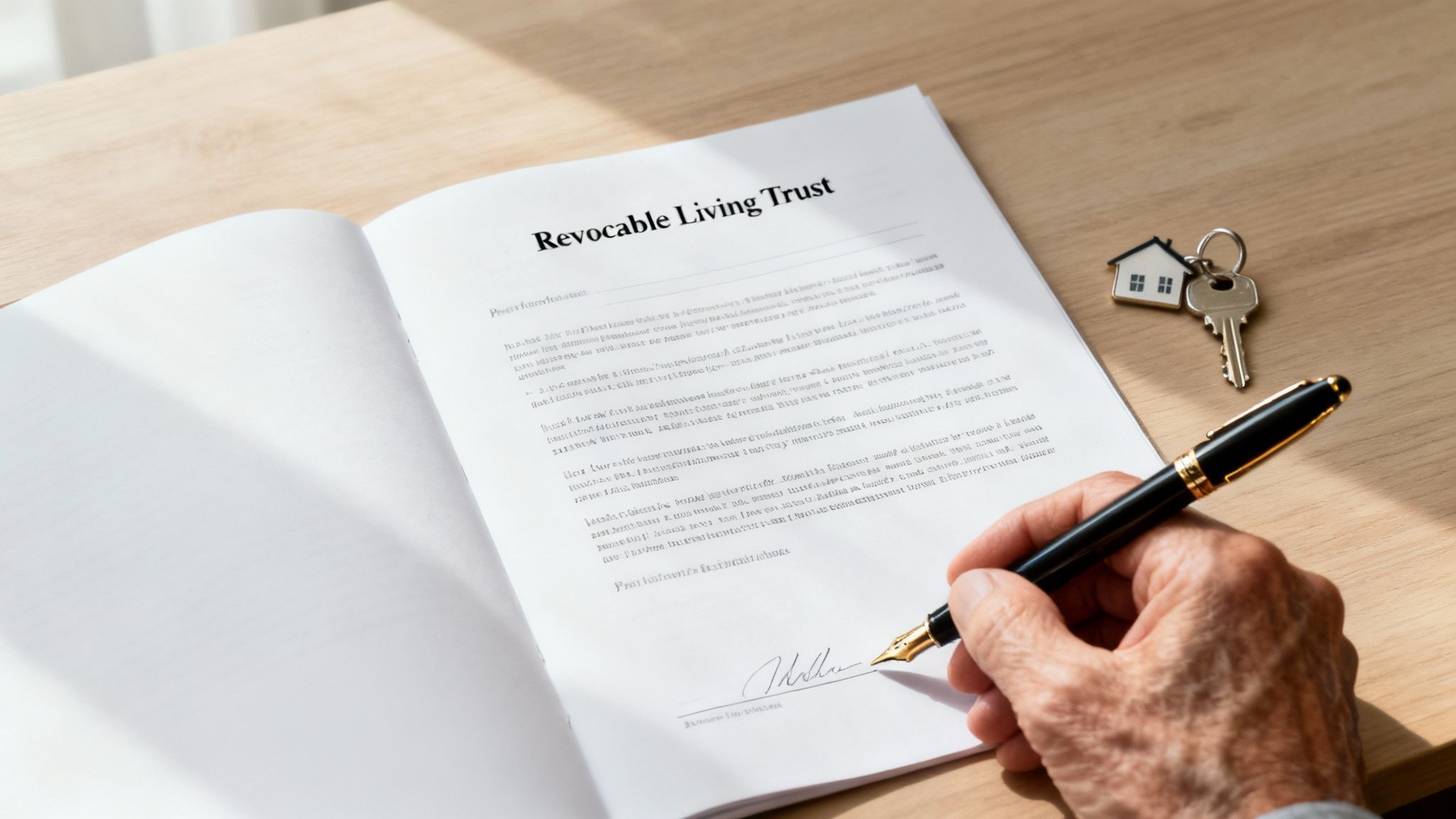
When we talk about the most effective tools for avoiding probate in Texas, the revocable living trust is often at the top of the list. It’s one of the most robust and comprehensive tools you can use. Think of it as creating a private set of rules for your assets—a playbook that works for you while you’re alive and for your family after you’re gone.
So, how does it work? You create a legal entity (the trust) and then transfer ownership of your property from your individual name into the trust’s name. While that might sound like you’re giving up your property, the opposite is true. You maintain complete control over every single asset you place inside it.
The real benefit comes later. Because your assets are technically owned by the trust, they aren’t part of your personal estate when you pass away. This simple fact means they get to skip the entire public, often lengthy, probate process. Instead, your assets can be passed on to your loved ones privately and efficiently, just the way you intended.
Understanding the Key Roles in a Living Trust
To really understand how a living trust operates, you need to know the three main players. The best part is that when you set it up, you usually fill all three roles, which is how you keep total control.
- The Grantor: That’s you. You’re the one who creates the trust and puts your assets into it.
- The Trustee: This is the manager. As the initial trustee, you’re in charge. You can still buy, sell, and manage the assets just like you always have.
- The Beneficiary: This is also you, at least at first. You’re the one who gets to enjoy and benefit from all the assets held in the trust.
You’ll also name a successor trustee. This is a person or institution you trust to take over management of the trust if you become unable to do so or after you pass away. They have a legal duty to follow your instructions to the letter.
A living trust is essentially a private agreement that allows your chosen successor to manage and distribute your assets without court supervision, keeping your family’s financial affairs out of the public record.
Let’s imagine an Atascocita family with a home near Lake Houston, some investment accounts, and a small business in Humble. By setting up a living trust and funding it with these assets, they create a seamless transition plan. When the parents pass, their daughter, the successor trustee, can immediately step in to manage everything without ever setting foot in a Harris County probate court. That means no frustrating delays and no public airing of the family’s finances.
The Flexibility and Privacy a Trust Provides
One of the biggest advantages of a revocable living trust is right there in the name: it’s flexible. “Revocable” simply means you can change your mind. You can amend the trust or even dissolve it completely anytime you want while you’re alive.
Life changes, and your estate plan should be able to change with it. A new grandchild, a major property sale, a change in relationships—your trust can be easily updated to reflect your new reality. It’s a dynamic tool, not a static document set in stone. For a closer look at how these are put together, our page on wills and trusts in Atascocita offers more detail.
Beyond flexibility, the privacy a trust provides is priceless. A will, once it enters probate, becomes a public court record. Anyone can go look up the details of your estate. A trust, on the other hand, is a private document. The specifics of what you owned and who gets what remain completely confidential. This can shield your loved ones from nosy onlookers and potential scammers during an already difficult time.
Just remember, setting up a trust is a two-step process. First, you create the document. Second, you have to formally transfer title of your assets—your house, bank accounts, investments—into the trust’s name. This crucial step is called funding the trust, and it’s what makes the whole thing work. An unfunded trust is like an empty box; it won’t help you avoid probate. This is where working with a local Atascocita attorney can ensure everything is done right, giving you and your family true peace of mind.
Protecting Your Real Estate from Probate
For most of us here in the Humble and Atascocita areas, our home is far more than just four walls and a roof. It’s where life happens. It’s also likely your single biggest financial asset, which is why the thought of it getting tangled up in probate court can be so stressful.
Thankfully, Texas law gives us some very direct and effective ways to make sure your real estate passes smoothly to your loved ones, sidestepping the probate process entirely.
Two of the best tools for the job are special types of property deeds. These aren’t complicated, but they are powerful legal documents designed to make the transfer of your home or land automatic when you pass away. Let’s break down how they work.
The Power of a Transfer on Death Deed (TODD)
The Transfer on Death Deed, or TODD as it’s commonly known, is a real game-changer for Texas homeowners. It’s a simple concept that works a lot like the beneficiary designation you’d put on a life insurance policy or bank account. You fill out and sign a specific deed that names who you want to inherit the property, and then you file it with the Harris County Clerk’s office.
Here’s the brilliant part: while the TODD is filed now, it has zero effect on your ownership while you’re alive. You maintain complete control. You can sell your home, take out a new mortgage, or even revoke the TODD and create a new one if your plans change. The property only transfers at the moment of your death, automatically and without a judge’s involvement.
A TODD is essentially a pre-recorded instruction for your property. It tells the county who the new owner is the moment you’re gone, saving your family a ton of time, expense, and public hassle.
Texas was actually one of the first states to authorize this powerful tool back in 2015, allowing property owners to name a beneficiary who gets the property without any probate court intervention. You can learn more about these statutory changes by reviewing historical findings on Texas court procedures.
Joint Tenancy with Right of Survivorship
Another popular strategy, especially for married couples, is owning property as Joint Tenants with Right of Survivorship. This is a specific way for two or more people to hold the title to a piece of real estate.
The magic words are “right of survivorship.” This legal phrase means that when one of the joint owners passes away, their share of the property is automatically absorbed by the surviving owner (or owners). It doesn’t become part of the deceased’s estate, so it completely avoids probate. For a husband and wife in Atascocita, this means if one spouse passes, the other becomes the sole owner of their home almost instantly.
Comparing the Two Deed Strategies
It can be tough to decide which is the better fit. Here’s a quick side-by-side look:
| Feature | Transfer on Death Deed (TODD) | Joint Tenancy with Right of Survivorship |
|---|---|---|
| When it Takes Effect | Only upon the owner’s death. | Immediately upon creating the joint tenancy. |
| Control | You keep 100% control to sell, mortgage, or change it. | Both owners have a current ownership interest. |
| Best For | Individuals or couples wanting total flexibility and control. | Married couples or committed partners in a stable relationship. |
| Simplicity | Very straightforward to create and file. | Requires very specific legal language in the deed to be valid. |
Practical Steps to Protect Your Property
Whether you go with a TODD or joint ownership, the process isn’t as simple as downloading a form from the internet. It involves carefully drafting a new deed with precise legal language that complies with Texas law and then properly recording it with the Harris County Clerk.
A small mistake in the wording or a failure to file it correctly can completely invalidate your efforts. If that happens, the very property you tried to protect could end up right back in the probate court you wanted to avoid. This is one of those times when working with a local attorney who handles these documents every day is the smartest way to safeguard your most valuable asset.
If you have questions about which deed is right for your family or need help getting the documents prepared and filed correctly, our team in Atascocita is here to help. Schedule a free consultation with us today to find the best way to secure your family’s home for the future.
Tapping Into Beneficiary & POD Designations
When it comes to keeping your estate out of the Texas probate courts, some of the most effective tools aren’t hiding in a lawyer’s office—they’re probably already part of your financial portfolio. Many of your accounts have a simple, built-in feature that lets you name someone to inherit them directly.
These are known as beneficiary designations, Payable-on-Death (POD), or Transfer-on-Death (TOD). Setting them up is often as simple as filling out a one-page form from your bank or investment company. It’s one of the easiest and fastest ways to get your money straight into the hands of your loved ones.
Where You Can Use These Probate-Skipping Tools
Think of these designations as a direct order you give to a financial institution. This instruction is a binding contract that, for that specific account, actually overrides whatever your will says. It’s a powerful shortcut.
You’ll find this feature on a whole host of common assets:
- Life Insurance Policies: This is the classic example. The payout goes directly to your named beneficiary, period.
- Retirement Accounts: Your 401(k), 403(b), IRA, and other pension plans all rely heavily on beneficiary designations.
- Bank Accounts: Checking, savings, money market accounts, and CDs can all have a Payable-on-Death (POD) beneficiary named.
- Investment Accounts: Your brokerage accounts with stocks, bonds, and mutual funds can be set up with a Transfer-on-Death (TOD) registration.
- Annuities: These also let you name a beneficiary to receive whatever is left in the contract.
When you properly name a beneficiary on these accounts, you’re effectively taking them out of the probate pile. After you pass away, your beneficiary usually just needs to show the bank or brokerage firm a death certificate and their ID to claim the funds. It’s that simple.
How This Plays Out for an Atascocita Family
Let’s look at a pretty typical situation we see here in the Atascocita area. A retired teacher had her savings in a few places: a checking account at a local bank in Humble, her old 401(k) from the school district, and a small life insurance policy she’d had for years.
Her late husband was still listed as the beneficiary on everything. It’s an easy thing to overlook. When we sat down for a review, she realized none of her designations were current. Her wish was simple: leave everything split evenly between her two kids.
So, she went to her bank and filled out a POD form for her checking account, naming both children 50/50. She then logged into her 401(k) portal online and did the same thing. One phone call to her insurance agent got her the right form for that policy. In a single afternoon, she made sure her most significant assets would pass to her children almost immediately, no court required.
Keeping your beneficiary designations up-to-date isn’t a one-and-done task. It’s a crucial, ongoing part of smart estate planning that saves your family from headaches and unintended consequences.
Why You Can’t “Set It and Forget It”
That teacher’s story drives home the single most important rule here: review your beneficiaries regularly. Designations you made a decade ago might be completely wrong for your life today. Life happens, and your estate plan needs to keep up.
It is absolutely critical to pull out these forms and check them after any major life event:
- Getting married or divorced
- The birth of a child or grandchild
- The death of someone you named as a beneficiary
- A major falling out or change in your relationship with a beneficiary
Forgetting to make updates can create truly messy and heartbreaking problems. We’ve seen cases where an ex-spouse inherits a huge IRA, or a child born after the forms were signed gets left out entirely. Taking five minutes every year or so to double-check your choices can prevent a world of hurt and conflict for the people you leave behind.
Comparing Your Probate Avoidance Options Side by Side
So, you’ve seen the main tools in the Texas estate planning toolbox: revocable living trusts, special property deeds, and simple beneficiary designations. They all promise to help your family steer clear of the probate courts. But how do you know which one is right for you here in the Atascocita or Humble area?
The truth is, it’s not about finding one magic bullet. The best approach often involves a combination of these tools, tailored to your specific assets, family dynamics, and what you want to accomplish. Let’s lay them out side-by-side to see how they stack up.
Think of it this way: you wouldn’t use a hammer to turn a screw. It’s all about picking the right tool for the right job.
This simple chart shows how many of your financial accounts can pass directly to your loved ones, skipping probate entirely, just by filling out a form.
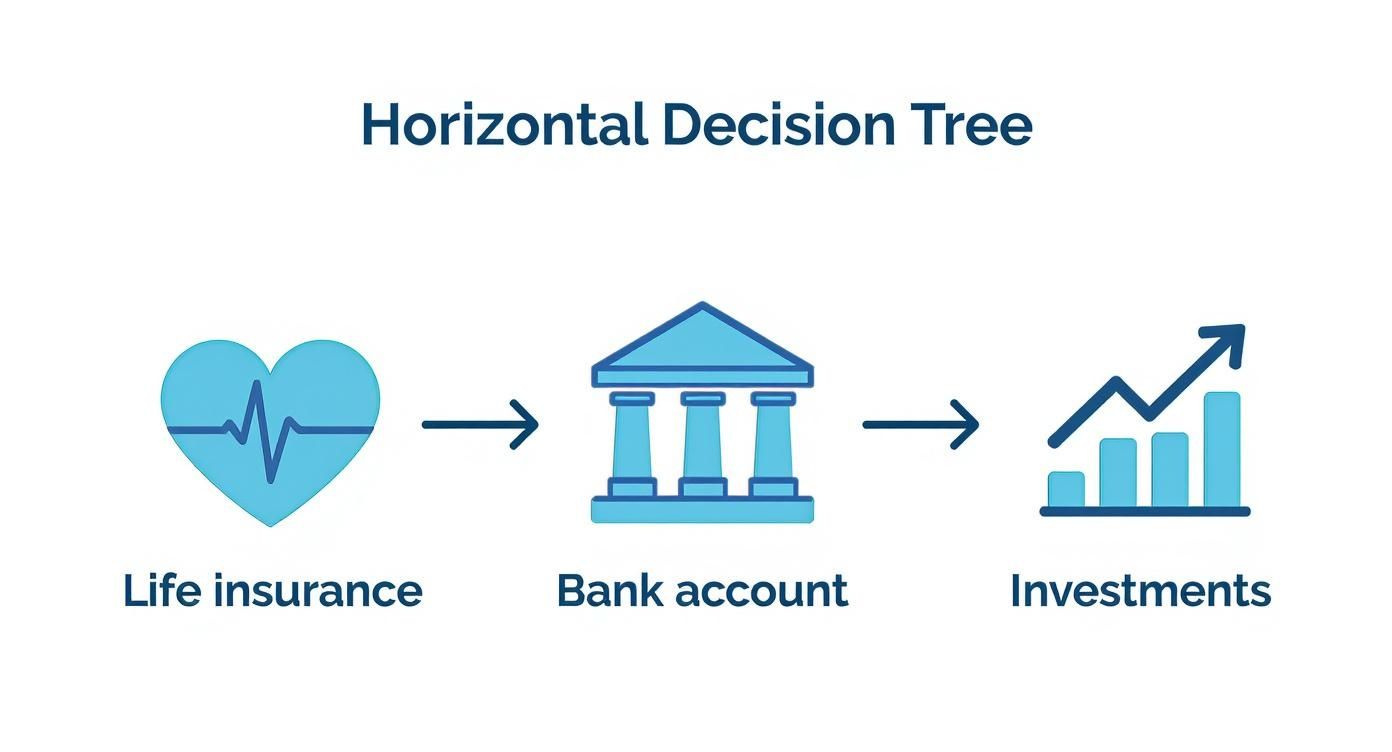
The biggest takeaway here is that many financial products you already own have probate-avoidance features built right in. You just have to activate them by naming a beneficiary.
Probate Avoidance Strategies in Texas: At-a-Glance
To really understand the trade-offs, a direct comparison is incredibly helpful. This table breaks down the key differences between the most common strategies we use for our clients in Atascocita. It should give you a clear picture of where each one shines and where it might fall short.
| Strategy | Assets Covered | Level of Control | Best For | Potential Drawback |
|---|---|---|---|---|
| Revocable Living Trust | All types of assets (real estate, accounts, business interests) | Full control as trustee during your lifetime. | Comprehensive planning for multiple assets, blended families, or providing for minors. | Higher initial setup cost and requires diligent funding of the trust. |
| Transfer on Death Deed (TODD) | Only real estate (your home, land). | Full control during your lifetime; you can sell or revoke it. | Simply passing a specific property directly to a beneficiary without probate. | Does not cover any other type of asset and offers no incapacity planning. |
| Joint Tenancy with Right of Survivorship | Real estate, bank accounts, vehicles. | Shared control; major decisions may require all owners’ consent. | Married couples or partners in stable, long-term relationships for shared assets. | Can create unintended consequences if a relationship sours or one owner has debt issues. |
| Beneficiary/POD/TOD Designations | Financial accounts (bank accounts, IRAs, life insurance). | Full control over the account during your lifetime. | A simple, no-cost way to transfer cash and investments directly. | Must be updated regularly; can conflict with a will if not managed carefully. |
Looking at the options this way makes it easier to see how a complete plan comes together. You might use several of these in tandem to cover all your bases effectively.
Making the Right Choice for Your Atascocita Family
As you can see, there’s no universal answer. A young family in Atascocita whose biggest asset is their house might do perfectly well with a Transfer on Death Deed for the property and ensuring their retirement account beneficiaries are up-to-date. It’s a straightforward, highly effective start.
But what about a business owner in Humble with a few rental properties, a brokerage account, and children from a previous marriage? That situation has more moving parts. For them, the structure and control of a revocable living trust would almost certainly be the better fit. A trust allows for sophisticated planning, like protecting assets for a child with special needs or setting up staggered inheritances for young adults who aren’t ready for a lump sum.
The goal is to match the tool to the job. Simple tools work for simple situations, while more complex family and financial pictures often require a more comprehensive strategy to ensure your wishes are truly protected.
Thinking through these scenarios helps you get clear on your own goals before you ever sit down with an attorney. When you’re ready, having this groundwork done makes the official planning process far more efficient and less intimidating.
We invite you to schedule a free, no-obligation consultation at our Atascocita office. Let’s sit down together, review your unique situation, and map out the most effective path forward for you and your loved ones.
When You Need an Atascocita Estate Planning Attorney
On the surface, many strategies for avoiding probate in Texas can seem simple. But the truth is, estate law is filled with nuances, and even a tiny mistake can create huge, lasting problems for your family. It’s crucial to know when a DIY approach is too risky and when you need an expert to protect your legacy.
A seasoned local attorney does more than just fill out paperwork. We get to know you, understand your unique life situation, and build a complete strategy that is legally solid and actually does what you want it to. Our job is to protect what you’ve worked so hard for, head off painful family arguments, and give you real peace of mind.
Situations That Demand Professional Guidance
Some family and financial dynamics are just too complex for the standard, one-size-fits-all forms you find online. If any of the following describe your situation, talking to an attorney isn’t just a suggestion—it’s a critical step to prevent future legal messes for the people you love most.
- You Have a Blended Family: When you have children from previous marriages, careful planning is absolutely essential. We need to be very clear about how assets are divided to prevent misunderstandings and make sure everyone is provided for exactly as you intend.
- You Own a Local Business: The future of your Humble or Atascocita business depends on a clear succession plan. Without one, the business can get tied up in probate, disrupting operations and creating chaos for your family and employees.
- A Beneficiary Has Special Needs: This is a big one. You must use specific legal tools, like a Special Needs Trust, to provide for a loved one. If you don’t, you could accidentally disqualify them from the essential government benefits they rely on.
- You Have Complex Assets: If your estate includes multiple properties, real estate in another state, or a large investment portfolio, simple beneficiary forms just won’t cut it. You need a more sophisticated plan to manage these assets effectively.
Your estate plan is one of the most important gifts you will ever leave your family. Ensuring it is crafted with professional care is the best way to make sure that gift doesn’t become a burden.
For those of us living in Atascocita, Humble, and northeast Harris County, having a lawyer who knows our community makes a tangible difference. We understand the local landscape, the specific ins and outs of the Harris County courts, and we can help you build a plan that will hold up for years to come.
Take the next step toward peace of mind. Schedule a complimentary, no-obligation consultation at our Atascocita office. Let’s sit down, talk through your goals, and put together a personalized plan that truly protects your family and secures your legacy.
Common Questions About Avoiding Probate in Texas
When families in the Atascocita area first start exploring estate planning, a lot of the same questions tend to pop up. Getting straight answers is the first step, so let’s clear up a few of the most common things we hear in our office.
Does a Will Let Me Avoid Probate in Texas?
This is probably the biggest misconception out there. A will doesn’t avoid probate at all—in fact, it’s a document written specifically for the probate court.
Think of it as a set of instructions for the judge in Harris County, telling them how you want your property divided. The will is your voice in court, but it absolutely requires the court process to become legally effective.
To truly sidestep the court system, you need to rely on other tools like living trusts, beneficiary designations, and Transfer on Death Deeds.
Are These Strategies Only for People with Large Estates?
Not at all. Smart planning benefits families of all sizes here in Humble and Atascocita.
It’s true that Texas has a simplified process called a Small Estate Affidavit for estates under a certain value. However, using straightforward tools like Payable-on-Death (POD) bank accounts or a Transfer on Death Deed (TODD) for your home makes the transfer of assets faster, easier, and more private for your family, no matter the size of your estate.
How Much Does It Cost to Set Up a Living Trust?
The cost for a living trust really depends on how complex your finances and family situation are. While it’s definitely a bigger upfront investment than drafting a simple will, that initial cost is often a fraction of what your family would end up paying in court costs, attorney fees, and executor compensation during probate.
We encourage clients to think of it as a one-time investment that saves their family a significant amount of money, time, and stress down the road. If you’re curious about just how long that process can take, you can learn more about how long probate can take in Texas.
Navigating all the options can feel overwhelming, but you don’t have to figure it out alone. The dedicated team at the Law Office of Bryan Fagan – Atascocita TX Lawyers is here to offer clear, practical guidance to protect your family’s future. Schedule your free consultation with us today to get started.