So, is Texas an "alimony" state? Yes, but probably not in the way you're thinking. The term you’ll hear in a Texas courthouse is spousal maintenance, and our state has some of the strictest, most limited rules in the entire country.
Forget what you’ve seen on TV. For families here in Atascocita, spousal maintenance in Texas isn't about long-term financial support. It's designed to be a temporary bridge, giving a lower-earning spouse just enough time and support to get back on their feet after a divorce.
Understanding Texas Spousal Support In Atascocita

When you're going through a divorce here in Atascocita or Humble, the financial unknown is often the biggest source of stress. How will I pay the bills? How can I support the kids and keep our lives as stable as possible? These are completely normal fears, and at The Law Office of Bryan Fagan, we're here to cut through the noise and give you a clear, compassionate picture of what to expect.
The very first thing to understand is that court-ordered support is not automatic in a Texas divorce. Far from it. Judges view it as a tool of last resort, reserved only for spouses who can prove they meet very specific, and frankly, very high, legal hurdles.
Alimony Myths vs. Texas Spousal Maintenance Reality
It’s easy to get confused by what you see in movies versus what happens in a Harris County courtroom. This table should help clear things up for our Atascocita community.
| Common Alimony Myth | The Texas Reality (Spousal Maintenance) |
|---|---|
| "I'll get alimony for life." | Support is temporary and tied to marriage length, with a 10-year maximum. |
| "It's a 50/50 split of income." | Payments are capped at $5,000 or 20% of the payer's gross income—whichever is less. |
| "I automatically qualify if I earn less." | You must prove you can't meet your "minimum reasonable needs" on your own. |
| "It's a reward for my time in the marriage." | It's not a prize. It's a temporary support system to promote self-sufficiency. |
This isn't meant to discourage you, but to provide you with realistic expectations based on how Texas law actually works. We believe an informed client is an empowered client.
The Strict Limits Of Texas Law
Texas law puts very clear, very firm caps on both how much can be paid and for how long. Think of it as a safety net with strict rules, not a blank check.
The Texas Family Code dictates that a judge cannot order payments that exceed the lesser of two amounts: $5,000 per month or 20% of the paying spouse's average monthly gross income.
For most families in northeast Harris County, that 20% rule is the real ceiling. It often results in a maximum possible payment that's significantly less than the $5,000 cap. This really highlights the state's underlying policy: to push both spouses toward financial independence as quickly as possible.
The clock is ticking, too. The length of time you can receive maintenance is directly tied to how long you were married, ranging from five years for shorter marriages up to a hard maximum of ten years for marriages that lasted 30 years or more.
As you get a handle on the specific rules for spousal maintenance, it's wise to consider the entire financial picture of your divorce. For those with more complex finances, a comprehensive guide on finance and divorce for high net worth individuals can offer crucial perspective on asset protection and untangling complex financial partnerships.
When you're going through a divorce in Texas, you'll run into two key terms: spousal maintenance and contractual alimony. They might sound like the same thing, but they're fundamentally different ways to handle post-divorce financial support for families here in Atascocita and Humble. Getting a handle on this difference is the first step toward securing the best financial footing for your new life.
I like to explain it like this: spousal maintenance is like a fixed city bus route. The state of Texas, through the Family Code, dictates the route, the stops, and the schedule. It's rigid, has very strict rules, and is only available under a very specific set of circumstances.
Contractual alimony, on the other hand, is like hiring a private car. You and your spouse get to decide the destination, the route, and how much it will cost. It’s a private agreement built entirely on flexibility and what works for your family, free from the strict limitations of a courtroom.
Court-Ordered Spousal Maintenance: The Official Route
In Texas, spousal maintenance is the only kind of support a judge can force one spouse to pay the other after a divorce. To even be considered, you have to meet a very high legal standard. A Harris County judge can't just award maintenance because one spouse was the primary breadwinner; their hands are tied by the strict eligibility rules in the Texas Family Code.
This type of support is intentionally hard to get. The law starts with the assumption that maintenance isn't needed, and it puts the full burden of proof on the spouse who is asking for it. Because the requirements are so tough, court-ordered maintenance is actually pretty rare. It’s designed to be a temporary safety net, just enough to help a spouse get back on their feet financially.
The whole idea behind Texas spousal maintenance is to promote self-sufficiency. The courts are aiming to provide minimal, temporary support for the shortest time necessary to allow the receiving spouse to find a job or get the skills they need to support themselves.
Contractual Alimony: A Custom-Made Agreement
Contractual alimony operates in a completely different world. It’s a private agreement that you and your spouse negotiate, usually with your attorneys or a mediator guiding the process. Since it’s a contract, you aren't stuck with the rigid caps and rules that apply to court-ordered maintenance.
This flexibility is a huge advantage for local families. You can craft an agreement that a judge simply doesn't have the power to order.
With contractual alimony, you can:
- Go Beyond the Legal Caps: Agree to payments that are higher than the statutory $5,000 or 20% of gross income limit.
- Design Creative Payment Plans: Payments could be a one-time lump sum, step down over time, or be tied to a specific milestone, like a child graduating from a Humble ISD high school.
- Set a Longer Timeline: You can agree to a support term that lasts longer than the law allows, maybe providing support until a spouse can finish a degree at Lone Star College-Kingwood.
- Guarantee the Payments: You can agree to make the support non-modifiable, which provides rock-solid certainty and prevents you from ending up back in court if circumstances change down the road.
By opting for contractual alimony, you and your spouse keep control over your finances instead of handing that power over to a judge. It opens the door for creative solutions tailored to your unique situation. If you want to dig deeper into the specifics, you can check out our guide on what spousal support is in Texas. This collaborative path often results in a far more amicable outcome, saving everyone the stress and cost of a prolonged court battle.
How to Qualify for Spousal Maintenance in Texas
Let's be clear: getting a Texas judge to order spousal maintenance is an uphill battle. The law starts with the assumption that this kind of support is not needed. This means the spouse asking for help carries the full burden of proof. You have to convince a Harris County judge that you not only need financial assistance but that you also fit into the state’s very strict eligibility criteria.
For our neighbors here in Atascocita and Humble, it’s vital to understand this isn't just about asking for help—it’s about building a solid legal case. To even have a shot at court-ordered maintenance, you have to clear two major hurdles.
The First Hurdle: Proving You Genuinely Need Financial Help
Before a judge even considers the specifics of your marriage, you have to prove you will lack enough property after the divorce to provide for your “minimum reasonable needs.” This is the bedrock of any spousal maintenance claim in Texas.
So, what does that actually mean? It means that after the marital property is split up—your portion of the house, savings, retirement funds, and other assets—you must show the court that what you’re left with simply isn’t enough to cover basic living expenses. We’re talking about essentials like a roof over your head, food, and utilities. This isn't about maintaining your marital lifestyle; it's about proving you'll face a real financial shortfall.
The chart below helps visualize the two paths for post-divorce support in Texas. It draws a sharp line between a flexible, private agreement and the very rigid, court-ordered route.
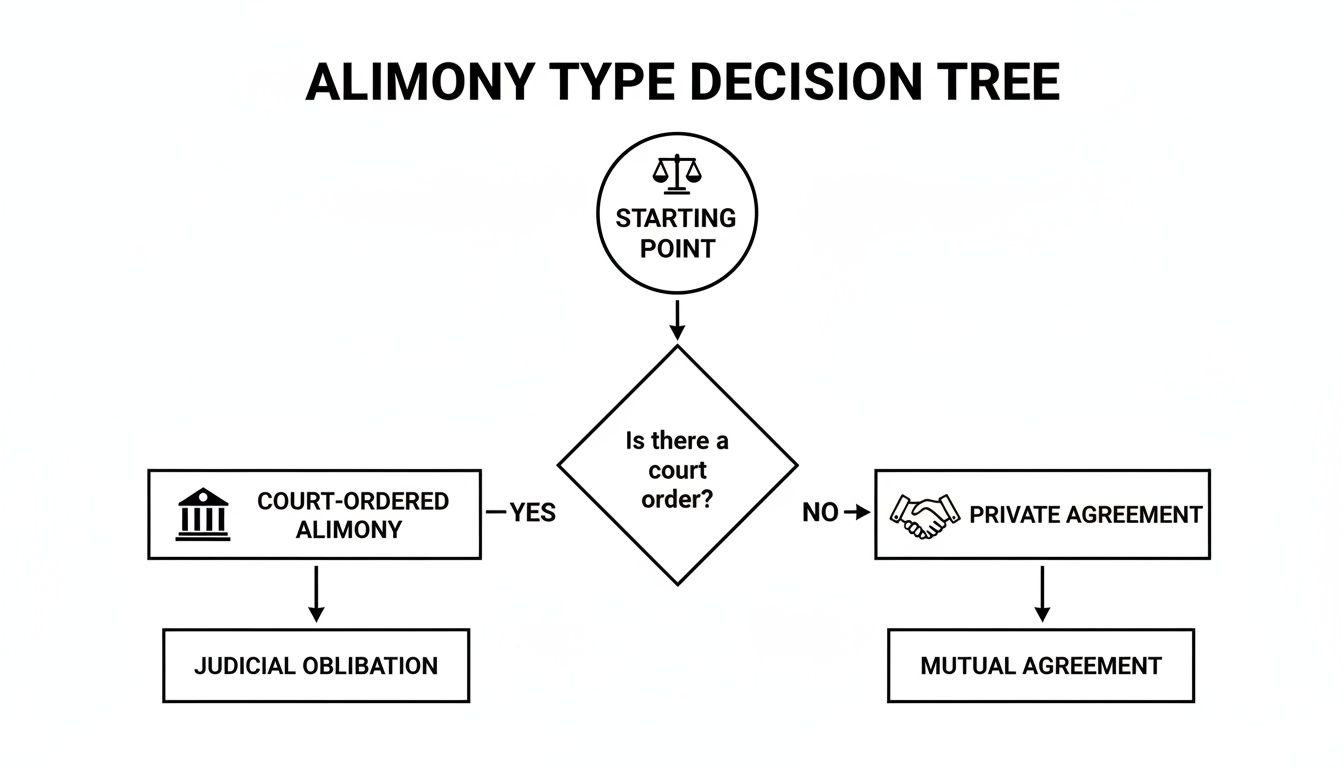
As you can see, a private agreement gives you more control and flexibility. The court-ordered path, on the other hand, is governed by a strict legal checklist you absolutely must satisfy.
The Second Hurdle: Fitting into a Specific Legal Category
Once you've established your financial need, the next step is to prove that your circumstances fall into one of the specific scenarios laid out in the Texas Family Code. You only need to meet one of these conditions, but you must meet at least one.
A judge can only grant spousal maintenance if you can prove one of the following is true:
The 10-Year Marriage Rule: You were married for 10 years or longer and you have actively tried to earn enough money or get the skills you need to support yourself while the divorce is ongoing. This is the most common path people take to qualify.
The Family Violence Exception: Your spouse was convicted of (or received deferred adjudication for) an act of family violence against you or your child. The act must have occurred within two years of filing for divorce or during the divorce proceedings. In this tragic situation, the 10-year marriage rule does not apply.
The Disability Exception (Spouse): You are unable to earn enough to cover your minimum reasonable needs because you have an incapacitating physical or mental disability. The length of your marriage doesn't matter here.
The Disability Exception (Child): You are the main caregiver for a child of the marriage (any age) who has a physical or mental disability that demands substantial care, which in turn prevents you from being able to work and earn a sufficient income.
For example, picture a Humble resident who has been a stay-at-home mom for 15 years. After the divorce, her share of the marital property isn't enough to cover her mortgage and basic bills. Because her marriage lasted more than 10 years and she lacks recent job experience to immediately cover her needs, she would likely clear both hurdles. A judge would probably award temporary spousal maintenance to help her get back on her feet and re-enter the workforce.
Making a successful case for spousal maintenance hinges on detailed financial records and a deep understanding of how local courts interpret these rules. Because the bar is set so high, having an experienced attorney present your case clearly and persuasively is absolutely essential.
If you think you might qualify for spousal maintenance—or if you're concerned you'll be asked to pay it—your financial future is on the line. At The Law Office of Bryan Fagan, we are dedicated to helping Atascocita residents understand their rights. Call us today to schedule a free, no-obligation consultation at our Atascocita office.
How Courts Figure Out How Much to Award and For How Long
So, a Harris County judge agrees that spousal maintenance is necessary. The two big questions on everyone's mind are always the same: how much will the checks be, and when will they stop?
Unlike other states where judges have a lot of wiggle room, Texas law is very buttoned-up on this. The statutes lay out clear and firm limits on both the dollar amount and the duration of payments. This isn't about maintaining a certain lifestyle; it's about providing a temporary, limited safety net.

The Two Hard Caps on Payment Amounts
When it comes to setting the payment amount, a Texas judge looks at two numbers and must order the lesser of the two. It's a simple but strict rule.
The monthly payment cannot be more than:
- $5,000 per month, or
- 20% of the paying spouse's average monthly gross income.
Let's be clear: that $5,000 figure is an absolute ceiling, and frankly, most cases never get close to it. For the vast majority of families here in Atascocita and Humble, the real cap is the 20% rule.
Think about it this way: say your spouse has a great job and brings in a gross monthly income of $15,000. While that's a solid income, the very most a judge could order in maintenance is $3,000 a month (20% of $15,000). The $5,000 cap doesn't even come into play. This shows how the law is deliberately designed to limit the financial burden.
Getting a realistic idea of what payments might look like is a critical first step. You can get a deeper look into the calculations in our guide on how much alimony is in Texas.
How Long Can Spousal Maintenance Last?
Just like the dollar amount, the duration of payments is also strictly limited. The law ties the maximum length of time you can receive maintenance directly to how long you were married. It’s crucial to remember that these are maximums—a judge can, and often does, order a shorter timeframe.
Here’s a look at the state's official guidelines for how long maintenance can last.
Texas Spousal Maintenance Duration Limits
| Length of Marriage | Maximum Duration of Maintenance Payments |
|---|---|
| 10 to 20 years | 5 years |
| 20 to 30 years | 7 years |
| 30+ years | 10 years |
The 5-year maximum also applies to shorter marriages where the award was based on a family violence conviction.
As you can see, the time limits are firm. There is one major exception to these rules: a judge can order indefinite maintenance if the spouse receiving it has a severe physical or mental disability, or if they are caring for a disabled child of the marriage. Even then, the payments stop automatically if that person remarries or moves in with a new romantic partner.
The court’s directive is clear: order support for the shortest possible time that allows the receiving spouse to get on their feet and provide for their own basic needs. This really drives home the core idea of Texas law—maintenance is meant to be a temporary bridge to self-sufficiency, not a permanent arrangement.
The Strategic Advantages of Contractual Alimony
While the path to getting court-ordered spousal maintenance in Texas is notoriously narrow, there’s another route that offers far more flexibility and control for families in Atascocita and Humble: contractual alimony. This is a powerful tool that allows you and your spouse to step outside the rigid confines of the Texas Family Code and craft a private financial agreement that actually works for your unique circumstances.
Think of it like this: the court system offers a one-size-fits-all solution, bound by strict, unbending rules. Contractual alimony, on the other hand, lets you design a custom-tailored plan. It puts you and your spouse in the driver's seat, not a judge who only knows a fraction of your story.

Customization and Control Beyond the Courtroom
The single biggest advantage of contractual alimony is its incredible flexibility. You and your spouse are free to negotiate terms that a Harris County judge legally cannot order. This opens up a world of practical, creative solutions that can help both of you move forward with a sense of stability and predictability.
Through direct negotiation or with the help of a mediator, you can build an agreement with features like:
- Payments Above Legal Caps: You can agree on monthly payments that exceed the state-mandated limits of $5,000 or 20% of the paying spouse's gross income.
- Extended Payment Durations: If one spouse needs support for longer than the law allows—say, to finish a degree or re-establish a career—you can build that directly into your agreement.
- Lump-Sum Payments: Instead of ongoing monthly checks, you might decide a one-time, lump-sum payment makes more sense to provide immediate financial stability.
- Guaranteed Non-Modifiability: For total peace of mind, you can agree upfront that the payments can never be changed in the future, providing certainty for both the payer and the recipient.
For instance, a Humble couple could agree that one spouse receives a set amount of support for four years to finish a nursing degree at a local college. This kind of forward-thinking solution is simply not on the table in a courtroom, but it can be the key to ensuring an amicable, stable future after the divorce.
The Financial and Emotional Benefits
Opting for contractual alimony almost always means sidestepping a contentious and expensive court battle. The process is typically handled through collaborative negotiation or mediation, which encourages open communication and helps preserve a respectful relationship—something that’s priceless when children are involved.
This approach lets you bypass the strict limits a judge is required to follow. Our firm often sees mediated deals that include creative solutions like lump sums or longer payment terms that go well beyond the typical caps. It's crucial to remember, however, that since the 2018 Tax Cuts and Jobs Act, these payments are no longer tax-deductible for the payer at the federal level. This has definitely shifted the financial dynamics, and it’s a key point to consider during negotiations. You can learn more about the differences between contractual and court-ordered support in our detailed guide.
By taking control of the process, you create a predictable outcome that you both had a say in. That kind of certainty is invaluable during a time of immense upheaval, offering a peace of mind that a court-imposed order rarely can. For many families in our community, this collaborative path isn't just a strategic move—it's the key to starting a healthier next chapter.
Why a Local Atascocita Attorney Is Essential
Trying to handle a Texas spousal maintenance case on your own is a huge gamble. The laws are notoriously strict, the financial stakes are incredibly high, and one wrong move can set you back for years.
Whether you're the one asking for support or the one who might have to pay, having a sharp local attorney fighting for you isn't just a good idea—it's absolutely necessary. A seasoned lawyer does way more than fill out forms. They know how to build a powerful case, dig up the right financial proof, and tell your story in a way that satisfies the very specific demands of the Texas Family Code.
Understanding the Harris County Court System
Every courthouse, and really every judge, has its own personality and way of doing things. An attorney who is in the Harris County family courts day in and day out gets to know the local judges and what they focus on when deciding spousal maintenance cases.
This kind of local insight is priceless when you're mapping out a legal strategy. We live and work here, so we understand the financial pressures families in Atascocita and Humble are facing. We use that firsthand knowledge to push for outcomes that are both fair and realistic for your life.
For us, it's personal. This is about looking out for our neighbors. We take the time to listen, break down your options in plain language, and create a plan built around your unique situation. Our goal is to give you clarity and peace of mind. For more on this, take a look at our guide on how to choose the right divorce attorney.
A skilled attorney is crucial not only for navigating the complexities of spousal maintenance but also for understanding related legal tools like wage garnishment in Texas, which can be used for enforcement.
Getting a fair spousal maintenance order is a critical piece of the puzzle for starting your next chapter on solid ground. You need someone on your side who is not only a tough advocate but also a compassionate guide dedicated to protecting your future. It all begins with a simple phone call.
Don’t go through this alone. The team at The Law Office of Bryan Fagan is ready to stand with you. Contact our Atascocita office today for a free, no-obligation consultation to see how we can help.
Frequently Asked Questions About Texas Alimony
Even after laying out the basics, we know our neighbors in Atascocita and Humble still have specific questions about how Texas alimony laws could play out in their own lives. Let's tackle some of the most common questions we hear to give you some quick, clear answers.
Can I Get Spousal Maintenance if My Marriage Was Less Than 10 Years?
Usually, a 10-year marriage is the starting line for a judge to even consider ordering spousal maintenance in Texas. But—and this is a big but—there are a couple of major exceptions you need to know about.
You might still be eligible for support in a shorter marriage if:
- Your spouse has a conviction or received deferred adjudication for an act of family violence against you or your child.
- You have an incapacitating physical or mental disability that keeps you from earning enough to cover your basic needs.
These exceptions are game-changers. If you're facing one of these situations here in the Atascocita area, it's absolutely crucial to talk to an attorney who can help you document your case correctly and protect your rights.
What Happens if My Ex-Spouse Remarries While Receiving Maintenance?
This is a straightforward one under the Texas Family Code. The obligation to pay court-ordered spousal maintenance ends automatically if the person receiving the payments gets remarried. It also stops if the recipient starts "cohabitating"—which is the legal term for moving in and living with a new romantic partner on an ongoing basis.
For folks in Harris County, this is a critical detail whether you're paying or receiving. If you are the one paying and believe your obligation should legally end, you need to talk to a lawyer. You can't just stop the payments on your own. An attorney will guide you through the proper legal steps to get the court order terminated the right way.
One of the biggest mistakes people make is stopping payments without a new court order. That can land you in serious legal trouble, including enforcement actions for what the court still considers unpaid support. Always follow the legal process.
Does Adultery Affect Spousal Maintenance Decisions in Texas?
Yes, it absolutely can. While Texas is a "no-fault" divorce state, that doesn't mean a judge ignores bad behavior. The court has the discretion to look at marital misconduct, including infidelity, when making a decision about spousal maintenance.
Think of it this way: if the spouse asking for support is the one who committed adultery, a judge might be less likely to approve the request, or they might award a much smaller amount. On the flip side, if the higher-earning spouse was the one who was unfaithful, the judge may look more favorably on the request for maintenance. It’s just one of many pieces of the puzzle the court considers, which is why having skilled legal guidance to frame your case is so important.
Figuring out the ins and outs of Texas spousal maintenance is tough, and you need a knowledgeable and compassionate advocate in your corner. At The Law Office of Bryan Fagan – Atascocita TX Lawyers, we're dedicated to helping our neighbors in Atascocita and Humble understand their rights and work toward a stable financial future. Schedule your free, no-obligation consultation with our team today by visiting our Atascocita law office website.