Yes, you absolutely can create your own will in Texas. For many families right here in Atascocita and Humble, it seems like a quick, common-sense way to save a little time and money. But while the law allows it, the real question isn't can you do it, but should you?
The hard truth is that a simple, overlooked mistake in a do-it-yourself will can unleash a cascade of expensive and heartbreaking problems for the very people you're trying to protect. At The Law Office of Bryan Fagan, we see this all too often, and our goal is to help our neighbors in northeast Harris County understand the risks and make informed choices.
Is a DIY Will a Safe Choice for Your Texas Family?
Taking the time to think about your legacy and plan for your family's future is a profoundly responsible act. It's only natural to look for a straightforward, cost-effective way to put your wishes down on paper. This is where the idea of "doing a will on your own" comes in. Find a template, fill it out, sign it, and you’re covered, right?
Unfortunately, it's rarely that simple. A will isn't just a document; it's a powerful legal tool that has to stand up to the detailed scrutiny of a Harris County probate court. There's a world of difference between a will that is technically "legal" and one that is legally effective. An effective will is one that is airtight—clear, enforceable, and carries out your intentions precisely, without leaving room for confusion, arguments, or legal challenges from Atascocita to Humble.
The Gap Between Intention and Reality
Many people instinctively know that getting professional legal advice is the smarter move, but they still hesitate. National surveys show a surprising disconnect: while most adults agree an attorney-drafted will is important, only about a third of them actually have one. As the 2023 wills survey points out, this means a huge number of families are relying on DIY kits or homemade documents without any legal oversight.
That gap is where the danger lies for our community.
A fill-in-the-blank template from a website can't ask you clarifying questions. It doesn't understand your unique family situation in Humble, and it can't offer advice on the best way to protect the assets you've spent a lifetime building. It knows nothing about the nuances of Texas community property laws or how to properly nominate a guardian for your children to prevent custody battles down the road. To get a better handle on the different tools available, it’s helpful to understand the living trust vs a will in Texas.
A DIY will is like a pre-packaged first-aid kit. It might have the basic supplies for a scrape, but it can't perform the delicate surgery needed to truly protect your family’s well-being when complex issues arise.
At the Law Office of Bryan Fagan, we want to be your local, supportive guide through this process. We believe protecting your family shouldn’t feel intimidating or out of reach. Before you choose a path that might leave your loved ones exposed, let’s talk through your options and find the right solution for you and your Atascocita family.
DIY Will vs. Attorney-Drafted Will: A Quick Comparison
When you're weighing your options, it helps to see a direct comparison. This table breaks down the fundamental differences between using a DIY template and working with an experienced local attorney to secure your family's future.
| Feature | DIY Will (Online Template/Handwritten) | Attorney-Drafted Will (Law Office of Bryan Fagan) |
|---|---|---|
| Legal Guidance | None. You interpret Texas law on your own. | Expert legal advice tailored to your specific situation and family dynamics in Atascocita. |
| Customization | Limited to pre-set fields and generic clauses. | Fully customized to your unique assets, family needs, and long-term goals. |
| Risk of Errors | High. Small mistakes in wording or execution can invalidate the entire will. | Low. We ensure the document is legally sound and executed correctly according to Texas law. |
| Cost | Low initial cost, but high potential for future legal fees for your family. | Higher upfront investment, but designed to prevent costly probate disputes in Harris County. |
| Handling Complexity | Not suitable for blended families, business ownership, or special needs trusts. | Specifically designed to handle complex situations and protect all beneficiaries. |
| Peace of Mind | Uncertain. You won't know if it works until it's too late. | Complete. Confidence that your wishes are clear and legally enforceable for your family. |
The takeaway is clear: while a DIY will might seem like a bargain now, the potential for error and future conflict can make it one of the most expensive mistakes you ever make. A professionally drafted will is an investment in your family’s security and peace of mind.
The Strict Legal Rules for a Valid Texas Will
For a will to be recognized by a Harris County court, it has to follow a precise legal recipe. I often tell my clients to think of it like baking a cake for a big family event in Atascocita. You need the right ingredients, in the right amounts, added in the right order. If you leave out the flour, you don't just get a bad cake—you get something that isn't a cake at all.
That's exactly how it is with a will. Texas law doesn't give you points for good intentions if the final document misses the mark on its legal requirements. These rules aren't suggestions; they're hard-and-fast mandates designed to make sure your final wishes are protected from fraud or future challenges. Mess this part up, and the whole document can be thrown out, leaving your family with a legal headache nobody wants.
This visual below shows the difference between a DIY will and one prepared with an attorney, and it really highlights the major risk you take on when you go it alone.
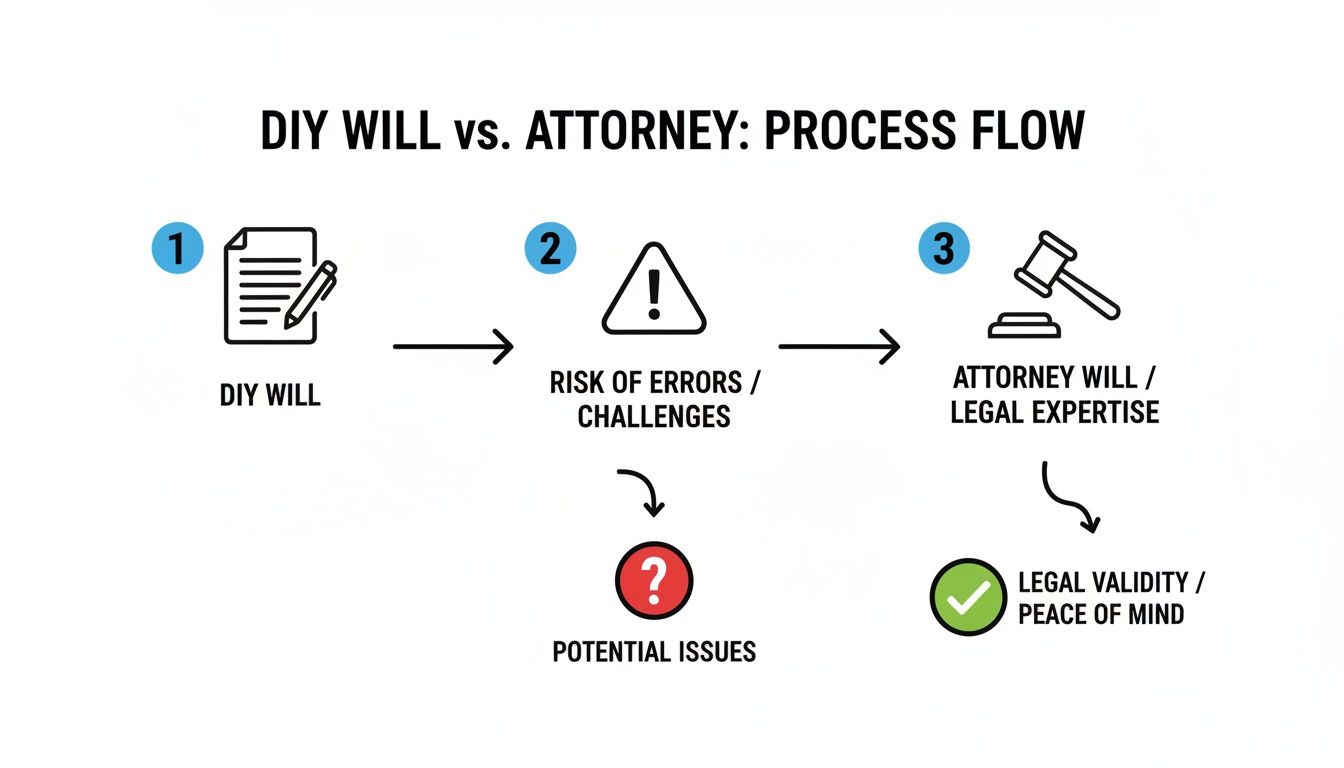
The takeaway here is pretty clear. While both paths aim for the same goal, the DIY route has a giant pitfall in the middle—the risk of invalidity—that professional guidance is specifically there to help you avoid.
The Three Core Ingredients of a Texas Will
To create a formal will that will actually stand up in court, you have to nail three essential components. Get just one of these wrong, and the will could be legally worthless.
It Must Be in Writing: A spoken will just won't cut it in Texas under most circumstances. Your wishes need to be down on paper, whether you type it up or write it by hand.
It Must Be Signed by You (the Testator): You, the person making the will (that's the testator in legal terms), have to sign it. There's a small exception where someone can sign for you, but it has to be done in your presence and under your direct instruction.
It Must Be Attested by Two Credible Witnesses: This is the step where so many DIY wills fall apart. Two credible witnesses, both at least 14 years old, must sign the will right there in your presence. They don't need to read what's in it, but they absolutely must watch you sign it (or hear you acknowledge that the signature on it is yours).
Let’s say you sign your will alone in your Humble home office and then ask your neighbors to sign it the next day when they drop by. Even with the best of intentions, that will is likely invalid because they didn't sign it in your presence. That one little detail matters immensely.
Speeding Up Probate with a Self-Proving Affidavit
Beyond those three must-haves, there's a fantastic tool that can make things so much easier for your family down the road: the self-proving affidavit. While it isn't technically required to make a will valid, it's something we strongly recommend for every single client in Atascocita and Humble.
A self-proving affidavit is a separate statement that gets attached to your will. You and your witnesses sign it in front of a notary public, and it basically pre-validates all the signatures for the court. It’s like telling the judge ahead of time, "Yep, we all signed this, and we did it the right way according to Texas law."
Without this affidavit, your executor might have to hunt down your original witnesses years later. What if they've moved away or even passed on? This can cause major delays and rack up legal bills during probate. By adding a simple, notarized self-proving affidavit, you help the court process run smoothly, saving your family time, money, and stress when they're already going through enough. It’s a small step that delivers huge value.
The Hidden Dangers of a DIY Will
It’s easy to see why doing a will on your own seems like a good idea. On the surface, it feels like you're saving money and getting a nagging task done quickly. The pull of simplicity and affordability is strong, leading countless people in our community to download a generic template and call it a day.
But that path is often paved with hidden legal traps—expensive mistakes that don’t surface until it’s far too late for you to fix them. The small amount you save today can easily be wiped out by the legal fees, family fights, and emotional stress a poorly written DIY will can cause for your loved ones. What looks like a smart shortcut now can become a devastatingly expensive problem for your family to sort out later.
Ambiguous Language: The Fuel for Family Fights
One of the biggest problems we see with do-it-yourself wills is vague or unclear language. A fill-in-the-blank form can't possibly grasp your family’s unique situation or the specifics of your property. A phrase that seems perfectly clear to you might be interpreted in a half-dozen different ways by your heirs, flinging the door wide open for arguments.
Think about a seemingly simple instruction: "I leave my car to my son." Straightforward, right? But what if you have two sons and two cars? Which son gets which one? What happens if you sell that car and buy a new one before you pass away? When your will is unclear, you’re essentially forcing a Harris County judge to guess what you wanted, which often sparks disagreements that can permanently fracture family bonds.
An experienced Atascocita attorney does more than just fill out a form; they act as a translator, turning your personal wishes into precise, legally-sound language that leaves zero room for misinterpretation. That kind of clarity is one of the most valuable gifts you can leave behind.
The Problem of Partial Intestacy
Another major risk is accidentally leaving property out of your will. This happens all the time, especially if you acquire new assets after you’ve written the will and simply forget to add them. When a will doesn't account for all of your property, it creates a legal headache called partial intestacy.
In this scenario, the assets mentioned in your will are distributed as planned. But everything else—the forgotten bank account, the new property, the unexpected inheritance—is divided up according to rigid Texas state laws. This can lead to bizarre outcomes you never would have wanted, like a chunk of your estate going to a distant cousin you haven't spoken to in decades.
Forgetting assets is like carefully packing most of your valuables for a move but leaving a box of precious family heirlooms on the curb. A well-drafted will ensures that every single asset is accounted for, using what’s called a "residuary clause" to catch any property not specifically mentioned.
Generic Templates and Texas Community Property Law
Texas is a community property state. This is a crucial legal distinction that has a massive impact on how property is handled after death, particularly for married couples. A generic, one-size-fits-all will template you find online is almost guaranteed to get these complex, Texas-specific rules wrong.
This oversight can create an absolute mess for your surviving spouse. It can blur the lines between what’s considered separate property and what’s community property, potentially opening the door for others to challenge your spouse’s rightful share of the marital estate. Here at The Law Office of Bryan Fagan, our deep experience in Texas family law matters means we craft wills that work in perfect harmony with our state's unique legal landscape.
It's no secret why people put off creating a will. Research shows that about 35% of adults report that they or someone they know have experienced family conflict directly because a proper will or estate plan wasn't in place—a problem frequently traced back to DIY documents. The biggest reasons people avoid getting professional help are often misunderstandings about the cost and complexity involved, which is something we work hard to clarify for our neighbors in Atascocita and Humble. You can discover more insights about these estate planning statistics and see why a little planning goes a long way.
What About a Handwritten Will in Texas?
Texas law carves out a unique exception to all the formal rules we’ve been talking about, and it’s something straight out of an old movie: the holographic will. This is a will written entirely, from top to bottom, in your own handwriting. It's one of the only ways you can create a will on your own in Texas that doesn't require any witnesses.
On the surface, it sounds incredibly simple, right? No need to round up witnesses or track down a notary. Just you, a pen, and a piece of paper. But while this old-fashioned method is technically legal, it's also one of the riskiest and most unreliable tools you could possibly use, often creating far more problems than it solves for the family you leave behind.
A Cautionary Tale from Humble
Let's paint a picture to show you what can go wrong. Imagine a well-loved small business owner in Humble—we’ll call him George. He’s built a successful shop over many years and knows he needs to get his affairs in order, but he just keeps putting it off. One evening, not feeling his best, he grabs a legal pad and quickly scribbles out who should get what: the business to his son, the house to his daughter, and his savings split between them.
He signs his name at the bottom, tucks the note in his desk drawer, and feels a wave of relief. A few months later, George passes away.
When his kids find the note, that sense of relief quickly morphs into confusion and then dread. What George thought was a simple fix has just become a legal nightmare for his family. This is where the real cost of a holographic will comes to light.
The Nightmare for the Family Left Behind
First off, his children have to prove to a Harris County probate judge that the entire document is undeniably in their father's handwriting. This isn't as simple as it sounds. It often means digging up old birthday cards, letters, and other documents to compare signatures, and sometimes even hiring expensive handwriting experts to provide testimony in court.
But the bigger landmine is the vague language. George wrote, "split my savings." What did he mean by that? Did it include his checking accounts? His investment portfolio? What about the certificates of deposit he had at the bank? His son and daughter have very different interpretations, and suddenly, a disagreement over money starts to tear their relationship apart.
A holographic will forces your family to become detectives and your probate judge to become a mind reader. The court is left to guess at your true intentions, and those guesses can have devastating financial and emotional consequences for the people you love most.
The fight over the "savings" could easily drag on for months, or even years, piling up tens of thousands of dollars in legal fees. The very inheritance George wanted to leave for his children is now being eaten away by attorney's bills—all because his handwritten note lacked the legal precision to be crystal clear.
While a holographic will is a valid option under Texas law, it's truly an outdated tool that belongs in the past. For families today in Atascocita and Humble, relying on one is an unnecessary and dangerous gamble. Your legacy is far too important to be left to guesswork. A properly drafted will ensures your wishes are not just written down, but legally airtight and ready to protect your family’s future.
Common DIY Will Mistakes We See in Harris County
Here at The Law Office of Bryan Fagan, we've helped countless families in Atascocita and Humble put plans in place to protect their futures. That experience has also given us a front-row seat to the heartbreaking fallout from a simple do-it-yourself will. These documents are almost always drafted with love and the best of intentions, but even small, technical errors can lead to devastating results for the people left behind.
When you're doing a will on your own, it’s incredibly easy to overlook legal details that seem minor but can completely invalidate your final wishes. Based on what we see day in and day out in Harris County probate courts, these are some of the most frequent and costly mistakes we encounter.
Forgetting the Residuary Clause
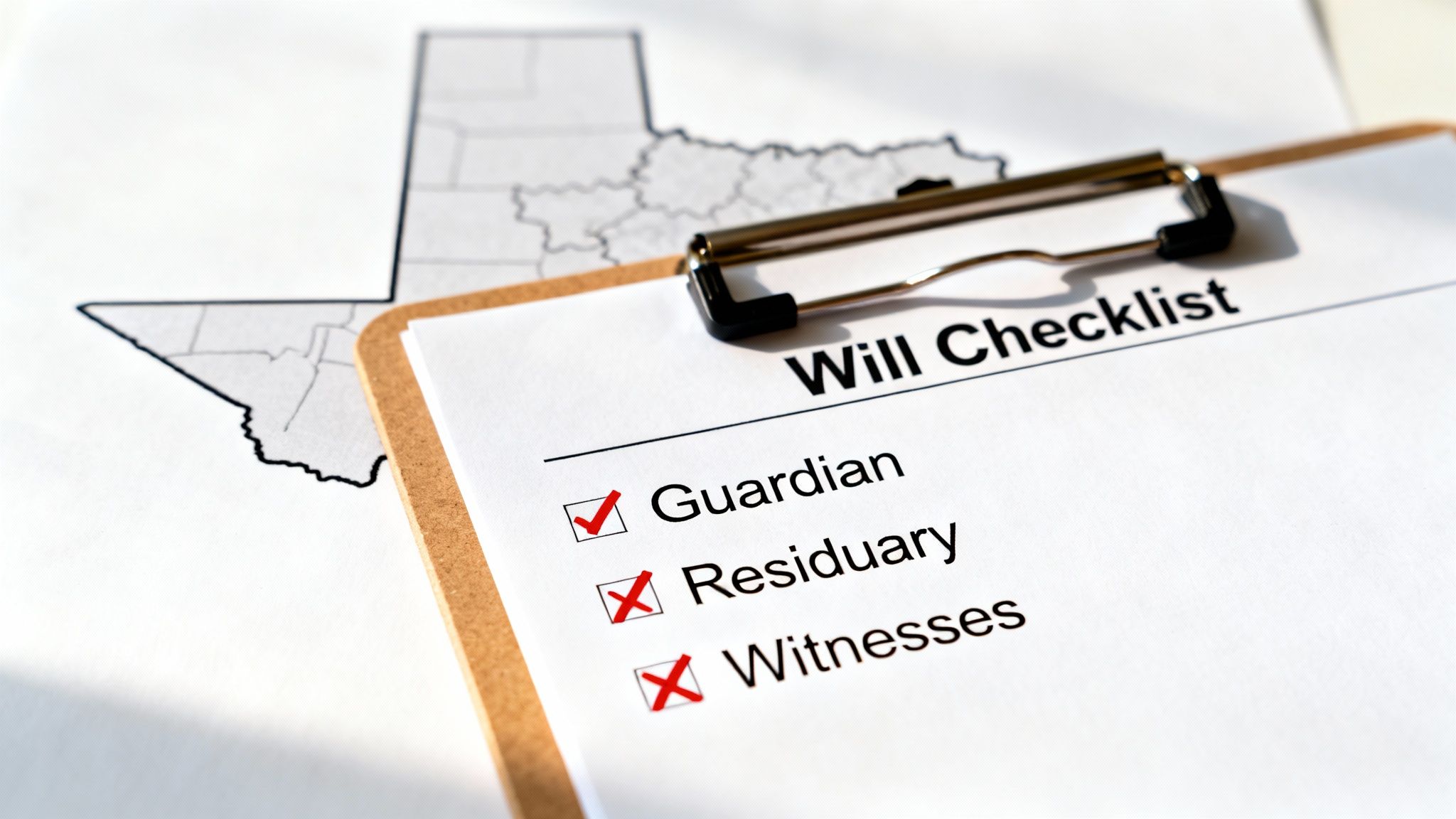
One of the most critical—and common—errors is leaving out a residuary clause. Think of this as a legal safety net. It’s a simple provision that dictates who should receive any "leftover" assets that you didn't specifically name in your will. This could be property you buy after writing the will, an unexpected inheritance, or an asset you just plain forgot to list.
- Atascocita Scenario: Imagine you create a DIY will, leaving your house to your daughter and your investment account to your son. A year later, you inherit a small plot of land from a distant relative but forget to update your will. Without a residuary clause, that land falls into a legal black hole. It becomes subject to Texas intestacy laws, and a court will decide who gets it—a decision that might be the exact opposite of what you wanted.
Improperly Naming Guardians
For any Texas parent, naming a guardian for your minor children is arguably the single most important job of a will. Unfortunately, DIY wills often get this dangerously wrong. Maybe you name a couple as co-guardians, but what happens if they get divorced? Or you name a beloved sibling without first asking them if they are truly willing and able to take on such a profound responsibility.
These oversights can ignite bitter custody disputes in court. It forces a judge, a complete stranger, to make a life-altering decision about your children’s future during what is already the most traumatic time of their lives.
Misunderstanding Texas Community Property Rules
Texas is a community property state, a fact that has massive implications for married couples. Generic, one-size-fits-all online templates rarely account for our specific laws, creating a legal nightmare for the surviving spouse. A poorly written will can blur the lines between what's separate and what's community property, opening the door for other family members to challenge assets you fully intended for your spouse.
This mistake can completely undermine your partner's financial security, forcing them into expensive legal battles just to defend what is rightfully theirs.
Using Vague and Ambiguous Language
DIY wills are famous for using fuzzy language that practically invites conflict. A phrase like, "I give my personal effects to my children to share," might sound fair, but it’s a recipe for disaster. Who decides what "personal effects" even includes? Who gets Mom's wedding ring or Dad's antique watch?
When your instructions aren't crystal clear, you are unintentionally asking your grieving family to fight over your legacy. An attorney’s job is to translate your wishes into precise, legally-defensible language that leaves no room for argument.
These issues are particularly common among certain groups. We know from demographic data that younger, working-class, and minority families right here in diverse communities like northeast Harris County are statistically the most exposed to the risks of flawed DIY wills. This is often driven by the misconception that they don't have enough assets to justify legal help—a belief that can leave their loved ones completely unprotected. You can learn more about the latest estate planning statistics to see why a solid plan matters for everyone.
Every one of these errors can lead to significant delays and crushing expenses during the legal process that follows. To get a better sense of what's involved, take a look at our guide on how to probate a will in Texas.
The good news is that every single one of these mistakes is entirely preventable. A small investment of time with a knowledgeable local attorney ensures your will isn't just a piece of paper, but a powerful shield that truly protects what you’ve built and the people you love most.
When You Absolutely Need an Attorney for Your Will
While the thought of creating a will on your own can seem straightforward and cost-effective, it’s vital to know when a situation is too complex for a template. A generic form simply can't account for the nuances of real life, and for many of our neighbors in Atascocita and Humble, certain circumstances make hiring an attorney an absolute necessity.
Think of it like this: you might feel comfortable changing a flat tire, but you’d call a mechanic to rebuild the engine. A DIY will is that flat tire change—fine for the simplest, most basic scenarios, but dangerously out of its depth for anything more complex.
Key Situations Demanding an Attorney
If any of the following situations sound familiar, a DIY will is a risky gamble for your family. The potential for expensive court battles, bitter family disputes, and your final wishes being completely ignored is just too high.
You Own a Business: For any local business owner in the Atascocita area, a will isn't just about personal assets; it's about the future of your company. A proper estate plan needs a detailed succession plan, and a DIY document can't handle the legal footwork of transferring business assets, ownership, or ensuring the business your built continues to thrive.
You Have a Blended Family: When your family includes step-children or children from a previous relationship, a DIY will can unintentionally create a mess. Texas law has very specific inheritance rules, and vague or improper wording can easily spark heartbreaking legal fights between your current spouse and your children.
You Need to Protect a Loved One with Special Needs: If you plan to leave assets to a child or relative with a disability, you have to be extremely careful. A direct inheritance could disqualify them from critical government benefits like Medicaid or SSI. Protecting them requires a specialized legal tool called a special needs trust, which is far too complex for any DIY kit.
More Red Flags for DIY Wills
Beyond those big-ticket items, other personal details should signal the need for professional legal advice. Spotting these red flags now can save your family a world of stress and financial pain down the road.
You should seriously consider working with an attorney if you:
- Own Significant or Complex Assets: This includes things like multiple real estate holdings, property in another state, or large investment and retirement portfolios.
- Wish to Disinherit a Close Relative: Texas law has specific legal standards you must meet to exclude a spouse or child. Simply writing "I leave them nothing" in a DIY will is often not legally sufficient and can be easily challenged in court.
- Worry About Your Will Being Contested: If you have any reason to believe a family member might challenge your will’s validity, an attorney can build in extra layers of legal protection. This helps ensure your document holds up under scrutiny in a Harris County probate court.
Deciding to work with a lawyer is a responsible and proactive step in estate planning. If you're not sure how to find the right fit, our guide on how to choose an estate planning attorney can help you get started.
Your family's future is too important to leave to chance. Recognizing when your situation requires more than a generic form is the first step toward creating a plan that provides true peace of mind.
If your life has any of these moving parts, please don't roll the dice with a DIY document. At The Law Office of Bryan Fagan, we invite you to our Atascocita office for a free, no-pressure consultation. Let’s sit down, talk through your unique circumstances, and build a solid plan that truly protects the people you care about most.
Common Questions We Hear About Texas Wills
When folks in Atascocita and Humble start thinking about creating a will, a lot of the same questions come up. It's a process that can feel a bit heavy, so our goal here is to give you some clear, straightforward answers to help you plan for your family’s future with confidence.
What Does a Lawyer Really Charge for a Will in Atascocita?
This is usually the first question on everyone's mind, and the answer is: it’s often much more affordable than you think. While the exact cost depends on how complex your family situation and estate are, it's a small fraction of the legal fees your family could get stuck with trying to clean up a messy DIY will in probate court.
At The Law Office of Bryan Fagan, we're completely transparent with our pricing. We’ll give you a clear estimate during a free consultation, with no obligation to move forward. The best way to think about it is as a one-time investment in your family’s long-term peace of mind.
Are Those Online Will Kits Actually Legal in Texas?
Here’s the tricky part: an online will is only legally binding if it’s printed out and signed perfectly according to Texas law. That means having two credible witnesses watch you sign it and then sign it themselves in your presence. The real danger is that generic software can't give you legal advice or flag issues specific to our state, like our community property laws.
What often happens is that these one-size-fits-all documents create confusion and leave gaps. Those ambiguities can easily spark intense family disputes and expensive court battles for your loved ones to sort out after you're gone.
What Happens in Harris County If I Die Without a Will?
Dying without a will has a legal term: "intestate." When that happens, a Harris County probate court has to step in. The judge will use a rigid, impersonal state formula to divide your property, completely ignoring your personal wishes or relationships.
This process can lead to some truly heartbreaking outcomes. For example, your spouse might be forced to share assets with distant relatives you never intended to receive a dime. A well-drafted will ensures that you—not a stranger in a courtroom—decide who inherits your life's work.
Trying to do a will on your own can feel like you're saving time and money, but as you can see, the stakes are incredibly high. A simple mistake can completely unravel your intentions and create a lasting burden for the people you care about most.
Your family's security is far too important to trust to a generic template. At The Law Office of Bryan Fagan – Atascocita TX Lawyers, we offer personalized, compassionate guidance to make sure your final wishes are legally solid. Schedule a free, confidential consultation with us today to build a plan that brings you and your loved ones true peace of mind.