When a loved one passes away, the grief can be all-consuming. On top of that, you're suddenly faced with a mountain of legal and financial tasks that feel impossible to tackle. Closing an estate in Texas isn't just paperwork; it’s a formal process designed to honor your loved one's final wishes, pay their last debts, and legally transfer their assets to the right people. At The Law Office of Bryan Fagan, we understand what families in our community go through, and we're here to provide clear, step-by-step guidance.
Your First Steps After a Loved One Passes in Atascocita
The first few days are often a blur. For families here in Atascocita, Humble, and the greater northeast Harris County area, having a clear starting point can bring a little bit of order to a chaotic time. The actions you take right away set the foundation for everything that follows. The goal is simple: secure your loved one's legacy and handle the immediate practicalities.
The very first thing you need to do is find the will and any other estate planning documents. This is the playbook for the entire process, as it almost always names the person who will be in charge of the estate.
Who Is in Charge? The Executor or Administrator
Figuring out who's at the helm is a critical first step. In Texas, this role falls into one of two categories:
- Executor: This is the person specifically named in the will to manage the estate. They were hand-picked by your loved one for this responsibility.
- Administrator: If there's no will, or if the named executor can't or won't serve, a Texas probate court will appoint an administrator to manage the estate.
Once this person is identified, their first official act is usually obtaining death certificates. You'll need to get several certified copies from the Harris County Clerk’s Office, as you'll need them for everything from closing bank accounts to claiming life insurance benefits.
Securing Property and Notifying Key Parties
Next, you need to protect the deceased’s property. This means securing their home, vehicle, and any other valuables. For example, if your mother owned a house in Atascocita, you'll want to make sure the doors are locked, any obvious valuables are put away, and the mail is being collected. Protecting these assets is vital. It's also worth noting that the global real estate market outlook for Q2 2025 shows some interesting shifts, which could impact the value of any property in the estate down the line.
At the same time, you need to begin notifying key agencies and companies. This isn't just a courtesy—it’s a crucial step to prevent fraud and stop any automatic payments from draining accounts.
A Practical Tip for Local Families: Get a binder or start a digital folder right away. Seriously. Use it to track every phone call, every piece of mail, and every receipt. This simple organizational habit will be a lifesaver when you're dealing with the Harris County courthouse.
Here's a quick list of who to notify first:
- The Social Security Administration
- Banks and financial institutions
- Life insurance companies
- The deceased's employer or pension administrator
- Credit card companies and any other lenders
To help you keep these initial tasks straight, here is a simple checklist breaking down what to focus on in the first few days and weeks.
Immediate Actions Checklist for Estate Administration
| Task | Timeline | Why It's Important for Atascocita Families |
|---|---|---|
| Obtain Legal Pronouncement of Death | First 24 hours | This is the official starting point. You can't get a death certificate without it. |
| Locate the Will & Trust Documents | First 72 hours | The will names the executor and dictates how assets should be handled. Finding it early prevents delays. |
| Notify Immediate Family & Close Friends | First 72 hours | Handling personal notifications early allows you to focus on administrative tasks later. |
| Order Certified Death Certificates | Within the first week | You'll need 5-10 copies from the Harris County Clerk to close accounts and claim benefits. |
| Secure the Deceased’s Home & Valuables | Within the first week | Prevents theft or damage to property in neighborhoods like Eagle Springs or Walden on Lake Houston. |
| Contact Social Security Administration | Within the first week | This is legally required and stops federal benefit payments, preventing issues later. |
| Notify Banks & Financial Institutions | Within two weeks | Protects accounts from fraud and freezes them until the executor gains legal authority. |
| Forward Mail Through USPS | Within two weeks | Ensures you receive important bills, financial statements, and other notices for the estate. |
Taking these initial steps one by one can make the road ahead feel much less intimidating.
If you're already feeling overwhelmed by these first responsibilities, you don't have to do it alone. The Law Office of Bryan Fagan is here to help our neighbors in the Atascocita area. Schedule a free, no-obligation consultation with our team to get the compassionate guidance your family needs.
Understanding the Harris County Probate Court Process
Once you've handled the immediate concerns after a death, the next step often involves the legal system. The word "probate" can sound intimidating, but for families in Atascocita and the surrounding areas, it's best to think of it as the official, court-supervised playbook for settling a loved one's final affairs correctly. It's the path Harris County provides to ensure everything is done by the book.
This process is what turns a personal document—the will—into a legally enforceable directive. It’s how the person named as executor officially gets the authority to manage the estate, whether that means accessing bank accounts, selling a house in Kingwood, or distributing assets to the heirs. Without this court validation, you simply can't legally manage or close the estate.
This infographic breaks down the essential first moves you'll make to get the ball rolling.
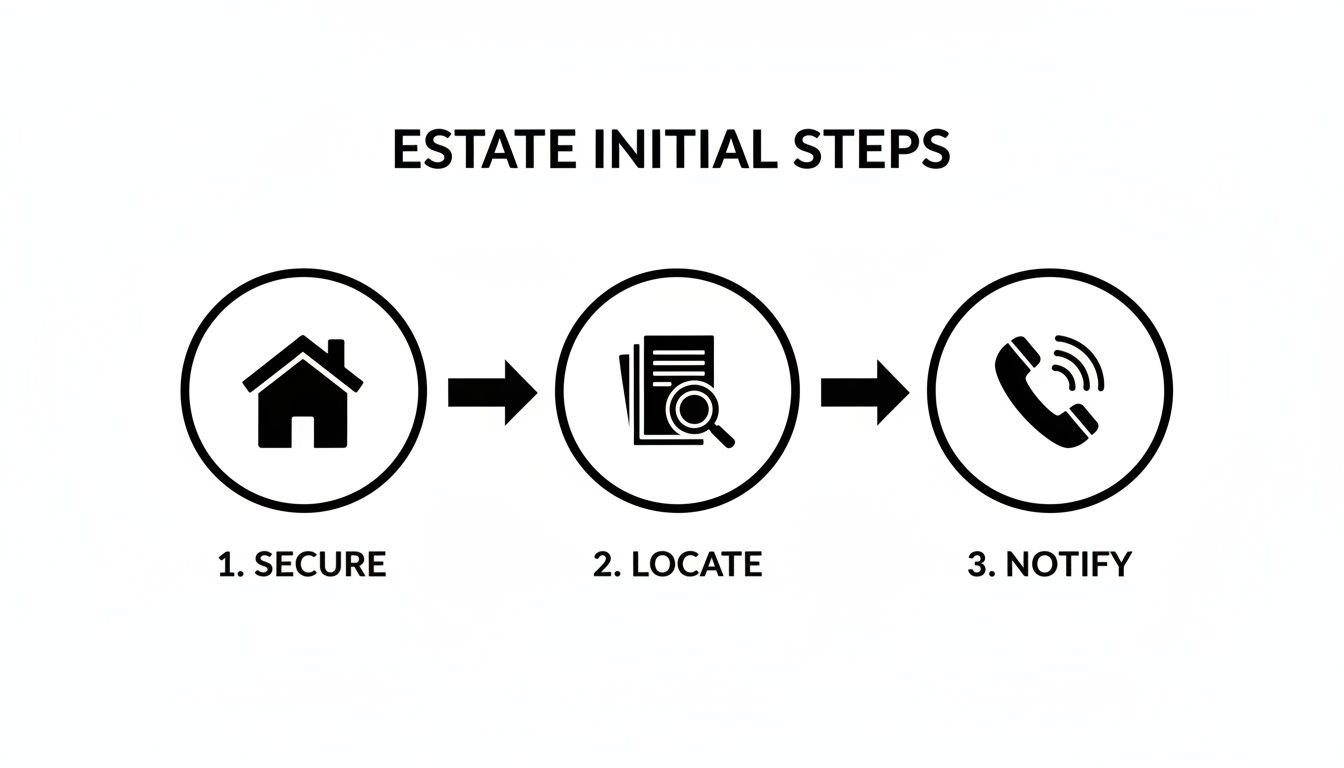
Securing property, finding all the crucial documents, and notifying the right people are the practical tasks you must complete before you can even begin the formal court process here in Harris County.
Different Paths Through Probate in Texas
Not every estate takes the same journey through the court system. Texas law wisely provides a few different ways to handle things, and the right path depends entirely on the will's instructions and the family dynamics.
Here are the two main avenues you might take:
- Independent Administration: This is, by far, the most common and preferred method in Texas. If the will allows for it, or if every single beneficiary agrees, the executor can handle most of the estate’s business without constantly running back to the judge for permission. This makes things much faster and cheaper for families in Atascocita and Humble.
- Dependent Administration: This is a much more hands-on, court-supervised process. The executor has to get a judge's approval for nearly every significant action, like selling property or paying debts. While slower and more expensive, it's sometimes necessary, especially when beneficiaries are in conflict or the will doesn't specify independent administration.
Figuring out which path to take is one of the most important early decisions, as it directly impacts the time and money spent closing the estate.
What to Expect at the Harris County Courthouse
The probate process officially kicks off when you file an "Application to Probate Will" with the Harris County Clerk. You'll submit this application along with the original will. After filing, there's a mandatory waiting period before a hearing can be scheduled, which allows time for any interested parties to be formally notified.
At that first hearing, a judge will review your application and the will itself. You’ll need to provide brief testimony to prove the will is legitimate. The judge is there to confirm a few key facts: that the person has passed away, that the document presented is their true last will, and that you are qualified to serve as executor.
A Word of Experience: The Harris County probate courts are generally very efficient, but they are sticklers for detail. One small mistake on your application can get it rejected, forcing you to correct the error and start the waiting period all over again. This is one of those times when having a local Atascocita attorney who knows the system can save you a world of frustration.
Receiving Your Authority to Act
If the judge is satisfied with everything at the hearing, they will sign an order admitting the will to probate. From this comes the single most important document you'll receive: Letters Testamentary.
Think of Letters Testamentary as your official badge of authority from the court. It’s the legal document that proves you have the power to act on behalf of the estate. With it in hand, you can finally:
- Open a new bank account for the estate
- Gain access to the deceased’s financial records
- Sell assets like a car or the family home
- Deal with creditors, government agencies, and insurance companies
Without this document, you're essentially powerless. It is the key that unlocks your ability to move forward. To get a deeper look into this critical first stage, you can review our comprehensive guide on how to probate a will in Texas.
Managing Estate Assets and Notifying Creditors
Once the Harris County court has officially named you as the executor and handed you your Letters Testamentary, your job shifts gears. You’re no longer just preparing for the process; you're now in the driver's seat, actively managing the estate. This is where the real work of settling a loved one's affairs truly begins.
Your fundamental duty at this stage is to act as a fiduciary. That’s a legal term meaning you're obligated to act in the absolute best interest of the estate. It boils down to two main tasks: gathering every single asset and meticulously handling every debt. This phase is all about painting a complete and accurate picture of your loved one's financial world, which requires organization, patience, and a firm grasp of your legal responsibilities to both beneficiaries and creditors.

Creating a Detailed Inventory of Estate Assets
One of your first major assignments is to track down, secure, and put a value on everything the decedent owned. This comprehensive list is called an "Inventory, Appraisement, and List of Claims," and it must be filed with the court, usually within 90 days of your appointment. Think of it less as a simple list and more as a detailed financial snapshot of the estate on the date your loved one passed away.
For someone living in Atascocita or Humble, this inventory can cover a lot of ground. It's crucial to be exhaustive here—leave no stone unturned.
Common assets you'll need to hunt down and document include:
- Real Estate: This could be the family home in a neighborhood like Eagle Springs, a rental property, or even a piece of undeveloped land in Harris County.
- Bank Accounts: You'll need to find all checking, savings, and money market accounts. Don't forget certificates of deposit (CDs).
- Vehicles: Cars, trucks, boats, and RVs all need to be listed with their estimated market value.
- Investments: This includes stocks, bonds, mutual funds, and critically, retirement accounts like 401(k)s or IRAs.
- Personal Property: This is the catch-all category for furniture, jewelry, collectibles, firearms, and artwork. It might feel overwhelming, but it all needs to be accounted for.
Some items, like a house or valuable art, will likely need a formal appraisal to pin down their fair market value. For other assets, you can often use resources like Kelley Blue Book for vehicles or find comparable sales for collectibles. It's a real detective-work phase of the process.
The Legal Duty to Notify Creditors in Texas
After you've got a solid handle on what the estate owns, it's time to turn your attention to what it owes. Texas law is very clear on this: executors must give formal notice to creditors, giving them an opportunity to file a claim against the estate. This isn't just a suggestion; it's a critical step that protects both you and the beneficiaries from potential lawsuits down the road.
There are two distinct types of notice you’re required to provide:
- Direct Notice to Known Creditors: For any secured debts—think mortgages or car loans—you must send a formal notice by certified mail. This needs to happen within 60 days of receiving your Letters Testamentary.
- Published Notice to Unknown Creditors: You also have to publish a general "Notice to Creditors" in a local newspaper that circulates in Harris County. This has to be done within one month of your court appointment.
Local Insight: For folks in the Atascocita and Humble areas, publishing the notice in a major paper like the Houston Chronicle or a community newspaper serving northeast Harris County will satisfy this legal requirement. The published notice essentially puts any potential unknown creditors on the clock, giving them a limited time to come forward and make their claim.
Evaluating and Paying Valid Claims
Once the notices go out, claims from creditors will start to arrive. It's your job to review each one with a critical eye. Before you pay a dime from the estate's funds, you need to determine if the debt is legitimate and legally enforceable.
Some claims might be invalid, based on an incorrect amount, or even expired because the statute of limitations has passed. You have the legal authority to formally accept or reject a claim. If you reject one, the creditor can then sue the estate to try and prove their claim is valid, which is why your record-keeping must be flawless.
Remember, valid debts—including funeral expenses, final medical bills, and credit card balances—must be paid before any assets can be distributed to the heirs. Navigating this can be tricky, and it helps to understand which assets are exempt from creditors. If you're thinking ahead and want to shield your own assets from this process in the future, our guide on how to avoid probate in Texas is a great place to start.
Handling Final Taxes and Preparing for Distribution
After you’ve tracked down all the assets and paid off the estate's debts, you’re on the home stretch. But before any money or property can be handed over to the heirs, there's one last major hurdle: settling up with the government. This is a critical step, and getting it right protects everyone involved—you as the executor and the beneficiaries—from any future tax headaches.
For many families we work with in Atascocita and Humble, the thought of dealing with the IRS on top of everything else is overwhelming. The good news is that for most estates, the tax situation is far less complicated than people fear. Let’s break down what you actually need to do.
The Two Tax Returns You Might Encounter
As the person managing the estate, you may need to file one or two different federal tax returns. It's important to know which is which, because they cover completely different things.
The Final 1040: This is the standard personal income tax return (Form 1040) for your loved one. It covers the income they earned from January 1st up until the day they passed away. You’re simply finishing up the tax filing they would have done themselves for that partial year.
The Estate's 1041: Think of the estate as a new, temporary taxpayer. If the estate’s assets generate more than $600 in gross income after your loved one’s death, you’ll need to file an income tax return for the estate itself using Form 1041. For instance, if a rental property in Harris County continues to collect rent while the estate is being settled, that income belongs to the estate and needs to be reported.
Most of the time, you'll only need to worry about the final Form 1040. An estate income tax return usually only comes into play when the administration process is lengthy and assets are actively earning money.
The Good News About Texas Estate and Inheritance Taxes
People hear "estate tax" and immediately get worried. We're happy to report that for almost everyone here in Texas, this is a non-issue.
Key Takeaway for Atascocita Residents: Texas does not have a state inheritance tax or a state estate tax. This is a huge relief for families, as it means beneficiaries won't see their inheritance reduced by a state tax bill.
What about the federal government? The federal estate tax is designed to apply only to the wealthiest individuals. For 2024, an estate is only subject to this tax if its total value exceeds a staggering $13.61 million. So, unless you're handling an exceptionally large estate, you won't even need to think about filing a federal estate tax return (Form 706).
Dealing with taxes when closing an estate can seem complex, but it often boils down to just a few key filings. Here's a quick reference to help you keep them straight.
Key Tax Filings When Closing a Texas Estate
| Tax Return Type | IRS Form | Who It's For | Common Trigger |
|---|---|---|---|
| Final Personal Income Tax | Form 1040 | The deceased individual | Every estate where the person earned income before passing. |
| Estate Income Tax | Form 1041 | The estate as a legal entity | The estate generates over $600 in income after death. |
| Federal Estate Tax | Form 706 | Extremely large estates | Total estate value exceeds $13.61 million (for 2024). |
As you can see, for the vast majority of Texas estates, your focus will be on the decedent's final Form 1040 and, occasionally, an estate income return if assets are producing income.
Preparing the Final Accounting for Beneficiaries
Once all debts are paid and the taxman is satisfied, your final major task is to prepare a "final accounting." This is simply a clear, straightforward report for the beneficiaries that shows where all the money went. It’s an essential act of transparency that builds trust and prevents confusion.
A good final accounting clearly shows:
- Every asset that the estate started with.
- Any income the estate received during administration (like bank interest or rent).
- All the money paid out (for bills, funeral costs, legal fees, and taxes).
- What’s left to be distributed to the heirs.
This document is your proof that you’ve managed everything properly and fulfilled your legal duties. By giving every beneficiary a copy before you write the final checks, you ensure everyone is on the same page and can close this chapter peacefully.
Wrapping It All Up: The Final Steps to Close the Estate
You've navigated a long and often difficult road, but the end is in sight. After marshalling the assets, dealing with creditors, settling debts, and filing taxes, you’re finally ready to close the estate. This is the moment you officially wrap things up with the Harris County court, distribute the remaining assets to the heirs, and bring closure to the family.
It's a huge relief to get to this point. All the careful record-keeping and hard work are about to pay off. Now it's time to follow through on your loved one's final wishes and pass their legacy on to the people they chose.

Distributing the Remaining Assets to Beneficiaries
Before a single dollar or piece of property changes hands, you need the beneficiaries to approve your final accounting. This breakdown shows every transaction you've made, offering total transparency. Once you have their signed approval, you can start making the distributions.
Your guide here is the will, and you have to follow it to the letter. If the will says the house in Atascocita goes to the oldest son and the bank account is split three ways, that's exactly how it has to be done. This isn't the time for creative interpretations.
Here’s a quick checklist for a seamless distribution:
- Get Receipts for Everything: For every single asset, whether it's cash, a car, or antique furniture, have the beneficiary sign a Receipt of Distribution. This is your proof that they got what they were supposed to.
- Transfer Titles Correctly: Assets like real estate and vehicles need new legal titles or deeds to officially transfer ownership from the estate to the individual heir.
- Close the Estate's Bank Account: This is your very last move. After all the checks have been cashed and the transfers are complete, you can finally close the estate's bank account.
Why You Can't Skip the Final Court Filing
It can be tempting to just distribute the assets and call it a day. After all the work, who wants more paperwork? But skipping the final court filing is a major mistake. Formally closing the estate provides a legal shield that you, as the executor, absolutely need. In Texas, this usually means filing a closing document with the Harris County court.
This isn't just a formality. This filing officially tells the court and the public that you've fulfilled all your obligations.
A Final Word of Advice: Don't ever skip the final court filing. It’s your legal protection against any future complaints or claims. Once the court accepts your closing paperwork, you are officially discharged from your duties, and your personal liability ends.
Getting Discharged and Finding Your Peace of Mind
The most common way to wrap things up is by filing what's known as an Application for Discharge. In plain English, you're telling the judge, "I did my job. I paid the bills, filed the taxes, and gave the beneficiaries what the will said they should get. Please release me from my duties."
Filing for discharge is about more than just ticking a box—it's about protecting yourself. It makes it incredibly difficult for a beneficiary or a surprise creditor to show up years later and accuse you of mishandling the estate. This simple action draws a legal line in the sand, marking the official end of your role and your liability. It provides true closure, not just for the estate, but for you—the person who stepped up to handle a loved one's final affairs.
Answering Your Top Questions About Closing a Texas Estate
When we sit down with families from Atascocita and Humble to talk about settling a loved one's estate, the same questions almost always come up. It's a confusing process, and knowing that others share your concerns can be a real comfort. Let's walk through some of the most common questions we hear every day.
How Long Does It Take to Settle an Estate in Harris County?
This is the big one, and the most honest answer we can give is: it really depends. Every estate is different. If you have a perfectly clear will, no family disagreements, and simple assets, you might get everything wrapped up in six to nine months. But frankly, that's a best-case scenario and not what we typically see.
Several key things will either speed up or slow down the process:
- The Assets Themselves: An estate with a house, a car, and a checking account is going to move much faster than one with a family business, rental properties, or mineral rights.
- Family Harmony (or Lack Thereof): When everyone is on the same page, things go smoothly. But if a will is challenged or beneficiaries are fighting, the timeline can stretch out for months or even years.
- Surprise Creditors: An unexpected bill or a disputed claim from a creditor has to be sorted out before anyone gets a dime. This can put everything on hold.
- The Court's Schedule: Harris County's probate courts are busy. While they're generally efficient, just getting a hearing date on a crowded docket can add time.
For a more detailed look at what influences the clock, we've put together a guide on how long probate typically takes in Texas. Realistically, most families in our area should probably plan for a timeline closer to 12 to 18 months.
What Happens If I Cannot Find the Will?
That moment of panic when you can't find the original will is completely understandable, but it's not a dead end. First thing's first: do a deep search. Look in every logical place—safe deposit boxes, fireproof safes at home, file cabinets—and don't forget to call your loved one's attorney. They often keep the original on file.
If the original is truly gone but you have a photocopy, you still have options. Texas law allows a copy to be probated, but it's a higher hurdle to clear. You'll have to convince the court that the copy is legitimate and that the original wasn't intentionally destroyed by your loved one (which would be the same as revoking it).
Local Tip for Humble Families: If you can't find any will at all, the estate is declared "intestate." This is a crucial distinction. It means the State of Texas—not your loved one's wishes—decides who inherits the property based on a rigid formula of family relationships. The court will appoint an administrator to follow these state laws precisely.
What Are the Average Costs of Closing an Estate?
The cost of settling an estate can be all over the map, but it’s important to remember one thing: these expenses are paid by the estate itself, not out of the executor's own pocket.
Generally, you can expect to see costs fall into these buckets:
| Expense Category | Description | Typical Cost in Harris County |
|---|---|---|
| Court Filing Fees | The basic fees for getting the process started with the Harris County Clerk's office. | $300 – $500 |
| Attorney's Fees | Fees for a lawyer's guidance. This can be a flat rate for simple cases or an hourly charge. | Varies greatly with complexity. |
| Executor's Fee | Texas law allows the executor to be paid for their work, up to 5% of the estate's gross value. | Often waived if the executor is also a main heir, like a child or spouse. |
| Bonding Costs | Think of this as an insurance policy the court sometimes requires to protect the heirs from mistakes. | The cost depends on the size of the estate. |
| Appraisal Fees | Needed to get a professional valuation for assets like real estate, art, or business interests. | $400 – $1,000+ for each appraisal. |
While there’s no magic number, a simple, uncontested administration might run a few thousand dollars in total. A complex estate or one involving a lawsuit, however, can see those costs climb dramatically.
Taking on the responsibility of closing an estate is a heavy weight. You're trying to manage a legal marathon while grieving. If you live in Atascocita, Humble, or anywhere in northeast Harris County and feel like you're in over your head, please know you don't have to figure this out alone. The experienced and compassionate attorneys at the Law Office of Bryan Fagan – Atascocita TX Lawyers are here to offer the clear, local guidance you deserve. Schedule your free consultation with us today and let us help you find the right path forward.