 Skip to content
In Texas, what many call a postnuptial agreement is legally known as a "partition or exchange agreement." It's a contract that you and your spouse sign after you're married to clarify your property rights. For families here in Atascocita and northeast Harris County, it’s not about anticipating a split; it’s a proactive financial planning tool. It allows you to decide together what is considered separate property versus community property, providing both of you with clarity and security as your life together evolves.
Charting Your Financial Future, Together

When folks in Atascocita, Humble, and our surrounding communities hear "postnup," their minds often jump to one conclusion: a marriage on the rocks. But that’s a common misconception. A postnuptial agreement in Texas isn't about planning for a divorce; it’s about building a more transparent and solid financial partnership during your marriage.
It’s like creating a financial roadmap for your journey as a couple. Life is unpredictable, and a postnup helps you navigate those twists and turns with confidence. It’s an opportunity for you and your spouse to get on the same page about financial goals, protect certain assets, and head off potential conflicts by making a plan you both agree on. It's about feeling understood, informed, and supported in your financial life together.
Why Are Postnups on the Rise in Our Community?
Life changes after the wedding, and a postnup is simply a compassionate way to address those changes proactively. For families right here in our Atascocita community, this could look like:
- Starting a Business: One of you launches a new business near Lake Houston and wants to shield the family from potential financial risks.
- Receiving an Inheritance: A large inheritance comes in, and you want to ensure the original giver's wishes are respected by keeping it separate.
- Career Shifts: One spouse decides to stay home to raise the kids, and you both want their financial security clearly spelled out and protected.
- Blending Families: You need to ensure specific assets are set aside for children from a previous marriage.
These agreements are becoming more common. In fact, a recent survey found that 50% of divorce attorneys have seen a significant jump in requests for postnups over the last three years. This isn't just a national trend; it's happening right here in the Atascocita and Humble areas, where new businesses and changing family finances make this kind of planning more important than ever.
A postnup isn't a prediction of failure; it's a tool for partnership. It encourages open, honest conversations about money—a process that can strengthen a marriage by making sure both partners feel secure and heard.
By getting on the same page about how property is handled, you can prevent many arguments and misunderstandings down the road. This is especially crucial in Texas, which is a community property state. That means most assets you acquire during the marriage are legally considered joint property. For a more detailed explanation, check out our guide on what community property means in Texas.
Ultimately, a postnuptial agreement is about empowerment. It lets you and your spouse define your financial future on your own terms, not the state's.
Crafting a Rock-Solid Texas Postnuptial Agreement

For a postnuptial agreement to do its job in a Texas court, it must be built on a solid legal foundation. Think of it like building a house here in Atascocita—you wouldn't pour a foundation on shaky ground. An agreement that doesn't meet the state's strict standards can be invalidated, leaving you right back where you started.
The Texas Family Code lays out the rules very clearly. These aren't just suggestions; they are mandatory safeguards to ensure fairness and prevent one spouse from being taken advantage of. Our goal as your local attorneys is to walk you through these requirements step-by-step, so you feel confident that the document you create truly protects you both.
The Three Pillars of a Valid Postnup
To be legally binding in Texas, your postnuptial agreement must stand on three core pillars. If even one of these is missing, a judge can refuse to enforce the agreement.
- It Must Be in Writing: This is non-negotiable. Verbal agreements or casual promises about property won't hold up in court. The entire agreement must be a physical document.
- It Must Be Signed Voluntarily: Both spouses must sign the agreement freely and willingly. Any hint of coercion, threats, or extreme pressure can invalidate the entire document.
- It Must Include Full Financial Disclosure: Before signing, both of you must provide a fair and reasonable disclosure of your assets, debts, and financial obligations to each other.
That last point about financial transparency is an absolute deal-breaker. Hiding assets or downplaying your financial situation is one of the fastest ways to get a postnup thrown out of court.
What Does "Unconscionable" Mean in Texas Law?
Even if an agreement is written and signed, a court can still set it aside if it’s found to be "unconscionable." In plain English, this means the deal is so outrageously one-sided and unfair that it shocks the conscience of the court.
An agreement might be deemed unconscionable if one spouse wasn't given a complete financial picture and had no reasonable way to find out the truth. For instance, imagine a business owner in Humble who hides significant company profits from their spouse right before asking them to sign away all rights to that business. A court would almost certainly see that as unconscionable and refuse to enforce it.
A Texas court doesn't just glance at the final terms. It examines the entire process—how the agreement was created, what information was shared, and whether both people truly understood what they were signing.
A Real-World Example of an Invalidated Postnup
The stakes are high. Texas courts will enforce these agreements, but they will also scrutinize them closely for fairness. A 2018 case from a Texas court provides a perfect example. The court invalidated a postnup because one spouse signed it involuntarily and did not receive an adequate financial disclosure. The agreement made grand promises of lifelong spousal support, but because it was created without transparency and fairness, it was ultimately voided.
A critical part of creating an enforceable postnup is a thorough evaluation of every term. Learning the skill of mastering contract review can be incredibly helpful here, as it ensures you understand every clause and its long-term consequences.
Building a fair and enforceable postnuptial agreement isn't a DIY project. At The Law Office of Bryan Fagan, we guide couples in Atascocita and throughout Harris County through this process with care and precision. We are here to help you build a stronger financial future, together. To talk about your specific situation, feel free to schedule a free consultation at our Atascocita office.
What Belongs in Your Postnup—And What Doesn't
When you and your spouse create a postnuptial agreement, you’re drafting a custom financial blueprint for your marriage. It's a chance to step outside the default Texas community property rules and create a plan that fits your specific life and goals here in northeast Harris County.
Think of it as drawing clear lines for your assets and debts. You're proactively preventing future misunderstandings by getting on the same page now, as your financial picture grows and changes. It’s all about taking control and building a framework that feels fair and secure to both of you.
What You Can Include in Your Agreement
The real value of a postnup is its flexibility. For couples in Atascocita, Humble, and surrounding communities, this means tackling the real-world financial shifts that happen during a marriage.
Here is some step-by-step guidance on the most common provisions you can build into your agreement:
- Define Separate Property: You can officially designate certain assets as belonging to just one spouse. This is perfect for protecting a family inheritance, a significant gift received during the marriage, or even a new business launched in Kingwood.
- Reclassify Community Property: Texas law allows you to change the character of your property. If you used joint funds to start a business but both agree it should be one spouse's separate asset going forward, a postnup can legally establish that.
- Manage Retirement Accounts: You can specify how retirement funds like a 401(k) or pension earned during the marriage will be handled, bringing peace of mind, especially when one spouse has a much larger nest egg.
- Assign Debt Responsibility: A postnup can clarify who is responsible for which debts, whether they were brought into the marriage or accumulated together. This is a practical way to shield one spouse from the other's student loans or business debt.
- Protect Assets for Children: For blended families in our community, a postnup is an invaluable tool. It can ensure that assets are preserved and passed down to children from a prior marriage.
- Outline Spousal Support: You can agree on the terms for spousal support (alimony) in the event of a divorce. This could mean setting a specific amount, limiting the duration, or even waiving it altogether to create financial predictability.
Mapping out these areas helps you construct a financial plan that reflects your unique family. If you're curious about how this compares to an agreement made before marriage, take a look at our guide that helps answer the question, what is a prenuptial agreement?
The Uncrossable Lines in Texas Law
While a postnup gives you a lot of freedom, Texas law puts its foot down when it comes to children. Certain rights and responsibilities are off-limits and cannot be negotiated away in any marital contract.
The "best interest of the child" is the guiding principle for every Texas family court. This principle overrides any private agreement between parents, ensuring that children's needs are always the top priority.
This means your postnuptial agreement cannot dictate anything related to child custody or child support.
- Child Custody (Conservatorship): You can't use a postnup to pre-determine who gets custody of the children if you divorce. A judge will always make that decision based on what is best for the children at that specific time.
- Child Support: You are not allowed to waive child support or lock in a specific payment amount. Child support is considered the child's right, not the parents', and it must be calculated using state guidelines when the time comes.
Furthermore, a Texas court won't enforce any part of a postnup that is illegal or goes against public policy. This means you can't include clauses that encourage divorce or are designed to hide assets from creditors. The agreement must be fair, transparent, and created to manage finances within the marriage.
Here is a simple breakdown to help you visualize what goes where:
What Belongs in Your Texas Postnuptial Agreement
This table summarizes the key topics you can and cannot include in your agreement, giving you a clear starting point.
| Permissible Provisions | Prohibited Provisions |
|---|---|
| Designating separate and community property | Determining child custody or visitation schedules |
| Assigning responsibility for debts | Waiving or pre-determining child support amounts |
| Protecting family assets or inheritances | Including provisions that encourage divorce |
| Managing retirement accounts and benefits | Adding illegal clauses or anything that violates public policy |
| Defining spousal support (alimony) terms | Using the agreement to defraud creditors |
| Outlining how a family business will be handled | Waiving a child's fundamental rights |
| Clarifying financial responsibilities during the marriage | Dictating personal matters like chores or behavior |
Understanding these boundaries is critical. It ensures you're creating a strong, enforceable agreement that safeguards your family's financial future. At The Law Office of Bryan Fagan, we guide couples in our Harris County community through these rules every day, helping them craft postnups that are both effective and legally sound.
Why Texas Couples Decide to Create a Postnup
It's easy to get lost in legal terms, but what our neighbors in Atascocita and Humble really want to know is, why would we need a postnuptial agreement? The answer usually isn't about trouble in the marriage. It's about navigating the real-life changes that happen long after you say "I do."
For many families in our community, a postnuptial agreement in Texas is about strengthening the partnership. These are practical tools that come from a place of foresight and respect, helping couples get on the same page during major life changes. It’s about having important money conversations before a crisis arises.
An Example: A Humble Entrepreneur’s Story
Picture a couple in Humble. One spouse dreams of quitting their corporate job to start a small business. It's exciting, but they're also realistic about the risks. A new company often means taking on debt, and the first few years can be a financial rollercoaster.
They decide to draft a postnuptial agreement. This legal tool allows them to designate the new business as the separate property of the spouse launching it.
This practical step achieves two important things:
- It protects their shared assets—their home, their savings—from any potential business debts or lawsuits.
- It gives the entrepreneur the freedom to take that calculated risk, knowing their family's financial foundation is secure.
Here, the postnup is a safety net. It empowers them to pursue a dream while protecting what they've built together.
An Example: An Atascocita Family's Inheritance
Now, let's look at another common scenario for a family in Atascocita. One spouse is about to receive a significant inheritance, which includes cash and a beloved family home. The grandparent's intention was clear: keep this legacy in the family line.
To honor that wish, the couple decides a postnup is the best path forward.
A postnuptial agreement provides a respectful and legally sound way to honor the intentions behind a family gift or inheritance, ensuring it is handled exactly as the giver wished.
The agreement officially defines the inherited assets as the recipient's separate property. This act of love and respect from the other spouse removes any gray area under Texas community property laws. It acknowledges the sentimental value of the inheritance and ensures it's protected for future generations.
More Real-World Scenarios for Local Families
The reasons for a postnup are as unique as the families in Harris County. A postnuptial agreement can be a smart move in many other situations:
Perhaps one partner has paused their career to be a stay-at-home parent. A postnup can formally recognize their non-financial contributions and provide a defined financial safety net. For blended families, it’s an invaluable tool for protecting assets you want to pass down to children from a previous marriage, making your wishes legally airtight.
Each of these examples gets to the heart of what a postnup is for: bringing clarity and security to your financial life as a couple. It’s a proactive step that lets you face the future with a solid, agreed-upon plan. If this sounds like your family's situation, the team at The Law Office of Bryan Fagan is here to help. We invite you to schedule a free consultation at our Atascocita office to discuss how a postnup could benefit your family.
Your Step-By-Step Guide to Creating a Postnup
Bringing up the idea of a legal agreement with your spouse can feel a little intimidating. Many couples we meet in Atascocita and Humble aren't sure where to start. The good news is the process is more straightforward than you might think, especially with an experienced local guide. A postnuptial agreement in Texas is built through a series of clear, manageable steps designed to ensure everything is fair, transparent, and reflects what you both want.
Think of this as your roadmap. We've broken down the journey, from the first conversation to the final signature, so you can see how a postnup can bring peace of mind and strengthen your financial partnership.
Step 1: The Initial Consultation
It all starts with a simple, compassionate conversation. The first step is to schedule a free, confidential consultation at our Atascocita office. This is where we listen. We want to hear your story, understand what you hope to accomplish, and answer all your questions in plain English. This meeting is about making you feel comfortable and informed before taking any next steps.
Step 2: Full Financial Disclosure
Transparency is the foundation of a strong, enforceable postnup. This is a critical phase where you and your spouse will each provide a complete and honest picture of your finances. You'll gather documents for things like:
- Assets: Bank accounts, real estate, investment portfolios, retirement funds, and any business interests.
- Debts: Mortgages, car loans, student debt, and credit card balances.
This ensures both of you are making decisions with all the facts on the table, a non-negotiable requirement under Texas law.
Step 3: Drafting the Agreement
Once we have a clear financial picture and a solid grasp of your goals, our attorneys begin drafting the postnuptial agreement. This is not a one-size-fits-all template. We carefully craft a custom document that speaks to your unique situation, whether you're protecting a new business in Humble, managing an inheritance in Atascocita, or making plans for your children's future.
As the infographic shows, postnups are practical tools for handling specific life events that change a family's financial landscape.
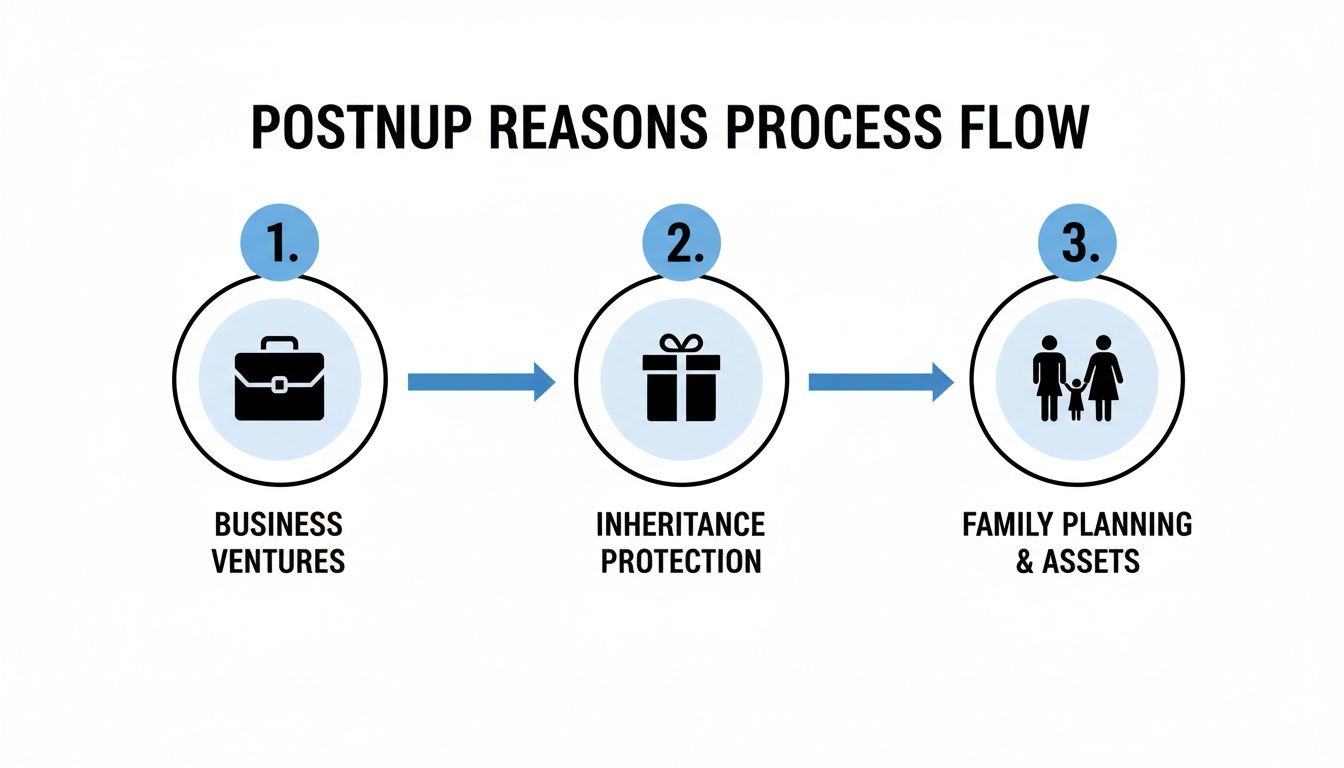
One of the biggest questions we get is about the cost. Creating a postnup is often far more affordable than people assume.
Recent data shows that in Texas, the average cost for a lawyer to draft a postnuptial agreement is around $890 on a flat fee basis. This makes it an accessible financial planning tool for families right here in Harris County.
Step 4: Independent Legal Review
To ensure the agreement is 100% fair and voluntary, Texas law strongly encourages both spouses to have their own separate lawyers. After the draft is ready, your spouse can have their own attorney review the document. This step protects everyone involved and adds a powerful layer of validity to the agreement, making it much harder to challenge later. It’s also wise for couples to understand how to protect assets during divorce as part of a comprehensive financial protection strategy.
Step 5: Final Signing and Notarization
Once both of you—and your respective attorneys—are happy with the terms, it’s time for the final step: signing the agreement. This must be done in front of a notary public, who will witness your signatures and put their official seal on the document. With that final stamp, your postnuptial agreement becomes a legally binding contract, giving you both the clarity and security you were looking for.
How Our Atascocita Lawyers Help Secure Your Future
Talking about finances in a marriage can be tough. It requires care, trust, and sometimes, guidance from someone who understands the local legal landscape. At The Law Office of Bryan Fagan, we do more than just draft legal documents; we act as your partners in securing your family’s future with a solid Texas postnuptial agreement.
We specialize in building agreements that are fair, legally sound, and truly reflect what you both want. Our roots in Atascocita mean we have a real-world understanding of the families here in Humble, Kingwood, and across northeast Harris County. We understand the local economy, the types of assets people own, and the specific concerns on your mind.
More Than Just a Document
Putting together a postnup is a delicate process. We don't just hand you a boilerplate template. Our job is to foster calm, productive conversations that can make your financial partnership stronger. We work to create an environment where both of you feel heard, respected, and clear about every step.
Here’s our step-by-step guidance for clients:
- We Listen First: We start by understanding your goals. Are you protecting a new business, an inheritance, or setting aside assets for kids from a previous marriage? We need to know what matters to you.
- Total Transparency is Key: We’ll walk you through the financial disclosure process. Getting this right—ensuring everything is out in the open and fair—is the best way to prevent legal challenges down the road.
- Your Agreement, Your Life: No two families are the same, so no two agreements should be. We carefully tailor every clause to fit your life, ensuring it’s built from the ground up to be enforceable under Texas law.
Our goal is simple: to build a legally strong agreement that gives you genuine peace of mind. We take what can feel like a complex, intimidating legal process and turn it into a collaborative effort that protects both of you.
Take the First Step with a Local Partner
Exploring a postnuptial agreement is a sign of foresight. It’s a proactive choice you make together to bring clarity and security to your financial future. You don’t have to figure it all out by yourselves. Our team is right here in the Atascocita community, dedicated to helping our neighbors build stronger foundations for their families.
If you’re ready to see how a postnup could benefit your marriage, we’re here to help. The next step is easy. Contact The Law Office of Bryan Fagan today to schedule a free, no-obligation consultation at our Atascocita office. Let’s talk about how we can help you secure your future, together.
Answering Your Questions About Texas Postnups
When couples in the Atascocita and Humble area start looking into postnuptial agreements in Texas, they usually have a lot of great questions. Getting clear, honest answers from a local attorney is the best way to figure out if it's the right move for your family. We've put together some of the most common questions we hear from our neighbors.
Is a Postnup a Sign That Our Marriage Is in Trouble?
Not at all. This is the biggest misconception. Think of a postnup less like an exit strategy and more like a financial roadmap for your journey together. It’s about being proactive, getting on the same page about money, and preventing potential arguments before they start. It's a tool for strengthening your marriage, not planning for its end.
Can We Just Write Up a Postnup Ourselves?
You can, but it's a huge risk. For a Texas court to uphold a postnup, it must meet very specific legal requirements. The agreement must be entered into voluntarily, and it requires a full and fair disclosure of all finances. It's incredibly easy to miss a crucial detail or use the wrong wording, which could make the entire document unenforceable right when you need it most.
How Much Is This Going to Cost?
It’s more affordable than most people think. Based on recent data in Texas, the average cost for a lawyer to draft a postnup on a flat-fee basis is around $890. When you weigh that against the financial clarity and protection it offers, many families in our community see it as a smart, manageable investment in their marriage.
What Happens if We Don’t Have a Postnup?
Without one, Texas law takes over. In a divorce, your property would be divided based on our state's community property rules. This means nearly everything you've acquired during the marriage is considered jointly owned and will be split in a way the court deems "just and right"—which often looks like a 50/50 split. A postnup lets you decide how things should be handled, creating a plan that fits your specific situation.
Can We Change the Agreement Down the Road?
Absolutely. A postnup isn't set in stone. You can amend or even cancel it later, as long as both spouses agree. Just like the original, any changes must be in writing and signed by both of you. Life changes, and your financial plan should be able to change with it.
What’s the Real Difference Between a Postnup and a Prenup?
It all comes down to timing. A prenuptial agreement is signed before the wedding. A postnuptial agreement is signed after you're already married. They both serve the same fundamental purpose of defining a couple's financial responsibilities and property rights.
A postnup simply gives you a chance to have the same crucial financial conversations and put the same protections in place that a prenup offers, just after you've already said "I do." It's never too late to plan for your financial future together.
Making these decisions takes clear information and thoughtful guidance. We hope these answers have helped.
At The Law Office of Bryan Fagan – Atascocita TX Lawyers, we're here to help local families have these important conversations with clarity and confidence. If you think a postnuptial agreement could bring peace of mind to your marriage, we invite you to schedule a free, confidential consultation at our Atascocita office. Let's talk about securing your family's future today.


