Skip to content

If you're in the middle of a divorce in Atascocita or Humble, there's a good chance you've already heard the words 401(k), pension, or retirement account come up with a lot more stress than you expected. For many families, those accounts represent years of work, planning, and security. They're also one of the easiest assets to mishandle if the legal paperwork isn't done correctly.
That's where a QDRO attorney in Atascocita, TX becomes important. A divorce decree may say who should receive part of a retirement account, but the retirement plan usually needs a separate legal order before it can divide the funds. When that step gets delayed or done incorrectly, people can wait months for money they were counting on, or face avoidable tax problems and rejected paperwork.
Families across northeast Harris County run into this issue more often than they should. The good news is that the process can be managed carefully when you understand what the order does, when it must be prepared, and what mistakes to avoid.
What a QDRO Is and Why It Matters in Your Texas Divorce
A couple in Atascocita signs their final divorce papers and feels a wave of relief. Then weeks pass, and the retirement account still has not been divided. The reason is often simple but frustrating. The decree says who should receive a share, but the retirement plan cannot act until it receives a separate order written in the form the plan requires.
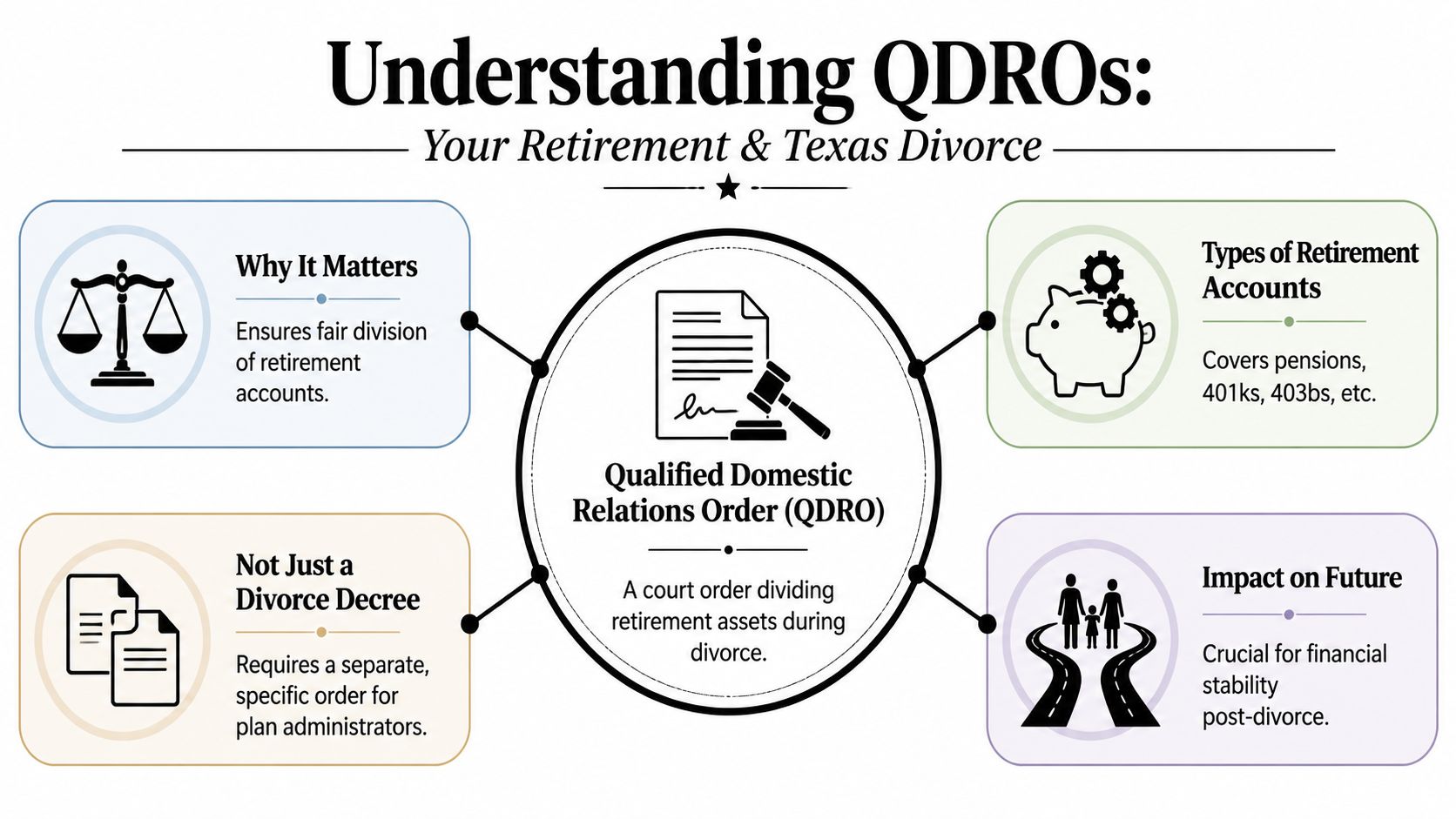
A Qualified Domestic Relations Order, usually called a QDRO, is that separate order. It works like detailed delivery instructions for a retirement plan. The divorce decree may award part of a 401(k) or pension to a former spouse, but the plan administrator still needs a document that spells out exactly who receives what, from which plan, and under what terms.
In Texas, retirement benefits earned during the marriage are often part of the community estate. According to Texas QDRO guidance, a Qualified Domestic Relations Order is legally required in Texas divorces when a retirement plan must be divided, and that order can allow a direct distribution to an alternate payee without triggering the same tax problems or early-withdrawal penalties that may come from handling the transfer the wrong way.
Why the divorce decree alone isn't enough
This is the part many Harris County families do not hear clearly until there is already a delay. A divorce decree settles the property division between the spouses. A QDRO tells the retirement plan how to carry out that division under its own rules and federal law.
Those are two different jobs.
For a checking account, the decree may be enough. For many employer retirement plans, it is not. The administrator usually needs precise language identifying the participant, the alternate payee, the amount or percentage awarded, and the method for calculating that share. If any of that is unclear, missing, or inconsistent with the plan's procedures, the order can be rejected and sent back for revision.
That timing gap causes real trouble. A spouse may believe the issue is finished once the judge signs the decree, while the plan still sees the case as incomplete. That is one of the most common reasons retirement funds get tied up for months instead of being transferred promptly.
Practical rule: If a retirement plan is being divided, the decree settles the right to receive benefits. The QDRO gives the plan authority to act.
What a QDRO can and cannot do
A QDRO can divide benefits that already exist under the plan. It cannot rewrite the plan's rules.
That distinction helps avoid a lot of disappointment. If the plan only allows distributions at a certain age or under certain conditions, the QDRO usually must follow those limits. If the plan has its own formula for valuing benefits, the order must fit that structure. A court can assign part of the benefit to a former spouse, but it cannot create a new benefit the plan never offered in the first place.
In plain terms, the QDRO is powerful, but only inside the boundaries of the plan.
Why this matters so much in practice
Many QDRO problems are not about the basic idea of dividing retirement. They come from procedure. The order is drafted too late. It is sent to the plan after key deadlines have passed. The language in the decree does not match the language in the proposed QDRO. The administrator asks for revisions, and no one responds quickly.
That is why timing deserves just as much attention as the legal wording. A well-written QDRO submitted at the wrong time can still create months of delay. A decree that says the right thing in general terms can still leave a family stuck if the follow-up order is never approved.
Suppose a spouse in Humble is awarded part of a 401(k) and plans to use that money for a deposit on a new apartment, debt payoff, or post-divorce expenses. On paper, the award exists. In real life, the funds may stay frozen until the administrator approves the QDRO. If the draft is rejected for technical reasons, the wait gets longer.
If you want a clearer picture of how these accounts are treated in local property division, this guide on division of retirement accounts in an Atascocita divorce explains the bigger framework. Families who are also juggling elder-care responsibilities during divorce may find useful support through Family Caregiving Kit legal resources.
Why a Specialized QDRO Attorney Is Crucial for Atascocita Families
A QDRO isn't a simple fill-in-the-blank form. It has to satisfy court requirements, federal rules, and the retirement plan's own internal procedures. That combination is why many families benefit from working with a lawyer who handles retirement division issues regularly, not just general divorce paperwork.
In the Atascocita and Houston area, that specialization is real. According to local QDRO attorney listings in Atascocita, attorneys handling these matters report experience levels ranging from 10 to over 54 years in family law and retirement division. That depth matters because the wording of a QDRO has to line up with the plan's rules, and one employer's pension language may differ sharply from another's 401(k) requirements.
Why experience changes the outcome
A specialized QDRO attorney knows that each plan has its own review process. Some require model language. Some have strict formatting preferences. Some reject orders for small procedural defects that don't seem important until the paperwork comes back marked deficient.
That lawyer also knows where divorce lawyers often need backup. The drafting process may involve retirement rules, tax concerns, and plan administration details that are outside the comfort zone of a typical family law practice. A local resident may assume, reasonably, that any divorce attorney can handle every part of the retirement split. Sometimes they can. Sometimes they need a narrower focus.
The risk isn't just delay. A poorly drafted order can affect when benefits are paid, how they're calculated, and whether the alternate payee receives what the decree intended.
What families in Atascocita should ask
When you're choosing a QDRO attorney in Atascocita, TX, the better questions are practical ones:
- Plan familiarity: Have they handled employer-sponsored plans like the one in your case?
- Drafting process: Do they obtain plan documents and review model language before drafting?
- Coordination: Will they work with the divorce attorney, accountant, or other professionals if tax questions come up?
- Problem prevention: Do they look for plan-specific issues before the order goes to the judge?
For some divorces, retirement division is only one piece of a larger property dispute. In that setting, a Property Division Lawyer in Atascocita may also be part of the broader legal picture because community property and complex assets often overlap.
Looking beyond the divorce itself
For older adults, retirement division often connects to larger family planning concerns. If you're helping a parent, a disabled spouse, or another loved one through legal transitions after divorce, these Family Caregiving Kit legal resources may help you think through related legal needs in a practical way.
The main point is simple. A specialist doesn't just draft words onto paper. They reduce the chance that the retirement plan will reject those words later, when time and money matter most.
Common and Costly QDRO Mistakes Atascocita Residents Must Avoid
The most expensive QDRO problems usually aren't dramatic courtroom fights. They're quiet administrative mistakes. Paperwork sits. The plan asks for revisions. A former spouse waits. Meanwhile, the retirement benefits that were supposed to provide stability remain out of reach.
One issue stands out above the rest. According to QDRO complaint information from the QDRO Center, the gap between the divorce decree and QDRO approval can delay distributions by 6–12 months, and 42% of QDRO-related complaints stem from plan administrators rejecting orders because of procedural missteps during that window.
The timing gap that surprises people
Many spouses believe the retirement division is finished once the judge signs the divorce decree. In reality, that's often the moment the separate QDRO process becomes urgent. If no one promptly gathers plan documents, drafts the order, and gets it in front of the plan administrator, the case can stall.
That delay can hit hard in Atascocita households where one spouse was counting on retirement funds to help with housing, debt, or post-divorce living expenses.
Mistakes that often lead to rejection
Some errors are technical. Others come from assumptions. All of them are preventable.
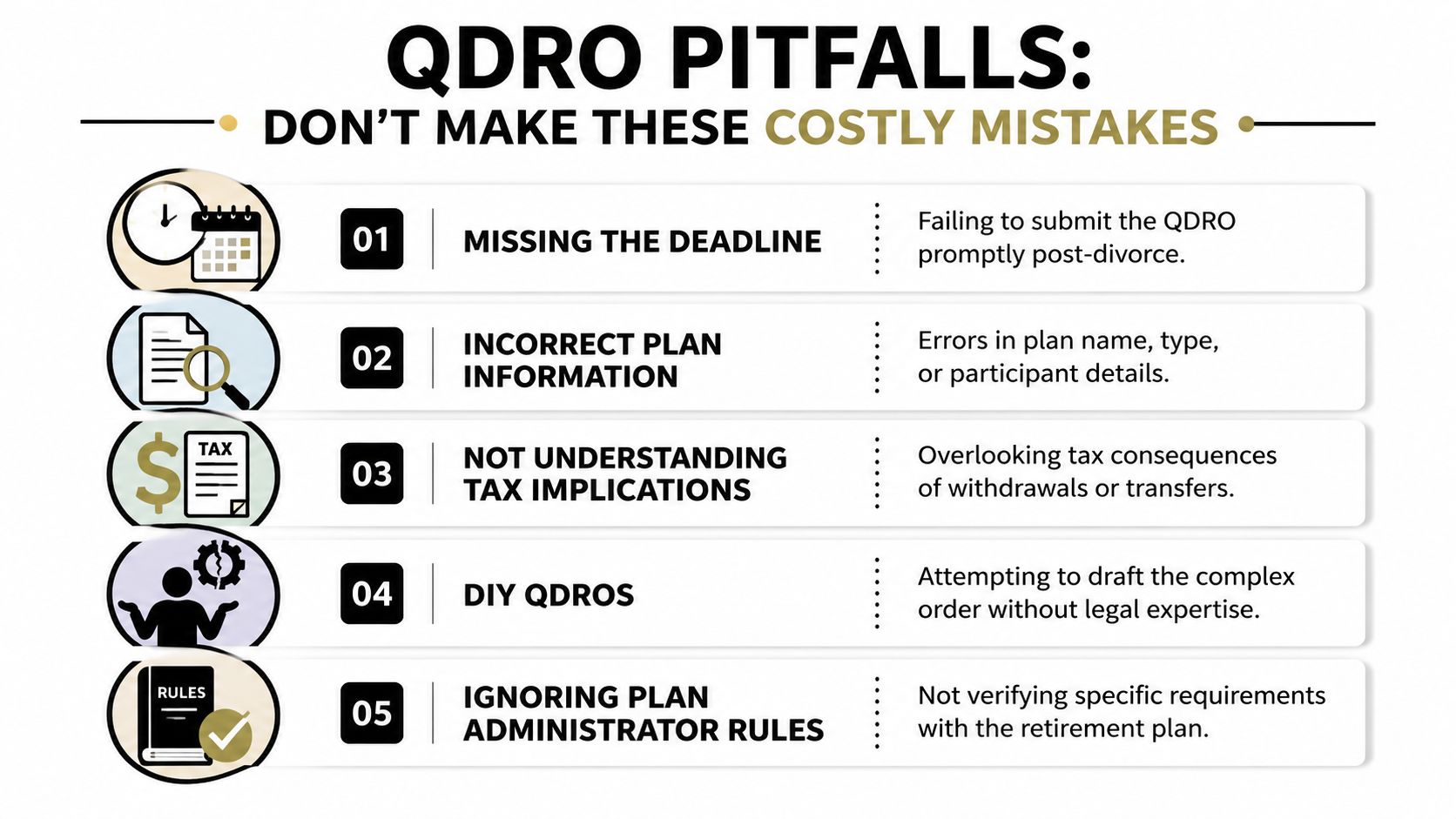
- Using generic language: A template that worked for one employer's plan may fail for another plan with different definitions and procedures.
- Listing the wrong plan details: The exact plan name, participant information, and account structure must match what the administrator recognizes.
- Ignoring gains, losses, or loans: If the order doesn't clearly address how the account is adjusted over time, disputes can follow.
- Waiting too long after the decree: Delay creates room for administrative complications and avoidable corrections.
- Skipping plan review: Some plans provide model language or internal requirements that should be checked before the order is finalized.
Local caution: The most common QDRO failure isn't usually bad intent. It's incomplete follow-through after the divorce is over.
A practical example from northeast Harris County
A spouse in Humble may receive language in the decree awarding part of a retirement account, then assume the employer will automatically divide it. Months later, they learn the plan never received an acceptable QDRO. The decree promised a share, but the plan can't act on promises alone. It needs precise legal instructions.
This same pattern can appear in divorces where one spouse worries the other hasn't been fully transparent about assets. If that concern exists, a broader review of marital property may be necessary. This article on what happens if a spouse hides assets in a Texas divorce in Atascocita explains how hidden asset concerns can affect the larger case.
Why the mistake matters beyond divorce
Retirement division isn't just about one order. It's part of long-term financial stability. After divorce, many people also need to revisit beneficiary choices, wills, and broader planning. An Estate Planning Attorney in Atascocita handles wills, trusts, and estate plans for Atascocita families, which often becomes relevant once property and retirement accounts have been redistributed.
A rejected QDRO can usually be corrected, but corrections cost time, attention, and peace of mind. Avoiding the first rejection is often the smarter path.
The QDRO Process and Timeline Step by Step
The QDRO process feels less intimidating once you can see the order of operations. Most delays happen when one of the steps gets skipped, rushed, or handled out of sequence.
Here's the overall path in a form you can follow.
The core legal step
A QDRO must become a signed court order before the retirement plan can act on it. As explained in this Texas family law FAQ about QDRO procedure, the QDRO must be signed by the divorce court judge, typically at the same time as the Final Decree of Divorce or shortly thereafter, and it remains separate from the decree itself.
That separation is why people often feel like they're doing part of the divorce twice. They aren't. They're handling a second legal document that serves a different audience. The plan administrator.
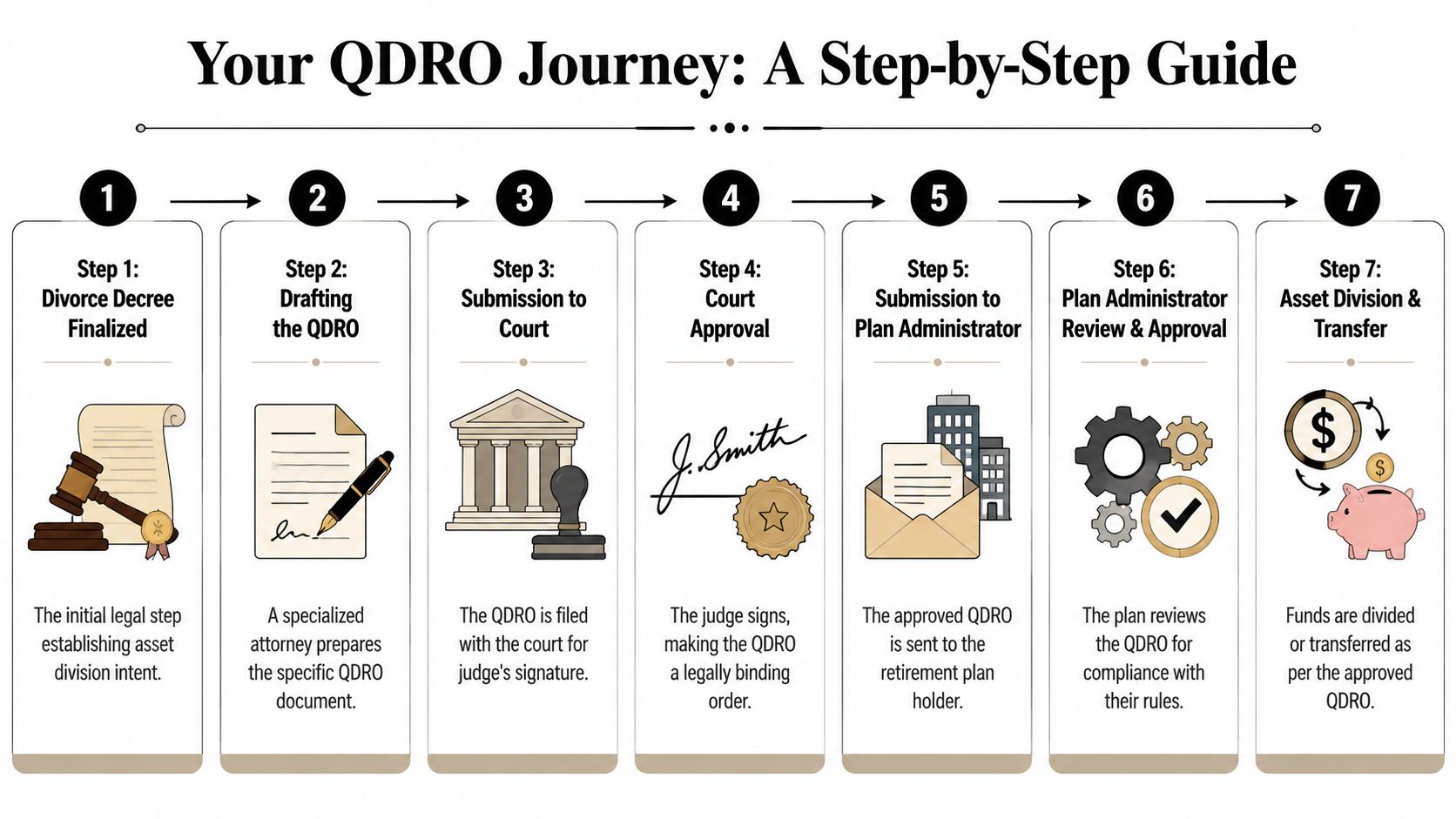
A straightforward roadmap
Confirm what the decree awards
The QDRO has to match the property division ordered in the divorce. If the decree language is vague, the QDRO stage gets harder.Get plan documents
The attorney should obtain the Summary Plan Description and any model QDRO language the plan provides. Those materials help the draft fit the plan's internal requirements.Draft the proposed order
Precise technical language is important. The order must clearly identify the participant, alternate payee, and the share being assigned.Seek plan-level review when available
Many lawyers try to get administrator feedback before the judge signs the final version. That step can prevent avoidable rejection later.Submit the order for the judge's signature
Once the language is ready, the divorce court signs it as a separate enforceable order.Send the signed order to the plan administrator
The administrator reviews the signed QDRO for compliance.Wait for implementation
If accepted, the plan divides or assigns benefits according to the order.
To hear another explanation of how retirement division orders work, this video may help:
What the timeline feels like in real life
The legal signing step can happen near the end of the divorce or soon after, but implementation depends on how quickly the administrator reviews the order and whether revisions are needed. That's why some Atascocita families feel confused. The judge has signed everything, yet the money still hasn't moved.
A short checklist helps:
| Stage | What you should watch for |
|---|---|
| Decree stage | Clear retirement division language |
| Drafting stage | Correct plan name and participant details |
| Review stage | Plan-specific compliance |
| Court stage | Separate signature on the QDRO |
| Implementation stage | Confirmation from the administrator |
Get written confirmation each time the document changes hands. That simple habit helps you track where the delay actually is.
Understanding the Costs Associated with a QDRO
Individuals asking about a QDRO aren't really asking only about legal fees. They're asking whether the cost makes sense when the divorce is already expensive. That's a fair question.
QDRO work is often billed in one of two ways. Some lawyers use a flat fee for straightforward drafting. Others charge an hourly rate when the case involves disputes, unusual plan rules, or repeated revisions. The right structure depends on how clear the decree is, how cooperative the parties are, and whether the retirement plan has a smooth review process.
Why this cost deserves attention
Under Texas law and ERISA rules described here, a spouse is generally entitled to one-half of the retirement plan benefits attributable to contributions made during the marriage, which establishes a default 50% threshold for many qualified plan divisions. When an asset may represent that much of the marital share, paying for careful drafting is usually easier to justify.
A useful way to think about it
Instead of comparing the fee to a simple form, compare it to the value of getting the division done correctly. A rejected order can create delays, added legal work, and uncertainty about access to retirement benefits. In many divorces, the larger financial risk isn't the attorney's bill. It's an avoidable mistake.
For some families, divorce planning also raises other legal issues involving children and extended family. For example, Grandparents' Rights in Atascocita addresses custody and visitation rights for grandparents in Harris County, which can become part of the broader legal picture during family transitions.
How the Law Office of Bryan Fagan Protects Your Retirement
When a retirement account is part of a divorce, careful sequencing matters. The decree has to say the right thing. The QDRO has to say it in a way the plan can honor. The timing has to be managed so the case doesn't drift into months of avoidable delay.
That's where Law Office of Bryan Fagan – Atascocita TX Lawyers fits into the process as one local option for families dealing with divorce, property division, estate planning, criminal defense, and civil matters in Atascocita, Humble, and Harris County. For readers trying to protect retirement assets after divorce, it can also help to review related topics such as asset protection guidance in Atascocita, especially when long-term financial planning is part of the conversation.

Divorce after midlife often raises other benefit questions too. If you're reviewing retirement timing more broadly, this guide on claiming Social Security at the right age can help you think through another important piece of post-divorce income planning.
The goal is clarity, not confusion. You should know what document is needed, who must sign it, what the plan requires, and what to expect next.
If you're dealing with divorce and retirement division in Atascocita, Humble, or northeast Harris County, schedule a free consultation with Law Office of Bryan Fagan – Atascocita TX Lawyers. A local attorney can review your decree, explain whether a QDRO is needed, and help you take the next step with confidence.