If you need to change a custody agreement in Texas, you must file a formal Petition to Modify the Parent-Child Relationship with the court. This is more than a simple paperwork update. For any changes to be considered, Texas law requires you to prove two key things: that there has been a material and substantial change in circumstances since the last order was signed, and that your proposed changes are truly in the best interest of the child.
As a local law firm serving the Atascocita community, we understand that life is unpredictable. A custody order that worked perfectly last year may no longer serve your family’s needs today. We’re here to help you understand the process and find a practical solution.
Knowing When to Modify Your Custody Agreement

Life in communities like Atascocita and Humble is always changing, and a custody order that made sense last year might be completely unworkable today. Your original agreement was based on a specific snapshot in time—your jobs, your child's age, and where you both lived. As life moves on, sometimes the court order needs to catch up.
You can't just ask a judge to change a custody order because you've changed your mind or have a minor disagreement with your ex. Texas family law requires a legitimate legal reason. This reason is called a "material and substantial change in circumstances," and it's the key that unlocks the door to a modification.
So, what does that legal jargon actually mean for a family in Harris County? It means something significant has happened that directly impacts your child's life, making the old order impractical or no longer in their best interest.
What Is a Material and Substantial Change?
Think of it this way: a minor argument over being 15 minutes late for a pickup probably isn't a material change. But one parent deciding to move from Atascocita to Austin? That absolutely is. The change has to be significant enough to affect the core of the parenting plan.
Here are a few common scenarios that Harris County courts typically recognize as valid grounds for a custody modification. This table gives a clearer picture of what the courts are looking for when you claim a "material and substantial change."
Common Reasons for Modifying Custody in Harris County
| Type of Change | Specific Example | Why It Matters |
|---|---|---|
| Parental Relocation | The custodial parent gets a new job and plans to move from Harris County to Dallas County. | The current possession schedule (e.g., every other weekend) becomes geographically impossible and must be adjusted for travel time and expense. |
| Change in Lifestyle | One parent remarries and now has three step-children, significantly changing the home dynamic. | The child's living situation is now very different, which could be positive or negative, and the court may need to reassess the environment. |
| Child's Safety Concerns | A parent develops a substance abuse problem, or there is evidence of neglect or family violence in their home. | The court's primary duty is to protect the child. An unsafe environment is one of the most compelling reasons for an immediate modification. |
| Child's Evolving Needs | A 14-year-old child living in Humble now has significant school, sports, and social commitments that conflict with the original visitation schedule designed for a 6-year-old. | The old order no longer fits the child's life and may be hindering their development and activities. The child's own preference can also become a factor at this age. |
| Change in Employment | A parent who once worked a standard 9-to-5 schedule now works overnight shifts, leaving the child without supervision during their possession time. | The parent is no longer available to care for the child as outlined in the original order, impacting the child's stability and daily routine. |
Each of these examples represents a genuine shift in the family's circumstances that a judge would likely agree needs to be addressed legally.
A custody modification isn’t just about tweaking a schedule; it’s about realigning the legal agreement with your family’s current reality to better serve your child's needs. The court's primary focus will always be what is best for them.
In some urgent situations, you may need to ask the court to establish temporary custody orders in Texas to protect your child while the main modification case proceeds through the system.
Reflecting Modern Family Dynamics
The legal world is also adapting to modern family life. Courts here in Texas and across the country are increasingly seeing the benefits of shared parenting. National trends show a massive shift away from old-school sole custody arrangements. By 2008, for instance, equal shared custody cases had already jumped from 5% to 27%, a trend that has only continued. For families in Harris County, this means judges are often very receptive to modifications that promote healthy co-parenting.
When you're dealing with these legal documents, it also helps to know the terminology. Understanding the difference between an addendum and an amendment, for example, can clear up confusion about how court orders are formally changed.
If your family's situation has changed and your current custody order is creating more conflict than stability, it might be time to take action. The first, most critical step is figuring out if your circumstances meet the legal standard for a modification.
The Law Office of Bryan Fagan is here to help you do just that. Contact our Atascocita office today for a free consultation to discuss your case and see how we can support your family.
Building a Strong Case for Custody Modification
Before you ever set foot in a Harris County courthouse, the most crucial work happens right now, at home. If you want to successfully change your custody agreement, you need more than just a gut feeling that things aren't working. You have to build an organized, compelling case that shows a judge exactly why a change is needed. That means gathering solid proof.
Your goal is to tell a clear story with your evidence. That story has to prove two key things: first, that a material and substantial change in circumstances has occurred, and second, that the new arrangement you’re asking for is in your child's best interest. The evidence you collect is what makes that story believable.
What Kind of Evidence Actually Persuades a Judge?
Don't just focus on one or two big blow-ups. In our experience, judges are often more convinced by a consistent pattern of behavior or a series of smaller issues that, when pieced together, paint a very clear picture. It's your job to collect all those puzzle pieces.
Here are the types of documentation that carry real weight in a custody modification case:
- Communication Records: Keep everything. Text messages, emails, and messages from co-parenting apps like OurFamilyWizard can be gold. They can clearly show a breakdown in communication, a pattern of the other parent ignoring the court order, or even reveal concerning statements.
- School and Medical Records: This is your objective proof. Report cards, attendance sheets, notes from teachers, and records from the pediatrician's office show how your child is actually doing. A sudden drop in grades or multiple absences from their school in Humble ISD can speak volumes.
- Financial Documents: Pay stubs, new job offer letters, or bank statements can demonstrate a significant shift in financial stability—for better or for worse. This is absolutely critical if you’re asking to change child support or questioning a parent's ability to provide a stable home.
- Photos and Videos: It's cliché but true: a picture is worth a thousand words. Photos of your child's clean, safe, and happy room at your house can be powerful. Conversely, photos showing unsafe or neglectful conditions at the other parent's home can be undeniable.
- Witness Information: Start a list of people who have seen things firsthand. Think about teachers, neighbors, your child's soccer coach at the Atascocita Sports Complex, or close family friends. Jot down their contact info and a quick note about what they’ve observed.
The strongest cases are built on organized facts, not just emotional pleas. A well-documented timeline gives the court a logical, step-by-step reason to grant your request to modify the custody order.
Putting It All Together: Your Timeline of Events
Once you start gathering documents, you need to get them organized. A shoebox full of random papers is just confusing. What you need is a chronological timeline. Start from the date your current custody order was signed and work your way to today.
For every important event, list the date, a simple description of what happened, and which piece of evidence you have to back it up.
Here’s what an entry might look like:
- Date: October 15, 2023
- Event: Other parent was a no-show for their weekend. I couldn't reach them for 8 hours.
- Evidence: Screenshot of my text/call log showing multiple unanswered calls and messages.
This simple method turns a messy pile of evidence into a coherent story that an attorney can quickly grasp and a judge can easily follow.
Sometimes, this evidence can also point to a more serious issue, like one parent trying to turn your child against you. If that’s something you’re worried about, it’s worth understanding how to prove parental alienation as you build your overall strategy.
Taking the time to build your case is a proactive step that puts you in a position of strength during a very stressful time. It fully prepares you for a productive meeting with a lawyer and lays the groundwork for a winning legal argument. If you've started collecting your proof and are ready to talk about what’s next, The Law Office of Bryan Fagan is here to help. Contact our Atascocita office for a free, confidential consultation to see how we can support you.
Filing Your Petition in the Harris County Courts
Once you've done the hard work of gathering your evidence and building a solid timeline, it's time to take formal legal action. For many parents in Atascocita and Humble, this is where things start to feel real—and a little intimidating. But think of it this way: filing your case is simply how you officially tell the court that things have changed and the old custody order just doesn't work for your child anymore.
The key document you'll need is called a Petition to Modify the Parent-Child Relationship. This isn't just a form; it's your story in a legal format. It lays out who you and the other parent are, details the "material and substantial change" that prompted this action, and clearly states the new arrangement you believe is in your child's best interest.
After the Petition is filed with the court, you have to legally notify the other parent. This critical step is called "service of process," and you can't just hand them the papers or send a text. Texas law requires an independent third party, like a constable or a private process server, to officially deliver the documents. This ensures there’s undeniable proof the other parent was notified, protecting everyone’s right to due process.
When You Need Immediate Court Intervention
But what if you can't wait? What if your child's safety is at risk right now? If you've just found out the other parent has a dangerous new roommate or is completely ignoring your child's serious medical needs, waiting months for a final hearing is simply not an option.
In these urgent situations, we can file for Temporary Orders at the same time as the main petition. This is essentially an emergency request for a judge to step in quickly and set temporary ground rules to protect your child while the full case proceeds. A judge can issue powerful orders that:
- Temporarily change who the child primarily lives with.
- Suspend the other parent’s visitation entirely.
- Require that all visits be professionally supervised.
- Order immediate drug testing or counseling.
These orders are a crucial tool for protecting your child’s well-being when time is of the essence.
This visual flowchart breaks down the foundational steps to take as you prepare to move your case forward.
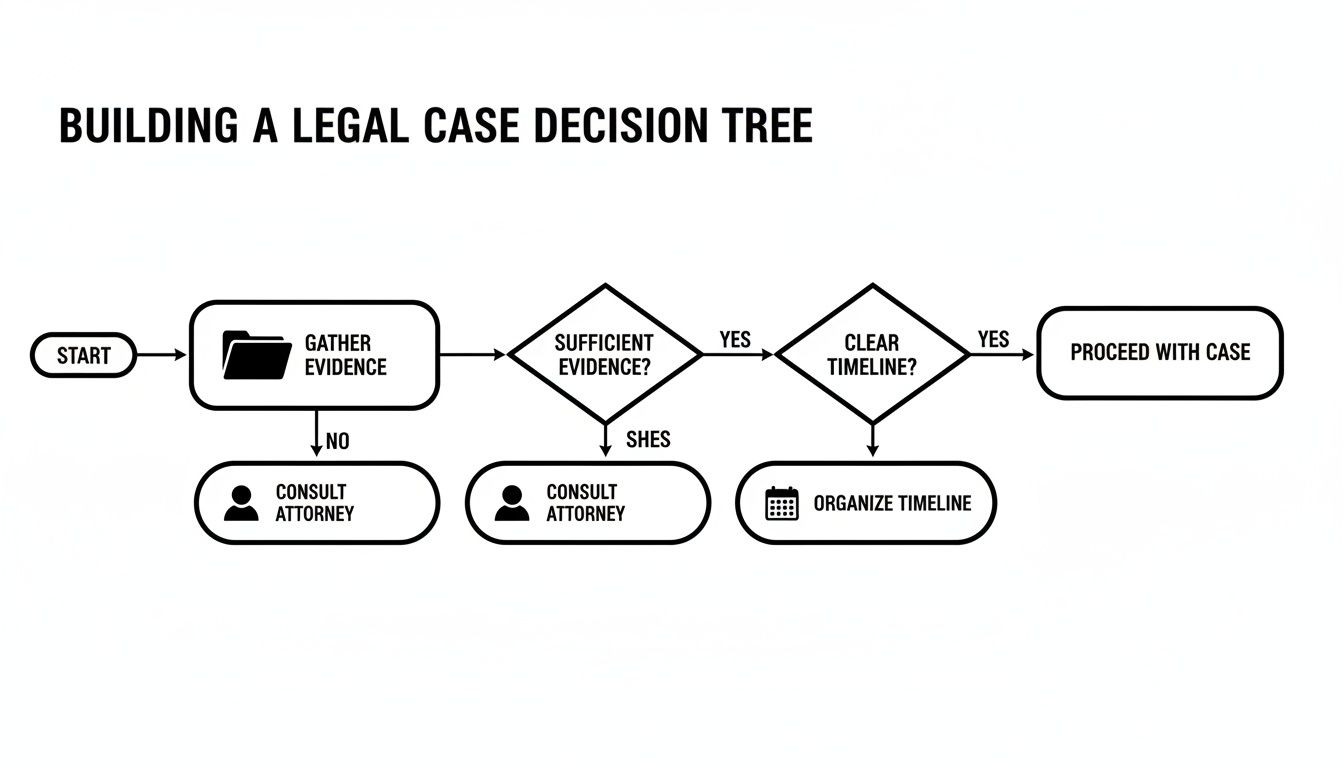
As you can see, each step logically builds on the one before it, helping you walk into court with a well-organized case from day one.
The Court's Evolving View on Custody
It’s also good to know that courts in Harris County, and really across the country, have changed how they look at custody. The old model—where one parent had the kids and the other just visited on weekends—is becoming far less common. The trend is clearly moving toward shared parenting.
Consider this: the rate of shared custody arrangements went from just 2% in 1980 to 14% by 1992. By 2008, shared custody was a factor in 43.5% of cases. This major shift shows that judges recognize that kids often do best when both parents are actively and meaningfully involved. For a parent in Atascocita seeking a modification today, this is an encouraging trend.
The legal filing process is your official entry point into the court system. Handling it correctly from the start prevents unnecessary delays and sets a professional, serious tone for your case.
Filing the petition and, if needed, requesting temporary orders are foundational steps that demand precision. Getting these initial moves right is absolutely critical to the long-term success of your case.
The team at The Law Office of Bryan Fagan can handle this entire process for you, making sure every document is filed correctly and served properly. If you're ready to take the next step, contact our Atascocita office for a free consultation to get started.
Using Mediation to Find Common Ground
The idea of changing your custody order probably brings to mind a tense courtroom battle. But for most families in Atascocita and Humble, that’s rarely how it plays out. In fact, Harris County courts almost always require parents in contested custody cases to try and work things out through mediation before they ever step in front of a judge.
So, what is mediation? Think of it as a structured, confidential negotiation session guided by a trained, neutral professional—the mediator. This isn't about one parent winning and the other losing. The entire point is to find a practical, creative solution that both of you can live with and, most importantly, one that puts your child's best interests first. It's your chance to shape the outcome yourself, rather than handing over all the decision-making power to a judge.
Preparing for a Successful Mediation Session
Walking into mediation unprepared is one of the biggest mistakes you can make. Real success comes down to doing your homework and coming in with the right mindset. This isn't the time to dredge up old fights; it’s a forward-looking process focused squarely on solving the problem at hand. Your best bet is to get organized and be ready to find some middle ground.
Before you even get to the table, sit down and really think through your goals. What does the ideal outcome look like for you and your child? Just as important, where are you willing to be flexible?
- Know Your Non-Negotiables: What are the absolute must-haves for your child’s well-being? Maybe it’s a specific change in the pickup location to work with a new school in Humble ISD, or a crucial tweak to the holiday schedule.
- Identify Areas for Compromise: Where can you give a little to get a little? Perhaps you’re open to adjusting the summer schedule if it means you get more flexibility during the school year. Knowing this ahead of time is key to effective negotiation.
- Keep Your Child at the Center: Frame every proposal around what’s best for your child. Instead of just saying, "I want more time," try explaining why. For example, "Having an extra weeknight would let me get our son to his tutoring sessions consistently, which will help his grades."
Mediation empowers you to craft a customized agreement that fits your family's unique circumstances—something a judge with a heavy caseload simply doesn't have the time to do. It puts the control back in your hands.
The Role of Your Attorney in Mediation
While the mediator is neutral, you don’t have to go through this alone. Having an experienced family law attorney from our Atascocita office by your side during mediation is a game-changer. Your attorney wears a few different hats in this setting.
First, we act as your legal safety net. We make sure any agreement you consider is fair, legally sound, and actually protects your parental rights. We can give you real-time advice on the long-term consequences of a proposal, stopping you from agreeing to something that seems fine now but could cause major headaches later.
Second, your attorney is your advocate and strategist. We can help you present your proposals clearly and calmly, taking some of the raw emotion out of the negotiation. If the conversation starts getting heated or veers off track, we can step in and steer it back to the core issues, keeping everyone focused on finding a workable solution.
Finally, we handle the crucial legal paperwork. Once you reach an agreement, we will draft a document called a Mediated Settlement Agreement (MSA). In Texas, a properly written and signed MSA is irrevocable—meaning there are no take-backs. We ensure the language is precise and crystal clear, so it can be turned into a new, enforceable court order that perfectly matches what you both decided.
Mediation gives you a path to a resolution that is often faster, less expensive, and far less stressful than a full-blown court trial. It allows you and the other parent to work together to design a new custody plan that actually works for your family's life today.
If you are facing a custody modification and want to learn more about how mediation can work for you, contact The Law Office of Bryan Fagan. Schedule a free consultation at our Atascocita office to discuss your case and build a strategy for a positive outcome.
What to Expect in a Harris County Courtroom

When mediation doesn't lead to a resolution, the final say on your child's future rests with a Harris County family court judge. We know the thought of a trial can be overwhelming for any parent in Atascocita. But understanding the process can take away a lot of that anxiety and help you feel more in control.
Forget the dramatic scenes you've seen on TV. A real custody hearing is a structured, methodical process where the judge simply wants to hear both sides and make the best decision possible for your child.
When we walk into that courtroom, our job is to present the evidence you’ve painstakingly gathered. That organized timeline, those text messages, the school reports—this is where they become the bedrock of your argument. We will lay everything out for the judge in a clear, logical way that tells the story of why this modification is so important for your child.
Your Role and Testimony on the Stand
One of the most crucial moments in the hearing will be your own testimony. You’ll be sworn in and will answer questions—first from your attorney, then from the other parent’s attorney. The absolute key here is to stay calm, be honest, and stick to the facts. This is your opportunity to speak directly to the judge and explain what has changed and why your proposal is the right move for your child.
Your demeanor speaks volumes. A judge is far more likely to be persuaded by a parent who comes across as composed and credible, not someone who is visibly angry or overly emotional. We will spend time preparing you for this, running through the kinds of questions you can expect so you feel confident and ready. For more on this, take a look at our guide on how to prepare for a custody hearing in Texas.
Witnesses can also be incredibly powerful. A teacher from Humble ISD who has seen a change in your child, a family therapist with professional insights, or a neighbor who has observed concerning behavior can all provide objective, third-party testimony that strongly backs up your case.
The Judge's Guiding Principle
At the end of the day, the judge’s decision boils down to one single, powerful standard in Texas family law: the best interest of the child. Every piece of evidence, every witness testimony, and every argument is filtered through this lens.
The court isn't trying to pick a "winner" or a "better" parent. A judge's sole focus is on figuring out which custody arrangement will best support the child’s physical, mental, and emotional well-being.
This is exactly why a fact-based, child-focused case is so much more effective than one built on personal attacks against the other parent.
A Broader Perspective on Custody Trends
It’s also helpful to know that custody philosophies have been evolving, not just here but globally. International data shows a major shift toward shared parenting arrangements. For instance, in parts of Europe, joint physical custody arrangements more than doubled in less than two decades, jumping from 5.7% to 13.0%. In countries like Sweden, over 42% of cases now result in equal joint physical custody.
These trends matter for families here in Atascocita because they show a broader legal recognition that children often thrive when both parents are actively and meaningfully involved in their lives.
Going to court is a serious step, but it’s sometimes the only way to protect your child’s best interests when you and the other parent can’t agree. With an experienced Atascocita family law attorney from our firm by your side, you will have a dedicated advocate fighting for you and your child every step of the way.
If a court hearing is on the horizon for your custody case, please don’t face it alone. Contact The Law Office of Bryan Fagan today to schedule a free consultation at our Atascocita office. We’ll help you understand what’s ahead and build the strongest possible case for the courtroom.
Common Questions We Hear About Custody Modifications
Even with a roadmap of the process, it's natural to have specific questions pop up. In our work with families across Atascocita, Humble, and the surrounding Harris County communities, we tend to hear the same questions time and time again. Let’s get you some direct, practical answers to what's probably on your mind right now.
What’s This Going to Cost Me?
This is usually the first question, and the honest answer is: it depends entirely on how much you and the other parent can agree.
If you’re looking at an uncontested modification, where you've both already agreed on the new terms, you're on the most affordable path. The costs are pretty straightforward—you'll mainly be paying attorney's fees to get the new order drafted correctly and the standard court filing fees.
On the other hand, a contested modification is a different story. When you can’t see eye to eye, the costs can climb into the thousands of dollars, sometimes more. This is because you’re no longer just filing a simple agreement. You’re paying for the time it takes for lengthy negotiations, formal discovery (the process of exchanging evidence), mediation, hearings for temporary orders, and potentially a full-blown trial. The more conflict there is, the more expensive it gets. The only way to get a realistic estimate is to sit down with an attorney and walk them through the specifics of your situation.
Can My Child Tell the Judge Who They Want to Live With?
We get this one a lot, especially from parents with older kids and teenagers. In Texas, the law says that once a child turns 12, they have the right to talk to the judge about their preference. They can do this by having a document filed with the court, sometimes called a Choice of Managing Conservator, which officially states who they’d rather have as their primary parent.
The judge is legally required to interview the child in their chambers, away from the parents and lawyers.
But—and this is a big but—the child's choice doesn't automatically seal the deal. A judge will absolutely consider the child's wishes as a very important factor, but their final decision must be based on what’s in the child's overall best interest. The court will also be looking at the child's maturity and trying to understand the reasons behind their choice.
How Long Does This Whole Process Take in Harris County?
Just like the cost, the timeline for a modification hinges on how much you and the other parent disagree.
- When You Agree (Uncontested): If everyone is on board and ready to sign the new order, things can move pretty fast. You could have everything filed and signed by the judge in as little as a few weeks to a couple of months.
- When You Disagree (Contested): Buckle up. If you're headed for a court battle, the process can easily stretch from six months to over a year here in Harris County. The court dockets are busy, and delays are common due to scheduling conflicts, the back-and-forth of the discovery process, and finding a time for everyone to mediate.
What if My Ex Just Ignores the New Custody Order?
A court order isn't a friendly suggestion; it's a direct command from a judge. If the other parent starts violating the new terms—say, by consistently failing to return your child on time—you have a powerful tool at your disposal. You can go back to court and file a Motion for Enforcement.
An enforcement action essentially asks the judge to step in and force the other parent to follow the rules. If the judge agrees that the order was violated, the penalties can be quite serious. The other parent could be ordered to pay for your attorney’s fees, be held in contempt of court, and in more extreme or repeated cases, even face steep fines or jail time. It is crucial to document every single violation with dates, times, and details, and then speak with an attorney about the best way to protect your rights.
Trying to change a custody agreement can feel overwhelming, but you shouldn't have to figure it all out on your own. Our team at The Law Office of Bryan Fagan – Atascocita TX Lawyers is here to bring clarity to your situation and offer the compassionate legal guidance your family needs. We help our neighbors in Atascocita and Humble find real-world solutions that put their children first. To talk through your options, schedule a free, no-pressure consultation with us today by visiting us online at https://www.atascocitaattorneys.com.