 Skip to content
You open your email after work in Atascocita or Humble and see the message you've been waiting on all year. Your employer is paying a bonus. Under normal circumstances, that's good news. In the middle of a divorce, it can feel like one more thing to worry about.
That worry is understandable. A bonus doesn't fit neatly into the same category as a regular paycheck, and many people assume the answer depends only on when the money lands in the account. In Texas, it usually isn't that simple.
Understanding what happens to bonuses in divorce Texas Atascocita often involves solving a very practical problem. They want to know whether the bonus is divisible, whether they need to disclose it, and what documents matter if the timing is messy. Those are the right questions.
In northeast Harris County, this issue comes up often for employees whose compensation includes year-end incentives, commissions, retention pay, or discretionary awards. The good news is that there is a framework for sorting it out. The better news is that once you understand the rule and gather the right records, the situation usually becomes much clearer.
That Big Bonus is Coming But So is a Divorce
A lot of divorces don't happen on a clean financial timeline. The marriage may be ending in the same season that annual reviews are finalized, company results are released, or performance awards are approved. That's why bonus disputes can feel so personal. One spouse may think, “I worked for this.” The other may think, “That work happened while we were married.”
Both reactions make sense.
Why this issue feels so confusing
Bonuses often arrive later than the work that produced them. A person might spend the whole prior year meeting goals, keeping a project on track, or helping a business hit revenue targets, but the company doesn't pay the bonus until months later. If the divorce is filed or finalized in that gap, people naturally wonder whether the money belongs to one spouse or both.
The confusion usually comes from three facts colliding at once:
- The payment date is visible. You can point to the deposit on a bank statement.
- The earning period may be less obvious. Some bonuses reflect a prior fiscal year or a long review cycle.
- The employer's language may be vague. Terms like “discretionary” or “subject to approval” can make people think the money can't be characterized until it's paid.
That's where legal guidance matters. The court won't look only at the deposit date. It will look at what the bonus was tied to and when the right to receive it arose.
A bonus issue usually isn't about one dramatic document. It's about building a timeline that shows when the compensation was actually earned.
A familiar local example
Consider a professional living near Lake Houston who works in a role with a year-end incentive. The spouses separate in the fall. The divorce moves forward. Then, after New Year's Day, the employer pays a substantial bonus based on the employee's performance from the prior year.
The first instinct is often to say, “The divorce was already underway, so that money should be separate.” But that isn't always how Texas treats it. The key question is whether the work that earned the bonus happened during the marriage.
That distinction can affect settlement talks, temporary orders, final property division, and even support issues later. It also affects what records your lawyer should request early, before payroll documents and internal HR communications become harder to gather.
Texas Community Property and The Time of Earning Rule
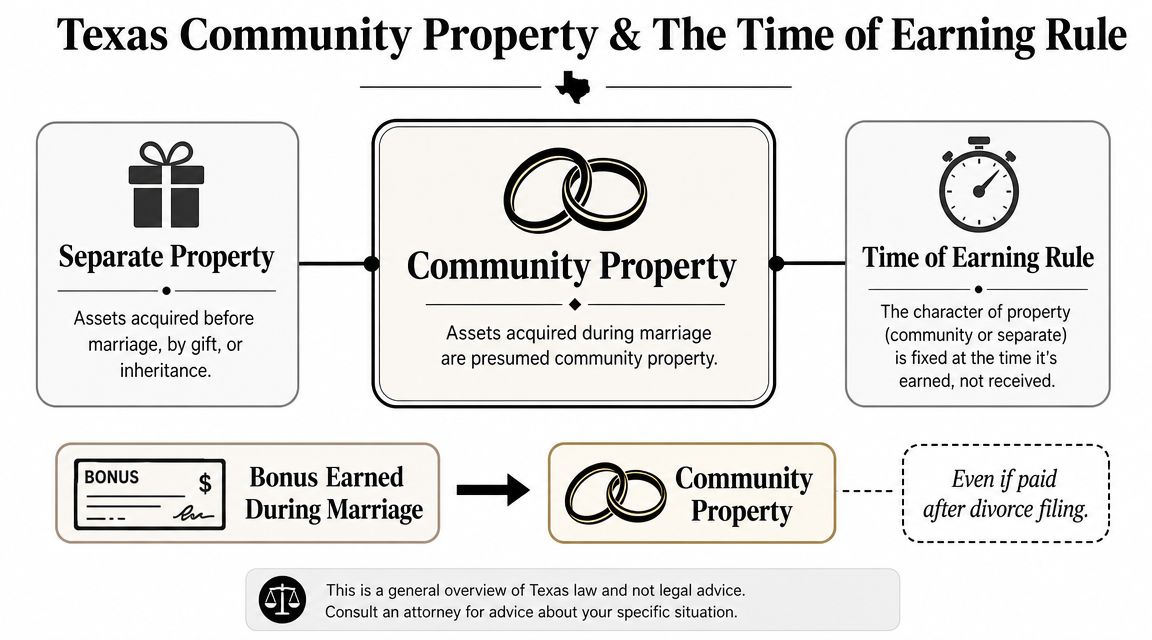
Texas starts from a broad rule. Property acquired during marriage is generally presumed to be community property. That includes compensation earned during the marriage. Think of the marital estate as a shared basket. If either spouse earns something while the marriage is ongoing, the law generally assumes it goes into that basket unless someone proves otherwise.
For a deeper look at the basic framework, you can read this explanation of community property in Texas.
The date on the check isn't the whole story
Bonuses trip people up because the payment date and the earning date often aren't the same. A check may arrive after separation or after the divorce is signed, but that doesn't automatically make it separate property.
Texas courts focus on when the right to compensation arose. If the employee earned the compensation through work performed during the marriage, the marital estate may still have a claim to it even if payroll processes the payment later.
The Texas Supreme Court gave a clearer benchmark
A major development came in the Texas Supreme Court's decision discussed in this summary of In re J.Y.O.. The court held that a discretionary bonus earned for work performed during the marriage was community property even though it was paid after the divorce. The court emphasized that salaries and bonuses are characterized by when the right to compensation arises, not only by when payment is made.
That matters because many people assume a discretionary bonus is too uncertain to count until the employer pays it. The court's reasoning pushes the analysis back to the earning period.
Practical rule: If a bonus pays for marital labor, a Texas court may treat it as community property even when the money shows up later.
A simple way to think about the rule
Here's a plain-English version that helps many clients:
- Ask what work the bonus rewards. Prior-year performance, staying through a future date, signing on to a new job, or something else?
- Match that work to the marriage timeline. Did the employee perform that work before divorce, after divorce, or across both periods?
- Check the employer records. The label “bonus” doesn't decide the issue. The plan documents and communications usually tell the full story.
That's why two bonuses paid on the same day can be treated differently. One may relate to work completed during marriage. Another may be tied only to post-divorce employment. Same payroll date. Different legal character.
Why Atascocita families should care about this early
In Atascocita, Humble, and the larger Houston area, many employees receive compensation that isn't limited to a fixed salary. Performance awards, incentive pay, and delayed compensation can all become part of a divorce conversation. If you wait until mediation or trial to sort out what the bonus was for, you may lose time and advantage.
A careful lawyer starts by building the timeline early. That approach often makes negotiations more realistic because both sides stop arguing in the abstract and start looking at the documents.
How Different Bonus Types are Handled in a Texas Divorce
Not every bonus works the same way. The label on the pay stub doesn't answer the legal question. The court will usually look at the purpose of the payment, the period it covers, and whether the employee had to do something in the future to receive it.
Annual performance bonuses
These are the most common source of dispute. An annual bonus often reflects work over a review period that started while the marriage was intact and may end after separation. If that earning period crosses the divorce timeline, the marital estate may have a claim to the part tied to work performed during the marriage.
That's why lawyers often look for records showing the exact performance window. If a company pays in the spring for the previous calendar year, the payment date may matter less than the fact that the employee did the underlying work while married.
Signing bonuses and recruiting incentives
A signing bonus can be harder to classify because it may serve more than one purpose. Some employers use it to compensate for money the employee gave up at a prior job. Others use it to induce the employee to join and stay through an initial period.
If the payment is really compensation for future service after divorce, the argument for separate property is stronger. If it replaces compensation connected to marital labor or a marital opportunity, the analysis may look different.
Retention bonuses and stay bonuses
Retention pay is usually tied to a condition such as staying employed through a specific date, finishing a project, or remaining through a merger or restructuring period. In those cases, courts and attorneys often examine whether the employee had to continue working after the marriage ended to become entitled to the money.
A retention bonus may therefore be partly marital, partly separate, or mostly separate depending on the terms. The key is not the title. It's the condition attached to the payment.
When a bonus spans both sides of the divorce timeline, the real fight is often over the marital portion, not whether the payment exists at all.
Deferred compensation and equity-style awards
Some compensation plans are more complex than cash bonuses. Deferred compensation, restricted awards, and incentive structures tied to later vesting may require a close reading of plan documents and, in some cases, financial analysis to determine what part is tied to past service and what part rewards future service.
These cases often turn on details such as vesting language, forfeiture conditions, and employer explanations. A spouse shouldn't assume an award is separate just because it hasn't fully matured. The other spouse also shouldn't assume the whole amount is divisible. Mixed-character assets are common.
Bonus Treatment in Texas Divorce
| Bonus Type | General Characterization | Key Factor |
|---|---|---|
| Annual performance bonus | Often community to the extent it was earned through work during the marriage | The performance period the company used |
| Signing bonus | Depends on whether it compensates for past opportunity or future employment | Why the employer paid it |
| Retention bonus | Often tied to continued service and may be partly or fully separate if future work is required | Whether employment had to continue after divorce |
| Deferred compensation or equity-style award | Frequently requires deeper analysis and may contain both community and separate components | Vesting terms and service conditions |
Questions to ask before making assumptions
If you're sorting through what happens to bonuses in divorce Texas Atascocita, start with these practical questions:
- What did the employer call the payment? The title isn't decisive, but it gives you a starting point.
- What period did the payment reward? Review periods, fiscal years, and performance metrics matter.
- Was future employment required? If the employee had to stay past a date, that may change the analysis.
- Did the employer explain the payment in writing? HR letters, plan summaries, and emails can be more useful than the pay stub itself.
- Is part of the payment replacing something lost elsewhere? That can affect characterization.
For many families in Harris County, this part of the case becomes less emotional once the compensation is separated into categories. A broad argument about “my bonus” or “our bonus” usually becomes more manageable when the records show what the payment represents.
Gathering Your Evidence Proving the Bonus Character
The law helps only if you can prove the facts. In bonus disputes, the strongest case usually comes from records created by the employer, not from guesses, assumptions, or a single bank statement.
A recurring problem in Texas divorce cases is proving and apportioning a bonus when the marriage ended in the middle of the bonus-earning period. That practical challenge is discussed in this article on proving the marital portion of a bonus, which highlights records such as bonus plans, performance metrics, employer letters, and payout formulas.
Start with the employer paper trail
If you think a bonus may be community property or you believe part of it is separate, gather documents before they disappear into an old HR portal or a deleted inbox.

The most useful records often include:
- Employment agreements that describe incentive eligibility, service requirements, or forfeiture terms.
- Bonus plan documents from HR or management that explain how the company calculates awards.
- Performance reviews and metrics showing the period measured and the goals involved.
- Award letters or emails that explain why the bonus was approved.
- Pay stubs and year-end wage records that confirm the payment and timing.
- Bank records that show where the money went after deposit.
Why a bank statement isn't enough
A deposit proves that money arrived. It usually does not prove what the money was for. Courts need more than a transaction line that says “bonus” or “payroll.”
A stronger presentation connects several pieces at once. The plan document shows the earning period. The employer email explains the reason for the payment. The pay stub confirms when it was paid. Together, those records tell a story the court can follow.
The question usually isn't just whether a bonus exists. The question is what records show the marital portion.
When financial tracing becomes important
Sometimes the dispute isn't only about characterization. It's also about where the money went. If a spouse deposited the funds into a joint account and the money mixed with other earnings, tracing may become necessary.
In more complicated cases, outside help can be useful. If you want a practical overview of how specialists approach uncovering hidden assets during divorce, that resource explains the role of financial analysis in sorting out difficult records.
A practical local checklist
If you live in Atascocita, Humble, or nearby and a bonus issue is on the horizon, take these steps quickly:
- Download records now. Employee portals change, and access may end.
- Save the full plan, not just a screenshot. Courts need context, not fragments.
- Keep emails that describe the payment. An HR explanation can be more persuasive than payroll shorthand.
- Mark the relevant dates. Marriage date, separation timeline, filing date, review period, and payout date should all be on one timeline.
- Give your lawyer the raw documents. Summaries are helpful, but originals matter more.
If you need legal help organizing that proof, a family law office handling property division cases in Harris County, including the Law Office of Bryan Fagan – Atascocita TX Lawyers, can review the records and identify what additional employer documents may be worth requesting.
How Bonuses Affect Child Support and Spousal Maintenance
A bonus can matter in two different ways during a divorce. It can affect property division, and it can also affect support. Those are separate questions, and many people are surprised to learn that the same compensation may be relevant to both.

Bonuses can count as income
Under the Texas framework described in this discussion of additional income streams in divorce, property acquired during marriage is generally community property, including compensation earned during the marriage even if the paycheck arrives later. That same framework matters for support because Texas Family Code Section 8.055 caps court-ordered spousal maintenance at the lesser of $5,000 per month or 20% of the obligor's average monthly gross income, and the income definition includes 100% of wage and salary income, including bonuses.
That means a year-end bonus can create a double issue. Part of the payment may be treated as community property for division purposes, and the same payment may also be included in gross income for maintenance analysis.
Why this matters for budgeting
For the spouse who may pay support, a bonus can increase the income picture the court reviews. For the spouse seeking support, a bonus may be relevant to showing the other spouse's earning capacity and available income.
This doesn't mean every bonus will be treated identically in every case. Courts and lawyers still look at the nature of the compensation, whether it is recurring, and how it fits into the broader financial record. But it does mean you shouldn't ignore bonuses when preparing financial disclosures or evaluating settlement options.
If you're trying to understand related support issues, this page on how much child support may be ordered in Texas is a useful starting point.
Consistent bonus history versus one-time payment
A steady annual bonus pattern often creates a different conversation than a rare one-time award. A court may view a regularly expected bonus as part of the actual income picture. A less predictable payment may require closer examination.
The important point is practical. If the bonus has been part of household finances, don't assume the court will ignore it. If the bonus was unusual or tied to a narrow event, don't assume the court will automatically treat it as a permanent income feature either. The supporting documents and the broader compensation history matter.
Here's a short explainer that helps many people connect the dots between income and support issues:
What spouses should do before temporary orders or mediation
Support disputes get harder when people walk into mediation with incomplete numbers. Before any negotiation about child support or maintenance, make sure you have:
- Recent pay records that show regular earnings and any bonus payments
- Employer communications that clarify whether a bonus is expected or unusual
- A timeline showing when the bonus was earned and when it was paid
- A working budget for post-divorce life in Atascocita, Humble, or the surrounding area
A bonus can affect the division of property and the support discussion at the same time. Treating it as only one or the other is a common mistake.
Common Mistakes Tracing, Commingling, and Negotiation
One of the biggest mistakes people make is assuming a good argument is enough. In bonus cases, records matter more than confidence. If separate and community funds have been mixed together, tracing becomes critical.
Commingling happens fast
A spouse may receive money they believe is separate, deposit it into a joint account, and then use that account for mortgage payments, groceries, tuition, or family travel. After that, the paper trail gets muddy.
That doesn't always make the claim impossible, but it does make it harder. Once funds are mixed, the spouse claiming a separate interest usually needs detailed records to trace the money back to its source.
Tracing is detailed, not casual
Tracing means following the movement of money through statements, deposits, transfers, and withdrawals so the court can see whether a separate claim is still identifiable. That process is rarely something a person can reconstruct from memory.
Useful tracing work often depends on:
- Complete account statements rather than selected pages
- Deposit records that connect a payment to a specific bonus
- Transfer histories showing where the funds moved
- Consistent labeling so one account doesn't become five different names in five different documents
Negotiation can solve a lot of this
Not every bonus dispute needs a courtroom fight. In many divorces, once both sides see the records, they can negotiate a practical resolution. One spouse may keep the bonus while the other receives another asset to offset it. In other cases, the parties may agree on a marital portion without litigating every line item.
That kind of resolution can be especially helpful for families who want to reduce conflict and move forward. Mediation works best when each side comes prepared with the documents, a realistic position, and an understanding that a bonus issue is often more nuanced than either spouse first believed.
Good negotiation doesn't avoid the facts. It uses the facts to reach a workable outcome.
If you're worried about commingling, don't try to “fix” the records after the fact. Gather what exists, preserve it, and let your lawyer evaluate the cleanest argument available.
Take Control of Your Future Your Next Steps in Atascocita
Bonus disputes can feel technical, but the core ideas are straightforward once you break them down. The most important question is usually when the bonus was earned, not only when it was paid. After that, the case often turns on proof. Plan documents, award emails, performance records, and account statements can make the difference between a vague argument and a persuasive one.
If you're dealing with what happens to bonuses in divorce Texas Atascocita, don't wait until the final hearing to sort through the paperwork. Early review helps you identify whether the issue affects property division, support, or both. It also puts you in a stronger position for mediation and settlement.
Families in Atascocita, Humble, and northeast Harris County often need more than general internet advice. They need a strategy built around their actual compensation structure, their actual records, and their actual divorce timeline. That can include questions about salary history, year-end incentives, executive compensation, and related issues like spousal support in Texas.
If your spouse received a bonus, if you received one yourself, or if you suspect a bonus is being minimized or overlooked, now is the time to get clear answers. A focused review can help you protect your share, prepare your disclosures, and avoid preventable mistakes.
If you're facing divorce and need clear guidance about bonuses, property division, child support, or maintenance, schedule a free consultation with Law Office of Bryan Fagan – Atascocita TX Lawyers. Our Atascocita office helps individuals and families in Humble, Atascocita, and across northeast Harris County understand their options and build a practical plan for moving forward.


